The Heritage Foundation
Budget policy in 2012 was characterized by deficit spending, major increases in the national debt, and a heated debate over the “fiscal cliff.”
With just days left for President Obama and lawmakers in Congress to avert a major tax hike, sequestration, and other major policy changes, today we bring you a list of the top 10 facts on federal spending in 2012:
- Four years of trillion-dollar-plus deficits. Fiscal year 2012 concluded with a $1.1 trillion deficit, marking the fourth year of trillion-dollar-plus deficits. Too much spending is the root cause of the federal government’s deep and sustained deficits. At 23 percent of gross domestic product (GDP) in 2012 and on track to rise further, federal spending is growing at a dangerous pace.
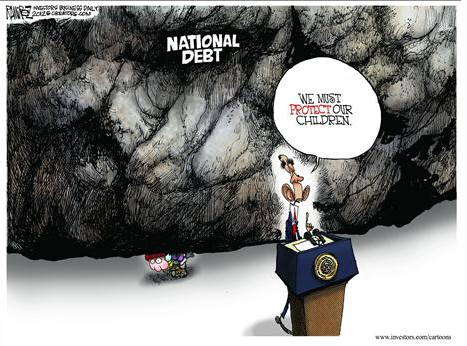
- National debt hit $16 trillion. On September 4, the U.S. national debt hit the $16 trillion mark. We owe more on the national debt than the entire U.S. economy produced in goods and services in all of 2012. Sixteen trillion dollar bills stacked one on top of the other would measure more than 1 million miles high, which would reach to the moon and back more than twice.
- The debt limit was raised by $1.2 trillion. On January 30, the federal government raised its debt limit from a staggering $15.194 trillion to an even bigger $16.394 trillion. This increase was the last one of three granted in the Budget Control Act of 2011, a result of that summer’s debt ceiling negotiations, which allowed for a total debt limit increase of $2.1 trillion.
- The $650 billion fiscal cliff distracted from the $48 trillion looming fiscal crisis.Much of 2012 was spent arguing over tax rates in the fiscal cliff debate while lawmakers ignored the much more dangerous looming fiscal crisis. As large and as major a concern as federal budget deficits are today, they stand in the shadow of $48 trillion in long-term unfunded obligations in Social Security and Medicare. Even with President Obama’s originally proposed tax hikes in his budget, the federal debt would still rise by more than $7.7 trillion in the next 10 years.
- Social Security ran a deficit for the second year in a row. According to the 2012 trustees report, Social Security spent $45 billion more in benefits in 2011 than it took in from its payroll tax. This deficit is in addition to a $49 billion gap in 2010 and an expected average annual gap of about $66 billion between 2012 and 2018. Social Security’s deficits will balloon yet further. After adjusting for inflation, annual deficits will reach $95 billion in 2020 and $318.7 billion in 2030 before the trust fund runs out in 2033 and a 25 percent across-the-board benefit cut occurs.
- Three years of spend-as-you-go policies without a federal budget. The last time both chambers of Congress agreed on a budget was on April 29, 2009. Since then, Congress has operated on a spend-as-you-go basis, characterized by incoherent, ad hoc budget procedures. The House passed budget resolutions each of the past two years, but the Senate failed to do its part.
- The government spent nearly $30,000 per American household. The average American household’s share of federal spending in 2012 was $29,691, or roughly two-thirds of median household income. The government collected $20,293 per household in taxes in 2012, resulting in a budget deficit of $9,398 per household in 2012.
- Obamacare will spend $1.7 trillion over 10 years. After the Supreme Court decision on Obamacare, the Congressional Budget Office did an update of its scoring of the law. The result: Obamacare will spend $1.7 trillion over 10 years on its coverage expansion provisions alone, including a massive expansion of Medicaid and federal subsidies for the new health insurance exchanges. This means that Obamacare will increase federal health spending by 15 percent.
- Social Security was the biggest federal spending program. In 1993, Social Security surpassed national defense as the largest federal spending category, and it remains first today. The top five biggest spending programs, in order, are 1) Social Security; 2) national defense; 3) Medicare; 4) Medicaid, CHIP, and other government health care; and 5) interest on the debt.
- More than 40 percent of Americans are on some government program. According to Census Bureau data and Heritage Foundation calculations, 128.8 million people in America depend on a government program for basic (or not so basic) needs, such as rent, prescription drugs, and higher education.