
A three part series on chronic abuse of other peoples’ money
Part I: The Moral Hazards of OPM
Principle Five: “Nobody spends somebody else’s money as carefully as he spends his own.”
(Thanks to Lawrence Reed, head of the Mackinac Public Policy Center at the time.)
The Clear and Present Danger:
For many of us, ‘somebody else’s money’ is called “other peoples’ money,” or “OPM,” which rolls off the tongue as “oh-pee-em.” This sounds eerily reminiscent of opium, usually pronounced “oh-pee-um.”
Which is ironic, since both are highly addictive, even though the latter is a controlled substance, legally speaking, while consumption of the former is entirely legal and virtually uncontrolled in today’s public policy environment.

Maine, New Hampshire, and other jurisdictions are fighting a growing distribution of opiates, including heroin and wholly legal variants dispensed via prescription. Noted for their addictive properties, and overdoses that can be fatal, distribution and attraction for the vulnerable is becoming increasingly difficult to control.
OPM, while not a medical challenge per se’, is in many ways more troubling than opium/heroin. OPM, by its very nature, is addictive not only to those who spend it, but to the millions who receive it in one form or another. They find themselves smitten with those who distribute it, quickly dependent upon it, and hence prone to keep the “OPM dealers” in power. The street name for OPM varies from case to case, but pork is as useful as any.
There are no laws against distributing and spending OPM. In fact, just the opposite is true. Its cultivation, harvesting, and distribution are highly celebrated by most.

(Above as of 4:30 pm, Fri, 26 Feb 2015)
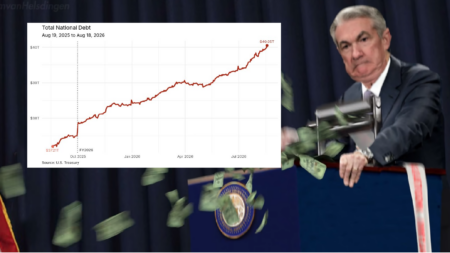
We currently live in an age of policy lunacy, driving us to unsustainable levels of public deficits and public debt. Fiscal and monetary common sense are being abandoned at every turn; negative interest rates are now being discussed. The campaign for the upcoming Presidential election is taking us into previously unexplored territory, and for reasons that are increasingly obvious.
Those who pay attention, even peripherally, to the state of our economy, our country, and our government know all too well that we are a train wreck waiting to happen. Fiscal responsibility and accountability have been tossed into the ash bin of good governance; they are simply too constraining to those whose ideals include ruling over us and keeping the power that allows them to do so. OPM is too “addictive” to the rulers and the subjects to bring under control.
Recently, the Press Herald ran an op-ed sourced from my one-time ‘hometown newspaper.’ Here’s one of the more worrisome passages:
“Over the next 10 years, CBO projects that the federal government will add another $9.4 trillion in debt, and even this is a rather rosy scenario, as it assumes Congress will not ratchet up spending again, and the economy will not experience another recession.”
And a related call to action:
“Paying down debt may not be as sexy a presidential campaign issue as buying votes with a new spending program, but we need responsible adults who will tackle the issue, lest we wake up one day and discover that we are Greece.”
Need we say any more about the suicidal path we’re on, in which addiction to OPM will lead to death by overdose of the American dream?
The Situational Background:
Before proceeding further, let’s review briefly the prominent differences between the various levels of governance in fiscal matters.
Federal: “Good intentions,” campaign financing (in the perverse sense,) the sum of all pork, and controlling behavior of the states via ‘revenue sharing’ dominate fiscal policy. Don’t believe me? Budget balancing – what’s that? Print money, borrow money, use creative accounting and budget gimmicks. Kick the can, and do whatever it takes to make awareness and focus on the problem go away. Treat deficits and national debt as purely academic (wonkish) abstractions.
States: Virtually all have ‘balanced budget’ laws, and printing their own currency is not an option. Succumbing to federal control so as to ‘draw down free money,’ and innovation in budget gimmicks are dominant factors. Playing shell games with surpluses and rainy day funds are popular. As are bond issues, which the vast majority of voters think provide access to money trees growing on hills. Do you have doubts? Attend some legislative committee hearings to see just how deeply federal controls and related revenue sharing affect policy/statute decisions, and how gullible the governing and the governed can be.
Municipal: ‘Balancing budgets’ is mandatory, though bond issues are a popular way to create the illusion that there’s always a way to spend more than the town can afford. Succumbing to state policy control, which in most cases succumbs to federal policy control, in the interest of maximizing state funds ‘flow down’ via ‘revenue sharing,’ is addictive. The bottom line, though, is simply recalculating the property tax rate every year to yield whatever revenues town officials want to spend. After allowing for dollars flowing down from higher sources.
(Note: Fiscal policy, as I understand it, relates to taxation and spending, while monetary policy relates to money supply and interest rates.)
In a nutshell, the States are “odd man out” in this shell game. Federal officials, elected and otherwise, ignore deficit and debt reality and simply kick the can into the future, while ignoring economic stability factors. Locals reset property taxation rates annually because they ‘have to;’ the only mitigating factor is where they believe the public breaking point is, and taxpayer memories and unhappiness are obligingly short lived. State officials have neither of these degrees of freedom, and love of staying in office makes most loathe to be associated with raising tax rates set in statutory ‘concrete.’
Simply put, addiction to OPM is chronic and widespread at all levels. Expertise in looking for the next fix is common and well compensated.
Parts II and III of this series will suggest how to “tackle” some obvious issues. We’ll go after low hanging fruit, but we’ve got to start somewhere!