Two bills to increase taxes on hardworking Mainers failed to pass at the end of the Maine Legislature’s hectic, marathon session last week. LD 498, which would place an additional three percent tax on income earned over $200,000, and LD 1524, which would have lowered the estate tax exemption threshold from $5.6 million to just $2 million, both failed to earn enough support for passage.
LD 498 sought to create a new income surtax under the guise of lifting “all Maine workers out of poverty.”
There were two significant problems with this measure. First, it would undoubtedly fail at its goal of ending poverty.
The way to lift workers out of poverty is not to throw more money at the government and say “fix it.” Robbing Peter to pay Paul has never resulted in prosperity and it wouldn’t here, either.
According to the Brookings Institute, the most effective way to avoid poverty and join the middle class is to be educated about three major adult responsibilities: graduating high school, getting a full-time job and waiting until at least the age of 21 to get married and have children.
By changing behavior and our understanding of personal responsibility, we can work to reduce poverty. Increasing government spending on welfare and other entitlements would not serve to accomplish this goal.
Second, many in the business community agree that LD 498 would have driven out both workers and employers alike from the state.
As Curtis Picard of the Retail Association of Maine noted in his oppositional testimony to the bill, raising individual income taxes is not the way to attract new workers, which was identified as a goal in Maine’s 10-year Economic Development Strategy.
Further, Picard noted that many Maine small business owners file taxes as an S corporation, meaning an increase to the top income tax rate hurts many small, locally-owned establishments. This type of increase is a hard sell for most in Maine as our state and its businesses hobble toward economic recovery.
The second failed bill, LD 1524, is another example of shortsighted tax policy. Under current law, estates are not subject to the estate tax, also known as the “death tax,” until they exceed $5.6 million in value.
The death tax serves to penalize inheritors of significant assets from their family members. Inheritors don’t deserve this; they should be given what was earned under their family’s name.
If a family knows their estate will be taxed, a rather simple solution would be to move to another state, like New Hampshire, which does not assess an estate tax. In doing so, these families and individuals take all of their earnings, assets and economic potential with them.
A 2015 report by the Heritage Foundation found that individuals whose estates would be “partially confiscated” through a death tax simply move to another state without one.
In 2020, Forbes published an article titled “Where Not to Die in 2020,” and, as you might guess, Maine made the list due to its burdensome death tax.
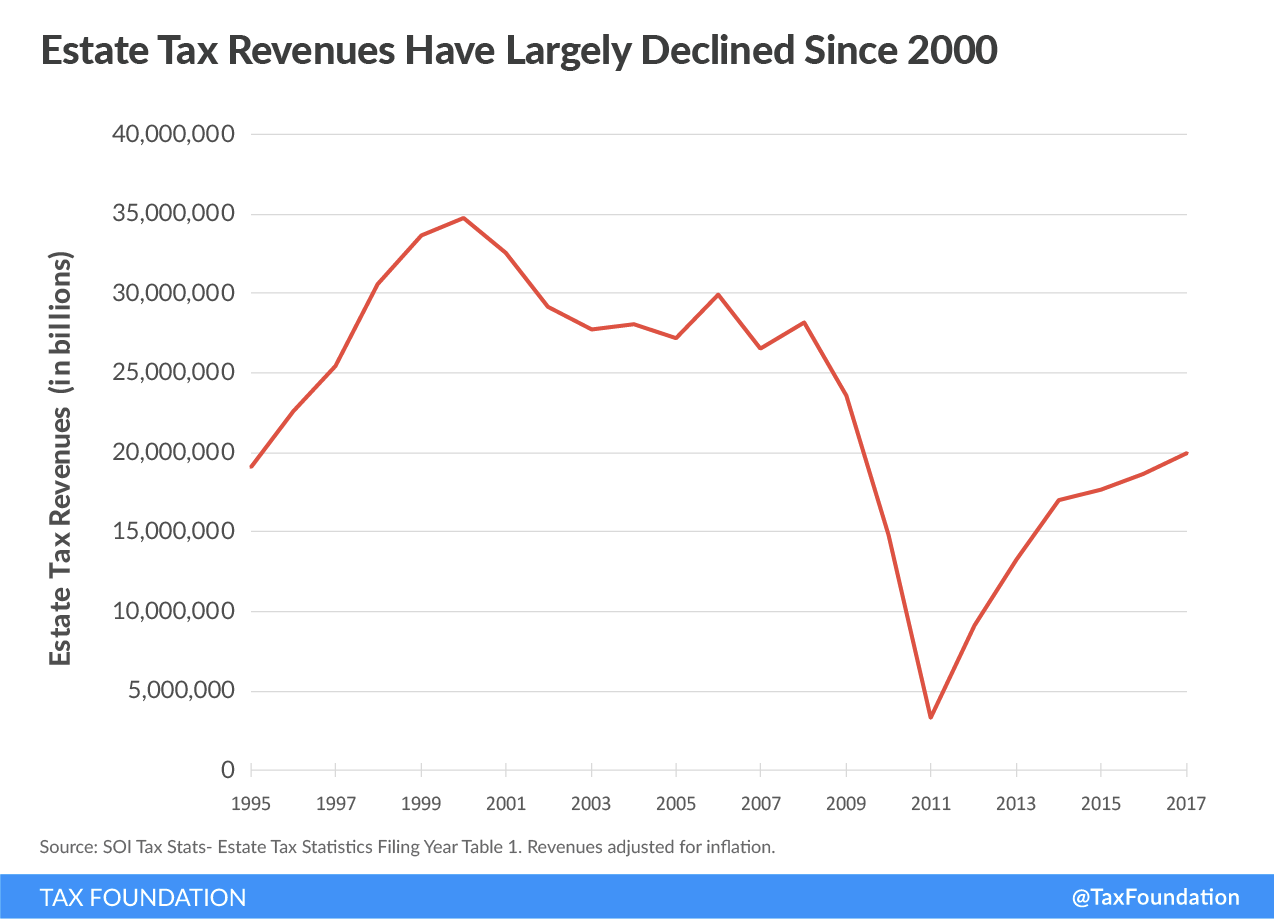
Further, the estate tax has offered inconsistent and diminishing returns in recent years, as illustrated by the graph above from the Tax Foundation.
The issue of taxing estates is incredibly complicated, too. Often, estates are not comprised of hard cash and are instead composed of assets, like a farm, that would be detrimental for a decedent’s family to have taxed.
Neither LD 498 or LD 1524 were crafted with any practical intent to improve the tax code, but rather to penalize Mainers for their success. Their demise this session is welcome, though these bills will almost certainly be reintroduced again in future sessions of the legislature.