A new Harvard analysis of various data points throughout the pandemic shows that poor Americans, those earning under $27,000 a year, have suffered the most over the past year and a half. Between January 1, 2020 to March 31, 2021, employment among low-wage workers dropped a whopping 23.6% while overall employment fell 6.5% in that time. While everyone was hit hard by the initial shutdowns, the poor continue to bear a disproportionate burden of job losses.
In Maine, while overall employment has fared better than the national average, the disparity along socioeconomic lines is stark. Employment rose in Maine from January 2020 to March 2021 over 15%, but these gains came entirely from workers earning more than $27,000 per year. For those making less, employment was down more than 15%, a disparity greater than 30%.
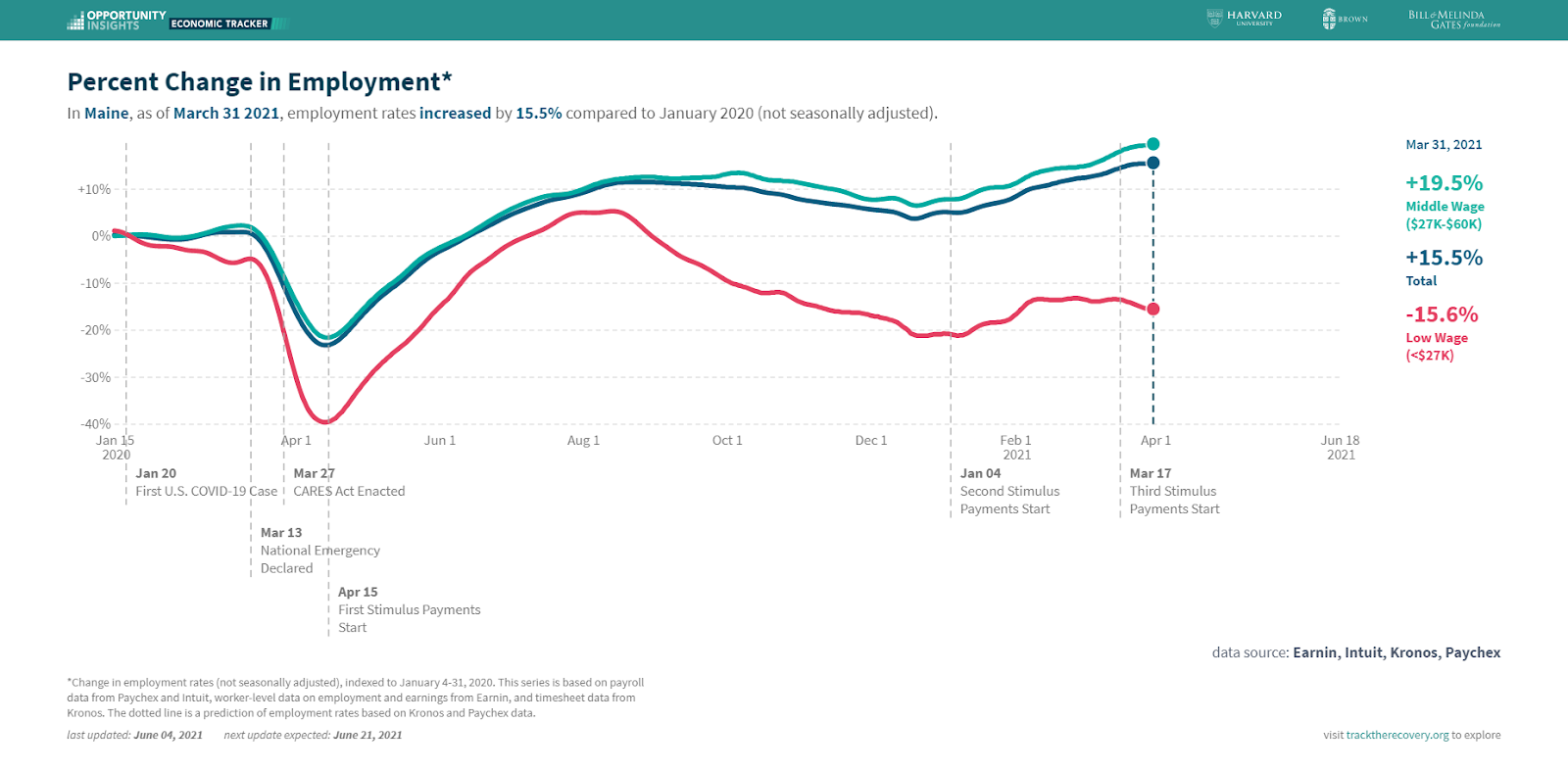
Among the New England states, Massachusetts had the largest disparity in this realm, with low-wage employment levels down more than 50% since January 2020. Even Vermont, a state which Maine Gov. Janet Mills sees as competition in the vaccination race, saw low-wage employment drop more than 25%, while statewide employment grew 1.5%.
The best-performing state is New Hampshire. Overall employment in the Granite State is up almost 12% and low-wage employment is down 9%. The disparity between the overall economy and low-wage earners is less than 21%, whereas that difference is 27% in Vermont, more than 31% in Maine and nearly 60% in Massachusetts.
After making waves last week for announcing a historically low unemployment rate of 2.5%, lower than before the pandemic, Gov. Chris Sununu is showing how the “New Hampshire Advantage” works. For decades, Granite State politicians have been keen to retain their status as the lowest-tax state in the northeast, repeatedly rejecting proposals for a personal income tax and expanded sales tax (for all items, not just prepared food and lodging).
Sununu’s policymaking during the pandemic, while not as bold as governors like Kristi Noem of South Dakota and Ron DeSantis of Florida, has allowed NH residents and businesses to make more of their own choices over the last 16 months. Combined with the friendly tax and regulatory environment, it is no surprise that our immediate neighbor is bouncing back stronger than any other state in the region, including among low-income workers.
Presumably, most of the bottom quarter of wage-earners have jobs that are not able to be performed remotely. Some of these workers were indeed deemed “essential” and therefore could keep their jobs, but the “nonessential” workers faced serious risk of being laid off, especially as aid programs like the Paycheck Protection Program ran out.
While many claim that these hardships are “due to the pandemic,” recent surveys of blood samples show us that the virus was circulating well before the media, governments and international agencies of the world decided to implement destructive lockdowns.
Last summer, The Maine Wire reported on studies from Europe, Brazil, and even Massachusetts, which found fragments of SARS-CoV-2 in wastewater samples as early as November 2019.
Research published this month in the journal Clinical Infectious Diseases tested 7,389 blood samples collected by the American Red Cross between December 13, 2019 and January 17, 2020 in nine states across the U.S. When testing for antibodies which react to SARS-CoV-2, the virus that causes COVID-19, researchers found 106 positive samples. Of these, 39 were collected in California, Oregon, and Washington between December 13 and 16, 2019. Another 51 were collected in Connecticut, Massachusetts, and Rhode Island, and 27 were collected in Michigan, Iowa, and Wisconsin between December 30, 2019 and January 17, 2020.
Though researchers cautioned that finding SARS-CoV-2-responsive antibodies could lead to false positives for other coronaviruses such as those which make up the common cold, they were able to further test 85% of the samples and determined with high confidence that SARS-CoV-2 was present in all of these areas in January 2020, two months before lockdown panic swept the nation.
If the virus was circulating in the US in December 2020, how could it have caused the immense economic shock that didn’t occur until March? Initial fears about the new virus were high, but even so, they were greatly exacerbated by the hyperbolic messages of politicians and public health officials. Narratives that ignored the 100-to-1,000-fold difference in risk of severe illness and death between the young and old drove much of society to mistakenly overinflate risk to the young and underestimate risk to the old.
Unproven, unscientific assumptions about asymptomatic spread required massive shutdowns of schools, travel, business and everyday gatherings. A never-before-seen push to embrace a suite of policy interventions, which had never gained consensus among the scientific community since the Middle Ages, was nevertheless employed by nearly every government in the developed world.
Unfortunately for nanny-state politicians, the data show no correlation linking lockdowns with fewer deaths. What does correlate with lockdowns, though, is substantial economic losses. As we now know, pandemic economic losses have been persistently worse for the poorest families.
We can dive deeper by looking at levels of restrictions in each state, using the Oxford Covid-19 Government Response Tracker (OxCGRT).
— Youyang Gu (@youyanggu) May 25, 2021
More restrictions in a state is NOT correlated with fewer COVID-19 deaths.
However, more restrictions IS correlated with higher unemployment. pic.twitter.com/AD3lv2nJIP
While the well-off logged on to their video calls, their lives nearly unobstructed by rash government policymaking, working-class people continued to go out into the world to attempt to keep it running. They were the ones who politicians ordered to face the highest risk of infection, regardless of whether they were more at risk. By treating risk as equal to all, policymakers ignored the places where we could help and instead inflicted massive psychological trauma on the youth, for whom this virus is even less dangerous than a normal flu season.
After more than a year of infection and case data, the truth is clear: COVID-19 is no more dangerous to 80% of the population than a severe flu season, similar to what we experienced in 2017-2018 without totalitarian measures to combat it.
Here’s hoping that we never have to try an experiment like this again before we learn that heavy-handed policy runs contrary to the notion of public health.