



A new study from the Committee to Unleash Prosperity has found that in 21 states and Washington, D.C., households can receive the equivalent of $25 an hour in unemployment benefits with no one working. The study was authored by Casey Mulligan, professor of economics at the University of Chicago; Stephen Moore, economist at Freedom Works; and E.J. Antoni, economist at the Texas Public Policy Foundation.
In 19 states, the study found, benefits equal about $100,000 a year in salary for a family of four with two non-working parents.
The findings come at a time when 25 states and D.C. continue to offer the enhanced unemployment insurance (UI) payments offered through March’s $1.9 trillion American Rescue Plan Act. The other 25 have opted out of those supplemental federal unemployment benefits.
Assuming a household comprising two children and two unemployed parents receive maximum benefits (UI, a portion of the value of the ACA subsidy and the enhanced child tax credit for children between 6 and 18-years old), the hourly wage equivalent of unemployment benefits is $37 in Massachusetts, the highest of any state, the study found. In Maine, it’s $29 an hour.
Based on average benefits, a household receiving unemployment is receiving about $21 an hour in Maine.
The debate over the labor shortage is a hot one right now, but this study outlines a major contributing factor. Mainers, and people across the country, are being paid more by state and federal unemployment benefits to stay home than they would earn working. Employers can only compete with these enhanced benefits for so long before the situation becomes untenable.
Congress misjudged the speed of the economic recovery following the COVID vaccines becoming widely available and, as a result, overcompensated. Indeed, after a year of lockdown, as soon as people could get vaccinated, they began itching to get back to normal life, and would, if they wouldn’t lose money by going back to work.
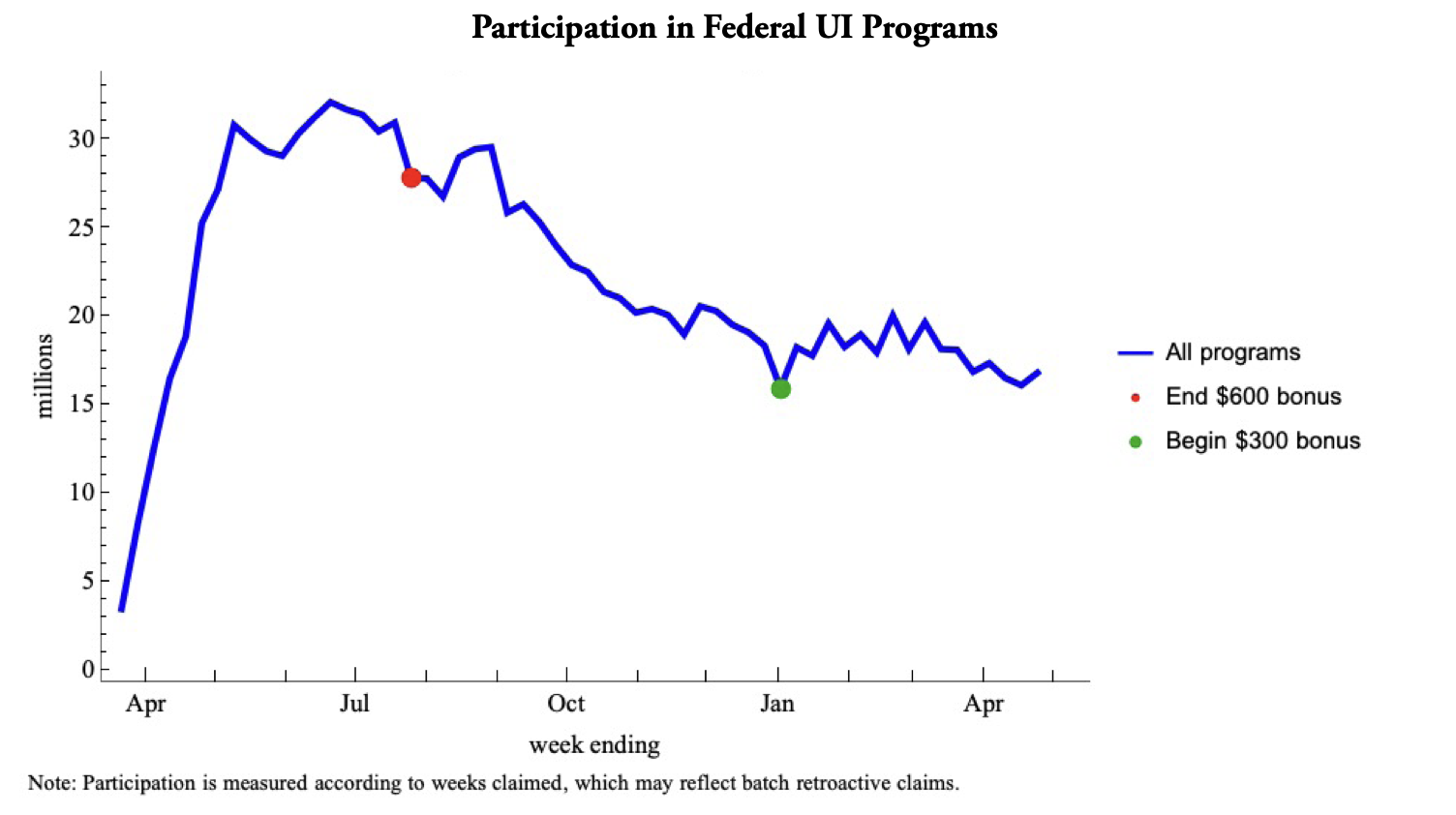
Shown above, as soon as the enhanced unemployment benefits ran out in 2020, there was a mostly steady decline in participation in the program. After they were reinstated at the beginning of 2021, participation essentially leveled off and has not fallen since.
The study ends with a recommendation: immediately suspend the enhanced UI. Though not touching on the outcomes of reemployment bonuses, the authors state that such incentives are preferable to UI.
These conclusions find Maine in a precarious spot. Gov. Janet Mills has just introduced a back-to-work incentive program, but it misses the mark.
The program pays $1,000 to $1,500 to an individual who was unemployed and works a new job for at least eight weeks. The state has not, though, opted out of the enhanced UI. Thus, a worker would still make more staying home for eight weeks than working during that time, despite the new bonus.
Currently, the seasonally adjusted unemployment rate in Maine is 4.8%, not horrible upon first glance, but it was 3.1% in March 2020. What this figure neglects to account for, though, is the change in labor force participation since the pandemic began.
At the start of the pandemic, labor force participation was 62.5%. Now, it is just over 60%. Capping at just under 700,000 in February 2020, 673,900 Mainers are in the labor force today. It has dropped by nearly 30,000 workers and has not recovered at nearly the rate expected.
As posited by the authors, “Our policy objective should be to get unemployed Americans back in the workforce as rapidly as possible.”
Further, the child care situation in Maine is certainly not helping matters, either. Maine has lost 170 day care centers since early 2020 and costs remain high, so many parents are deciding to stay home.
This study on the nationwide impacts of the historically high UI has simply confirmed what many have been sounding the alarm on for weeks: if you pay people to stay home, they will. If the government doesn’t incentivize work, and in fact does the opposite, an artificial labor shortage will surely follow.


