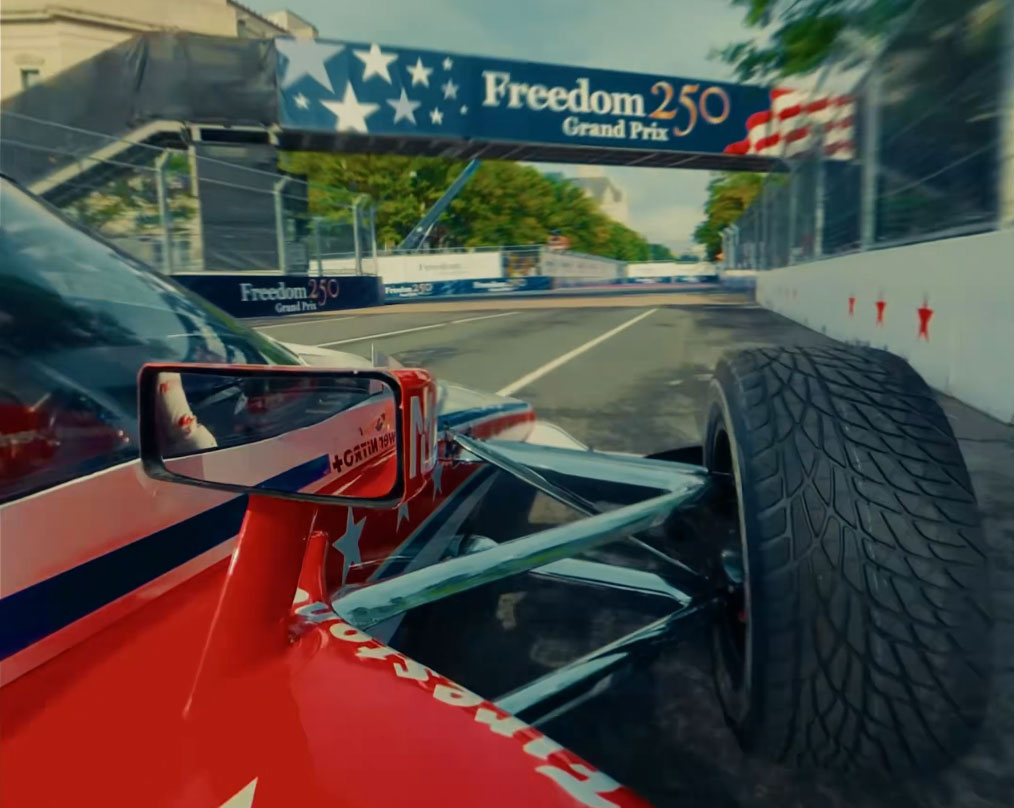
For the first time in American history, IndyCars will race Sunday through the streets surrounding the National Mall, turning some of the most recognizable ground in the country into a 250-mile celebration of speed, engineering and American independence.
But the Freedom 250 Grand Prix of Washington, D.C. is about considerably more than motorsports.
The race represents the culmination of an unusual, months-long effort involving the White House, multiple federal agencies, the District of Columbia, law enforcement, the National Park Service and the private sector to accomplish something that had never been attempted before: building a temporary professional racing circuit through the ceremonial center of the nation’s capital.
President Donald Trump launched the effort with an executive order on Jan. 30, directing his administration to establish an INDYCAR street race near the National Mall as part of the country’s 250th anniversary celebration.
Seven months later, cars capable of speeds well in excess of 150 mph are preparing to race past the Washington Monument, the Smithsonian museums, the National Archives and within sight of the U.S. Capitol.
It is difficult to overstate how unusual that is.
It Started With a Presidential Order
Trump’s Executive Order 14381, titled “Celebrating American Greatness With American Motor Racing,” did more than endorse the idea of a race.
It set the federal government in motion.
The order instructed the secretaries of Interior and Transportation to designate an appropriate course within 14 days and told the agencies to move quickly on the permits, approvals and authorizations necessary to stage the event. Trump also authorized the Department of Transportation to use available funding to facilitate the race where legally appropriate.
The administration was also directed to coordinate with Washington Mayor Muriel Bowser on roads, trails and bridges that could become part of the circuit. The Federal Aviation Administration was brought into the process because aerial photography, drones and restricted airspace around Washington create security issues virtually nonexistent at most American racetracks.
That distinction matters.
This was never simply a matter of INDYCAR finding several city streets and installing concrete barriers.
Much of the land surrounding the National Mall is controlled by the federal government. Roads needed to be closed. Parkland had to be restricted. Security plans had to account for the White House, Capitol, federal buildings and protected officials. Airspace had to be managed. Thousands of feet of barriers, fencing and racing infrastructure had to be installed in one of the most security-sensitive locations in the world.
The presidential order effectively created a mandate for those agencies to find a way to make it happen.
Building a Racetrack Where There Wasn’t One
By March, organizers unveiled the result: a 1.7-mile, seven-turn temporary street circuit surrounding the National Mall.
Unlike a permanent racetrack, virtually everything necessary to conduct Sunday’s race had to be brought into downtown Washington.
The course includes a roughly four-tenths-of-a-mile front straight along Pennsylvania Avenue, with the Washington Monument and Capitol forming part of the backdrop. The cars will also pass the Smithsonian National Air and Space Museum, National Gallery of Art and National Archives.
The visual effect is deliberate.
The race was designed not merely as a sporting competition, but as a television showcase of the American capital during the country’s 250th birthday year.
INDYCAR initially planned a shorter event before extending the race to 147 laps and approximately 250 miles, matching the “Freedom 250” theme.
Sunday’s race is currently planned as a one-time commemorative event, although its success will inevitably raise questions about whether Washington could eventually become a regular stop on the INDYCAR calendar.
Months of Closures and Construction
Transforming the Mall into a racetrack did not happen over a weekend.
The National Park Service began imposing temporary closures and public-use restrictions in portions of the National Mall area as early as June as crews prepared the site and federal officials worked through the logistical requirements of the event.
Those restrictions expanded significantly as race weekend approached.
The National Park Service said additional closures beginning Aug. 14 were necessary because of worker and public safety concerns, as well as Secret Service requirements associated with protected individuals attending the event.
By Friday, an extensive portion of downtown Washington had effectively been converted into the race footprint.
Metropolitan Police closed dozens of streets and ramps beginning at 3 a.m. Friday, including sections of 12th Street, E Street, Indiana Avenue, First Street, Louisiana Avenue and portions of the 12th Street Expressway and surrounding downtown road network. Those restrictions remain in effect through Sunday night.
The scale helps explain why the race is significant beyond racing.
Washington routinely hosts presidential inaugurations, demonstrations, state funerals, July Fourth celebrations and international summits.
It does not routinely permit 700-horsepower race cars to compete on streets bordering the National Mall.
Trump’s Vision Becomes Reality
Trump has explicitly tied the event to his broader effort to make America’s 250th birthday a yearlong national celebration.
The White House’s Freedom 250 program includes events and initiatives involving numerous government agencies, private organizations and major public celebrations intended to commemorate the signing of the Declaration of Independence in 1776.
The administration’s argument is straightforward: INDYCAR represents a distinctly American combination of competition, engineering, manufacturing and innovation.
“Freedom doesn’t ring, it revs,” Transportation Secretary Sean Duffy said when the administration announced the event in January.
Trump’s executive order similarly described INDYCAR as a source of national pride and traced the sport’s history through American racing legends including A.J. Foyt and Mario Andretti and the Indianapolis 500.
That helps explain why the administration chose racing rather than simply another parade or concert.
The event takes symbols Americans normally associate with government, Pennsylvania Avenue, the Capitol, the National Mall and Washington Monument, and combines them with something entirely different: competition, speed and American industrial engineering.
A Massive Public Spectacle
Organizers expect an enormous crowd.
Reuters reported approximately 200,000 spectators could attend, making the Freedom 250 one of the largest public events Washington has hosted this year. General admission has been offered free, while high-end hospitality packages have sold for thousands of dollars.
Corporate involvement has also been extensive. Sponsors connected to the event include Boeing, Delta and SpaceX’s Starlink, illustrating the degree to which organizers have attempted to connect the race with American aviation, transportation and technology.
Roger Penske, owner of INDYCAR and the Indianapolis Motor Speedway, played a major role in developing the event, with private interests covering much of the expense, according to the Associated Press.
Trump is expected to become part of the spectacle personally.
The president and First Lady Melania Trump are expected to ride around the circuit in the presidential limousine, commonly known as “The Beast,” before Trump signals the start of the race. Military flyovers and other ceremonial events are also planned.
And Then There Is the Racing
Once the ceremonies end, the politics and symbolism will give way to an actual INDYCAR race.
Four-time series champion Álex Palou captured the pole Sunday morning with a 56.899-second qualifying lap around the new circuit.
Kyle Kirkwood will start beside him, with Scott McLaughlin third and Christian Rasmussen fourth.
The circuit is already earning a reputation among drivers for being fast, wide and extremely bumpy, particularly in several corners.
Those imperfections could actually produce better racing.
Drivers have identified multiple potential passing zones, and Pato O’Ward characterized the challenge as a coming “street fight.”
That, ultimately, may be exactly what organizers wanted.
Sunday’s Freedom 250 takes one of America’s oldest national gathering places and temporarily transforms it into something completely unexpected.
The National Mall has witnessed presidential inaugurations, civil-rights demonstrations, military celebrations and some of the defining moments of American history.
On Sunday, it will hear racing engines.
And whether the Freedom 250 ultimately becomes a one-time curiosity or the beginning of a Washington racing tradition, simply reaching the green flag represents a remarkable logistical achievement.
A presidential order issued in January moved through the Interior Department, Transportation Department, National Park Service, FAA, Secret Service, Metropolitan Police, District government and private racing organizations.
Roads were redesigned. Federal land was temporarily repurposed. Security zones were created. A seven-turn circuit was built from ordinary city streets.
And seven months after Trump ordered his administration to figure out how to put INDYCAR racing in the nation’s capital, the first cars will take the green flag Sunday.
For one afternoon, Pennsylvania Avenue will not merely symbolize American power.
It will become a racetrack.