
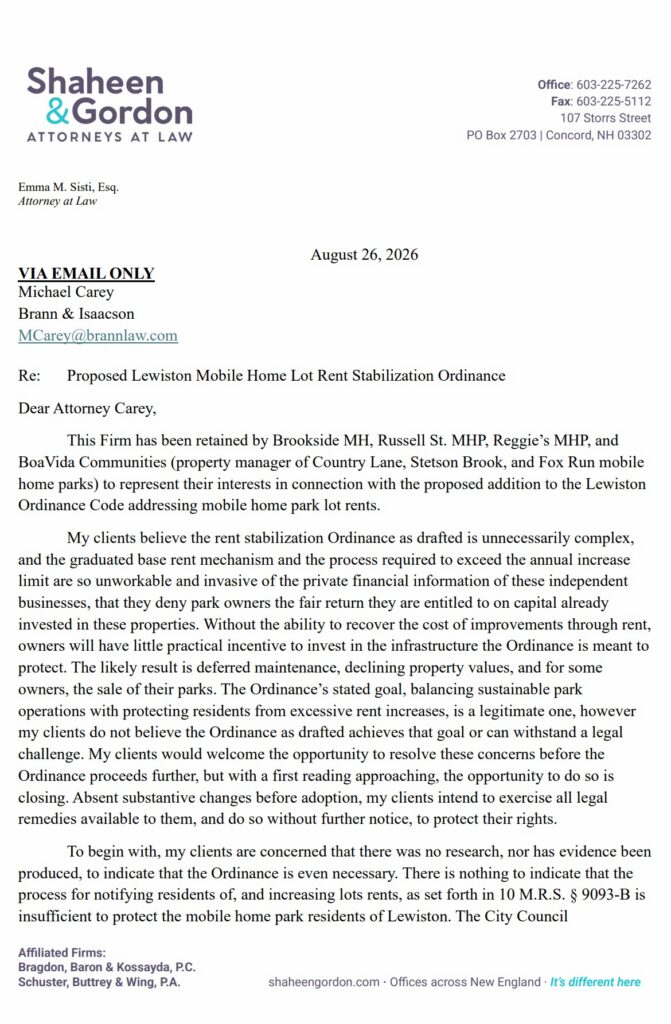
Attorney Emma M. Sisti of Shaheen & Gordon sent Lewiston Corporation Counsel Michael Carey a six-page letter on Aug. 26 challenging the city’s proposed Mobile Home Lot Rent Stabilization Ordinance and warning that park owners are prepared to pursue legal remedies.
Lewiston’s increasingly contentious effort to regulate mobile-home park rents is facing a potential legal challenge after attorneys representing several park owners warned city officials that the proposed ordinance may be unlawful, prompting Council President Joshua Nagine to halt work on the city’s legal review and rewrite while attorneys examine Lewiston’s potential exposure.
The six-page legal notice, dated Aug. 26 and obtained by The Maine Wire, was sent by Shaheen & Gordon attorney Emma M. Sisti to Lewiston Corporation Counsel Michael Carey.
Sisti represents Brookside MH, Russell St. MHP, Reggie’s MHP and Boa Vida Communities, which manages Country Lane, Stetson Brook and Fox Run mobile-home parks.
The letter delivers one of the strongest challenges yet to Lewiston’s proposed Mobile Home Lot Rent Stabilization Ordinance.
“My clients do not believe the Ordinance as drafted achieves that goal or can withstand a legal challenge,” Sisti wrote.
The warning comes as the City Council extended its temporary moratorium on mobile-home park lot-rent increases following two special council meetings this week.
The council approved the extension Wednesday night after giving the measure its first reading Tuesday. The meetings were necessary after an attempt Tuesday to suspend council rules and immediately hold a second reading failed.
The original 180-day moratorium was enacted in March to give Lewiston’s Housing Committee time to study the issue and develop a permanent ordinance.
The city’s own materials have said four of Lewiston’s 11 mobile-home parks reported lot-rent increases ranging from 10 percent to 50 percent before the moratorium. City officials have argued mobile-home residents face a unique housing situation because they generally own their homes but rent the land beneath them, making relocation difficult and potentially expensive.
But Maine law already provides protections for mobile-home park residents.
Under existing state law, park owners generally must provide residents at least 90 days’ written notice before increasing rent, fees or charges. Maine law also establishes requirements governing how increases are communicated to residents.
That existing statutory framework has now become a central component of the park owners’ argument against Lewiston creating an additional layer of local regulation.
Sisti contends the city has failed to demonstrate that existing protections under Maine law are inadequate.
“To begin with, my clients are concerned that there was no research, nor has evidence been produced, to indicate that the Ordinance is even necessary,” Sisti wrote.
The attorney specifically cited 10 M.R.S. § 9093-B, arguing there is nothing demonstrating that the state-mandated process for notifying residents of rent increases is insufficient to protect Lewiston residents.
Sisti also questioned why mobile-home park owners are being subjected to rent controls while other residential landlords in Lewiston are not facing comparable restrictions despite rising rents, property taxes, inflation and maintenance costs.
The owners argue the proposed ordinance’s graduated rent formula and process for obtaining increases above city limits could prevent them from earning a fair return while discouraging future infrastructure investment.
“Without the ability to recover the cost of improvements through rent, owners will have little practical incentive to invest in the infrastructure the Ordinance is meant to protect,” Sisti wrote.
The letter also targets how the proposed ordinance handles turnover.
According to Sisti, the ordinance generally allows an owner to reset a lot’s rent to market rate when a resident leaves and removes the home or following an eviction for nonpayment.
But when an owner sells a mobile home to another person who keeps the home on the same lot, the existing regulated rent would continue.
Sisti argues that arrangement amounts to “price control, rather than stabilization” because below-market rents could effectively remain attached to individual lots indefinitely.
The owners are also challenging provisions requiring extensive financial disclosures when seeking increases above the city’s annual limit.
According to the letter, owners could be required to provide complete financial records and lender agreements to the city while still receiving no guarantee that the Rent Stabilization Board would approve the requested increase.
Sisti argues no comparable private business in Lewiston faces that level of financial scrutiny.
The owners proposed several alternatives.
They want Lewiston to replace its graduated rent formula with a Consumer Price Index-based system; permit rents to return to market rates following bona fide turnover; allow owners to seek additional increases annually rather than once every 36 months; reduce required financial disclosures; eliminate application fees; and provide greater certainty that qualifying applications for additional increases will be approved.
They also want a specific seat on the proposed Rent Stabilization Board for someone representing mobile-home park owners.
Behind those proposed compromises, however, is an unmistakable warning.
“Absent substantive changes before adoption, my clients intend to exercise all legal remedies available to them,” Sisti wrote.
The owners stopped short of demanding that Lewiston abandon the ordinance altogether. Instead, they proposed extending the current moratorium for another 30 to 60 days while the two sides attempt to negotiate changes and avoid litigation.
“My clients are prepared to engage in that process promptly and in good faith,” Sisti wrote.
The legal warning appears to have immediately changed the city’s handling of the proposed ordinance.
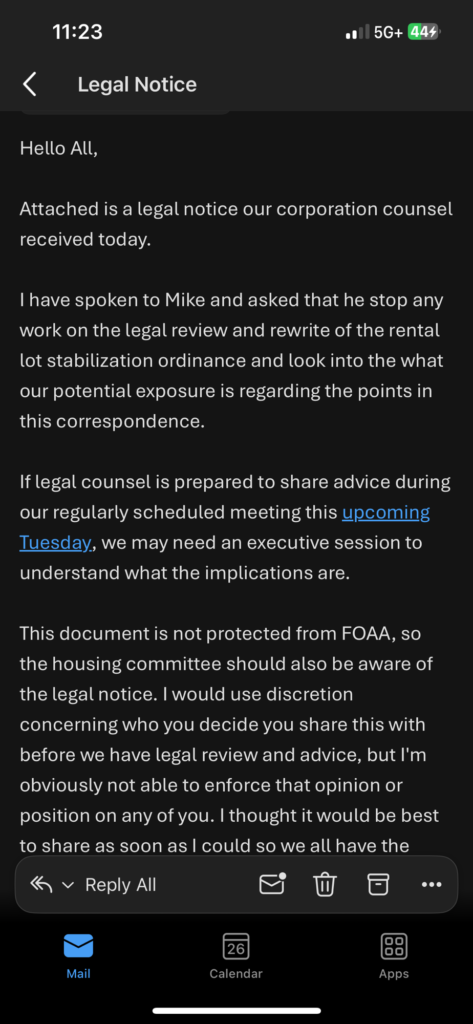
Lewiston City Council President Joshua Nagine told city officials that he asked corporation counsel to halt work on the legal review and rewrite of the proposed mobile-home lot rent stabilization ordinance while the city examines its potential legal exposure.
In an email circulated to city officials and obtained by The Maine Wire, Nagine said he had spoken with Carey and asked him to “stop any work on the legal review and rewrite of the rental lot stabilization ordinance.”
Instead, Nagine asked Carey to examine “what our potential exposure is regarding the points in this correspondence.”
Nagine also raised the possibility that councilors could receive legal advice behind closed doors.
“If legal counsel is prepared to share advice during our regularly scheduled meeting this upcoming Tuesday, we may need an executive session to understand what the implications are,” Nagine wrote.
Nagine also made clear that the underlying letter from the park owners’ attorney was a public document.
“This document is not protected from FOAA,” Nagine wrote, referring to Maine’s Freedom of Access Act.
But he simultaneously urged councilors to exercise discretion before distributing it.
“I would use discretion concerning who you decide you share this with before we have legal review and advice,” Nagine wrote, while acknowledging that he was “obviously not able to enforce that opinion or position.”
The email provides a glimpse into how seriously city leadership is treating the threat of litigation as Lewiston considers whether to move forward with permanent rent regulations.
Councilor Bret Martel responded to Nagine’s email by suggesting the city should take the same cautious approach with other ordinances that could expose taxpayers to litigation.
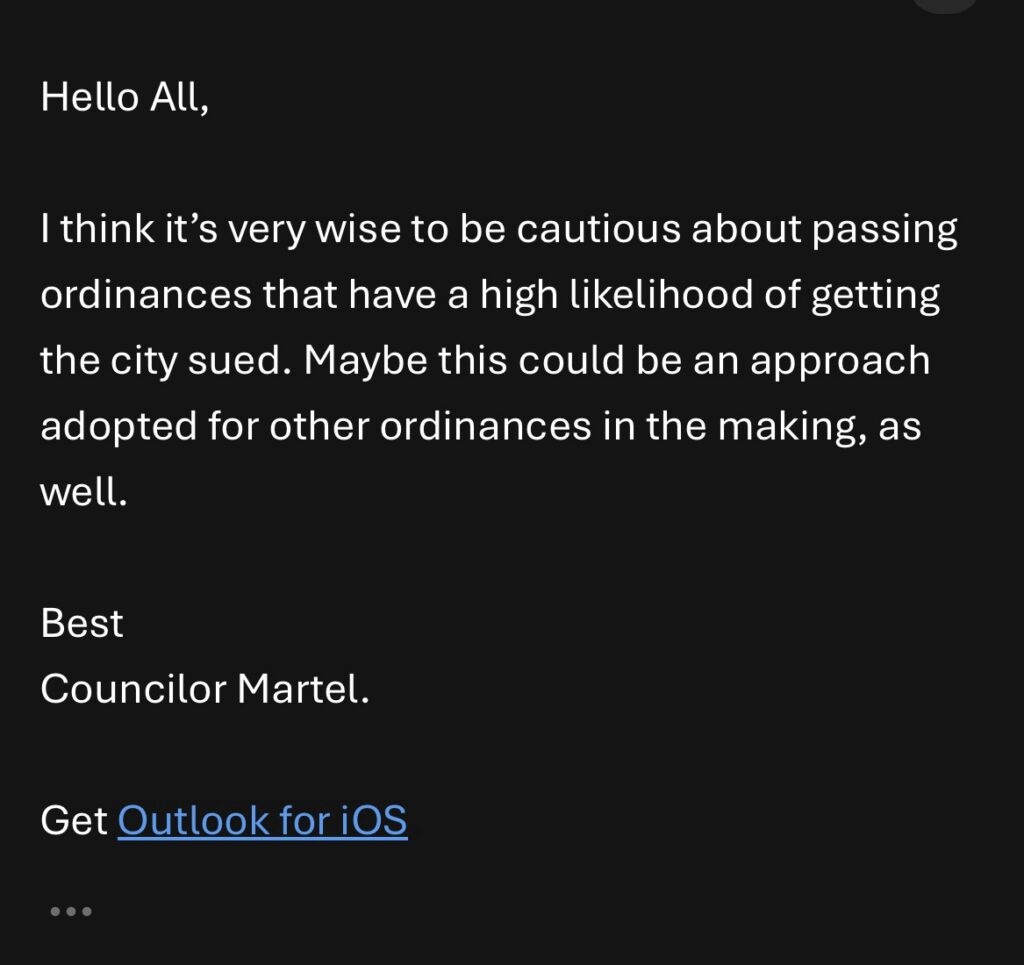
Lewiston City Councilor Bret Martel responded to Council President Joshua Nagine’s email by saying the city should be cautious about adopting ordinances carrying a high likelihood of litigation.
“I think it’s very wise to be cautious about passing ordinances that have a high likelihood of getting the city sued,” Martel wrote. “Maybe this could be an approach adopted for other ordinances in the making, as well.”
The exchange adds another layer to a process already facing questions over how quickly city officials have moved in recent days.
During Wednesday’s special council meeting, Martel declined to take his council seat and instead addressed the council during public comment, criticizing what he described as a lack of transparency surrounding the rapidly scheduled meetings.
Nagine strongly rejected those allegations and defended the process as transparent.
The latest development also creates an unusual situation for Lewiston.
The city originally enacted the moratorium to protect mobile-home residents from additional rent increases while officials developed permanent regulations.
Now some of the same park owners whose rents have been frozen are asking Lewiston to voluntarily extend that moratorium another 30 to 60 days, this time so the two sides can negotiate and potentially keep the city out of court.
The owners’ attorney left little doubt about what could happen if those negotiations fail.
“My clients are committed to preserving their economic position and to using any legal means available to them to ensure the continued viability of their investment in the City of Lewiston,” Sisti wrote.
She also encouraged city officials to consider the financial consequences of proceeding.
The owners, Sisti wrote, want Lewiston to “weigh carefully whether the City wishes to commit its resources to defending this Ordinance in litigation.”
For the City Council, the debate is therefore no longer simply about how much mobile-home park rents should be permitted to increase.
Lewiston must now decide whether to substantially rewrite the ordinance, negotiate with park owners or proceed with its current regulatory approach knowing that the next phase of the fight could move from City Hall to a courtroom.