



Facial recognition tech cannot be used as a tool by the government for mass surveillance.
Thankfully, the Legislature has put a stop to such a situation becoming a reality in Maine.
A new, nation-leading ban on facial recognition technology (FRT) was passed into law on July 1.
The law, LD 1585, sponsored by Rep. Grayson Lookner (D-Portland), passed unanimously in both chambers and was made law without the Governor’s signature last week. It will take effect Oct. 1, 2021.
It is one of the toughest restrictions in the nation on the up-and-coming technology and comes at a time when, thankfully, more and more states are questioning and reconsidering the use of FRT by police.
It’s a broad ban of the technology at all levels of government in Maine, though it does have some exceptions for law enforcement purposes.
The Maine law allows police to conduct an FRT search of the Federal Bureau of Investigations (FBI) and Bureau of Motor Vehicles (BMV) databases if they have probable cause to believe an unidentified person in an image has committed a crime. Such requests and their status will be tracked and kept as public record by the Bureau of State Police and the BMV.
The law’s text makes clear that an FRT match is not sufficient evidence for probable cause without other evidence, though. So, based on a facial scan alone, an individual cannot be subject to an arrest or personal search.
The new rules also give individuals the option to file a lawsuit if they believe a government agency or public official has broken the law.
The ACLU of Maine praised the bill, lauding it as the strongest measure in the nation to set the limits of this new technology’s ability to restrict citizens’ civil liberties.
The only other state that’s taken a legal approach to reining in the power of FRT, and the companies that wield it, is Washington. There, lawmakers implemented a less-than-ideal measure.
Backed by Microsoft, their bill regulated FRT used for real-time identification and ongoing surveillance, but it in no way prevents mass public surveillance, like at sporting events, street corners, or in places of worship.
Maine’s new law, on the other hand, has a much more concrete ban against FRT in all forms, including use by public officials and agencies to surveil their citizens.
Privacy alone, though, is not the only cause for concern with FRT.
Multiple studies have been conducted, including by researchers at Harvard, that have found FRT more frequently misidentifies women and minorities than white men. The fact law enforcement is using technology that does not fairly and equally identify people of all demographics is problematic at best.
A 2018 study named “Gender Shades” found that there is up to a 34% difference in error rates in FRT among different demographics. Not only does the technology impose upon the privacy of citizens in an unprecedented way, but it has major discrepancies in accuracy depending on how the person scanned looks.
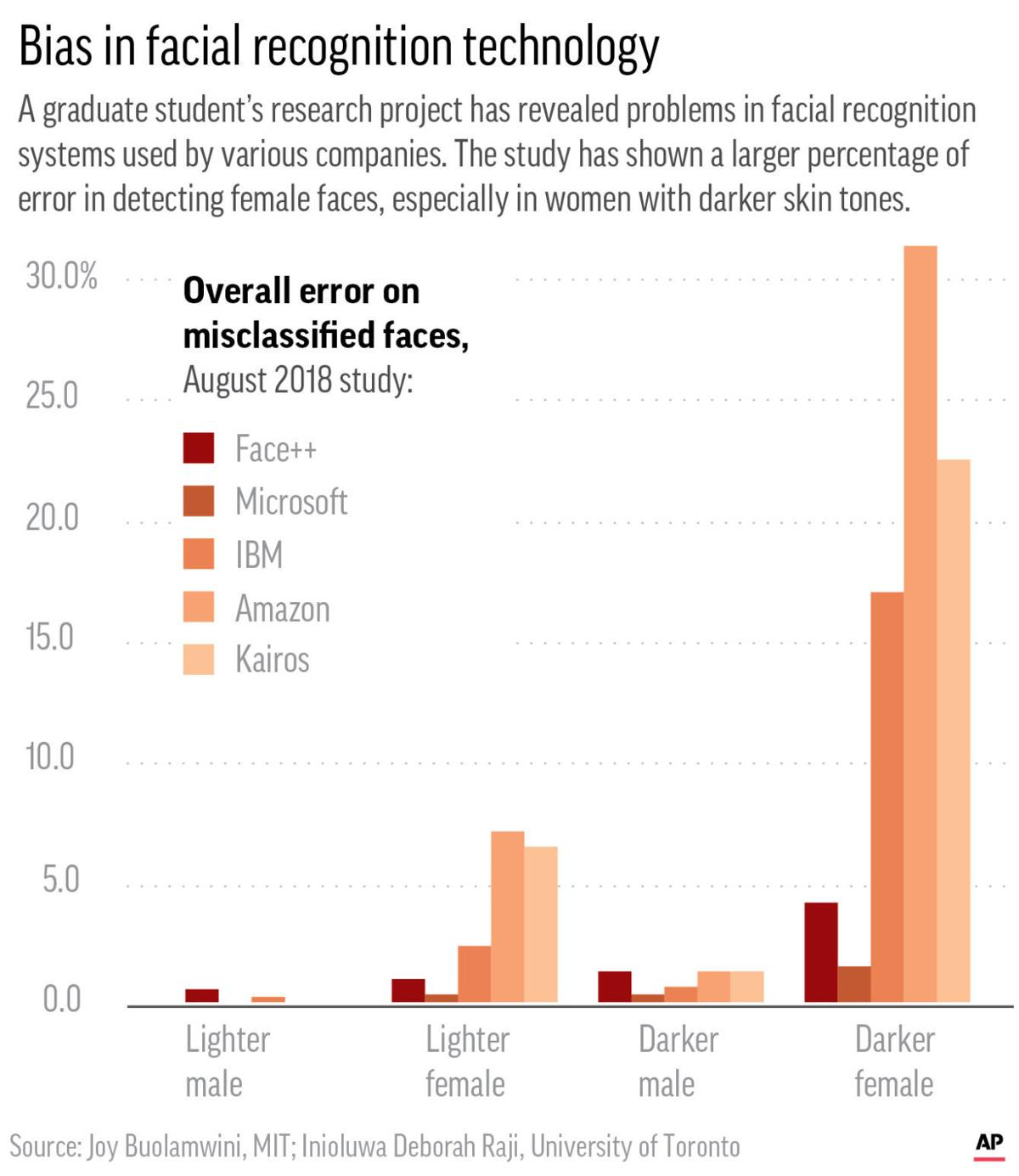
As shown in the graph above, made by the Associated Press, the “Gender Shades” project found severe discrepancies in FRT’s accuracy.
FRT has the potential to be used as a tool of the government to surveil its population in something straight out of an Orwell novel. It is an affront to the civil liberties of people across the country, and we must pump the brakes on it.
Thankfully, lawmakers in the Pine Tree State have come together to prevent this technology from abusing their residents. This law is another step at reining in unwieldy state power, and it should be celebrated.


