

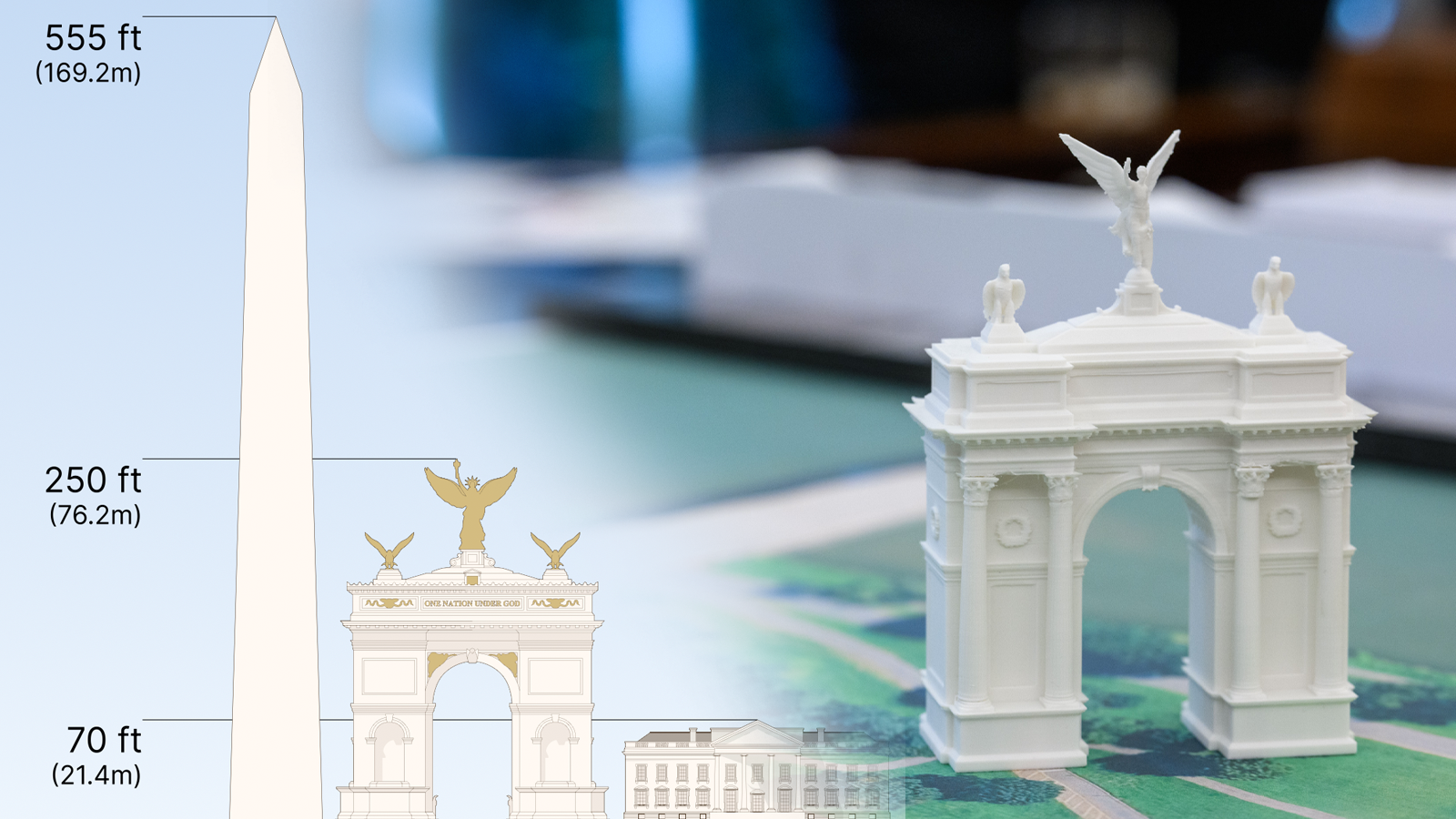
The U.S. Commission of Fine Arts moved Thursday to approve President Donald Trump’s plan to construct a 250-foot commemorative arch in Washington, D.C. across from the Lincoln Memorial.
The president announced his intention to pursue building “Independence Arch” during an October gathering at the White House for those who provided financial support to the $400 million ballroom project.
“We really need it,” President Trump said of the arch. “The United States is the greatest and most powerful nation on earth, and American presidents need to be able to host events at the White House that reflect the demands of the time, and that can… carry out the prestige of what we’re all doing.”
“Every time somebody rides over that beautiful bridge to the Lincoln Memorial, they literally say something is supposed to be here,” Trump added.
Although the Commission does not play a role in the funding or construction of projects, it does have the authority to oversee their design.
All current members of the Commission were appointed by Trump at the start of his term.
The Commission had already given the project a preliminary green light during their meeting in April but requested more information and proffered several recommended revisions. A similar proposal received final approval from the Commission Thursday.
While the White House agreed to remove four gold lion sculptures from the base of the arch and make the pedestrian access a series of surface-level walkways, it maintained its plan to include an 84-foot statue of a winged Lady Liberty and a pair of eagles on top of the structure.
According to reports from NPR, the commissioners acknowledged the public’s concerns over the arch, but explained that many of them are beyond the scope of their review.
“[I would] respectfully suggest that you bring those objections to proper venues,” Vice Chair James McCrery II said.
“This is the United States Commission of Fine Arts, and we’re here to work with designs that are presented to us,” he continued, “to make them better, to make them more appropriate, to make them more beautiful.”
Although not all details for the project have been finalized, the Commission decided to move ahead with final approval, as opposed to concept-level approval. Because of this, it is not clear exactly to what degree the Commission will be able to weigh in on design choices made going forward.
The Associated Press has reported that the National Capital Planning Commission, responsible for approving construction on federal land, has placed consideration of the arch on the agenda at its June meeting.
[RELATED: Sen. Angus King Joins Colleagues on Amicus Brief Challenging President Trump’s “Independence Arch”]
Critics have argued that the monument would disrupt the line of sight between the Lincoln Memorial and Arlington House — the Virginia monument to Confederate Gen. Robert E. Lee.
These two structures were deliberately designed to face each other as a symbol of the nation’s fracture and subsequent reconciliation in the wake of the Civil War.
Three veterans and an architectural historian filed a lawsuit against the president in early February in an effort to stop the arch’s construction, questioning whether the president has the authority to green-light projects on federal land in Washington, D.C., without congressional approval.
They also pointed to the layout issue, arguing that the project would “[obstruct] a line of sight that was designed to represent the unification of the Nation following the Civil War and that has existed for nearly a century.”
Under the Commemorative Works Act (CWA) and 40 U.S.C. § 8106, express authorization from Congress is needed before any monument or structure is built on federal reservations, parks, or public grounds in the nation’s capital.
Sen. Angus King (I), who joined an amicus brief in support of the effort to oppose the arch, submitted an inquiry to the Congressional Research Service (CRS) regarding the legality of Trump’s plan to build Independence Arch and was told that the CWA “would appear to govern the construction of the arch.”
“Likewise, § 8106 would appear to require congressional authorization to construct a memorial arch in Memorial Circle,” CRS explained.
Since being enacted in 1986, the CWA has facilitated the approval of over 40 projects. Under this law, commemorative works are subject to expert commissioning requirements and multiple rounds of review.
Court filings reported by the Washington Post indicate that the White House is arguing congressional approval for the project was given in 1925 when the legislature allowed for 166-foot-tall columns at the same location, a project that never came to fruition.
At the White House, Trump told reporters he thought the Commission’s vote was “fantastic” adding that “we’re the only important and major city that doesn’t have one.”
Still needed is permitting approval from local authorities, as well as from National Park Service, as the land upon which the arch is set to be built is under their management.



But the democrats don’t want him to build a ballroom .
Go figure .