

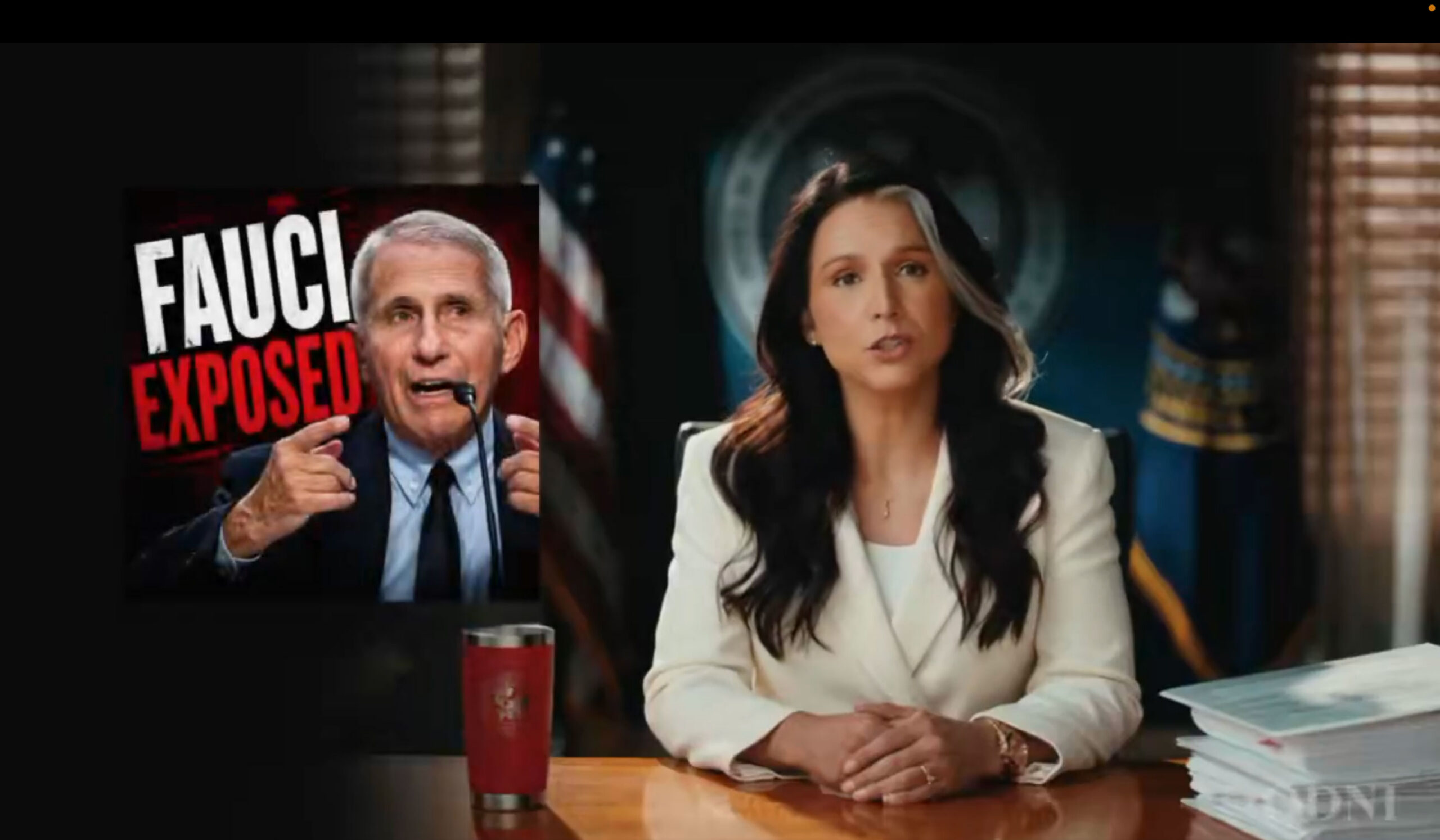
On her final day as Director of National Intelligence, Tulsi Gabbard released a trove of newly declassified documents and publicly accused Dr. Anthony Fauci of orchestrating a broad cover-up tied to the origins of the COVID-19 pandemic.
The document release came on June 19, 2026, as Gabbard executed President Donald Trump’s “maximum transparency mandate” by publishing hundreds of official emails and documents from the Office of the Director of National Intelligence.
Gabbard accompanied the release with a video statement sharply criticizing Fauci’s actions related to COVID-19, including his handling of questions surrounding U.S.-funded viral research, gain-of-function experiments, and the origins of the pandemic.
The release immediately reignited one of the most bitter and consequential debates of the COVID era: whether the pandemic emerged naturally from animals or whether it began with a laboratory accident connected to research at the Wuhan Institute of Virology.
For years, that question divided scientists, intelligence officials, lawmakers, public health authorities, and the American people. Early in the pandemic, the lab-leak theory was widely dismissed by many government officials, public health experts, and major media outlets. Over time, however, the theory gained traction as congressional investigators, intelligence agencies, and outside researchers continued examining the evidence.
Now, Gabbard’s final-day release places Fauci back at the center of that fight.
Fauci is one of the most recognizable and controversial public health figures in modern American history. He served for decades as director of the National Institute of Allergy and Infectious Diseases, advising presidents from both parties and helping lead the federal response to major infectious disease threats.
During the COVID-19 pandemic, Fauci became the face of the federal public health response. To supporters, he was a steady medical voice during a once-in-a-century crisis. To critics, he became the symbol of an arrogant public health establishment that imposed sweeping restrictions, shifted guidance, dismissed dissent, and failed to answer basic questions about the origins of the virus.
That is why Gabbard’s release is such a major story.
This is not simply another Washington document dump. It goes directly to the credibility of the federal government’s pandemic response, the conduct of the intelligence community, the use of taxpayer dollars for high-risk viral research, and whether top officials misled Congress and the American people about what they knew.
According to Gabbard, the newly declassified files show that Fauci used American taxpayer dollars to fund dangerous gain-of-function research on bat coronaviruses at the Wuhan Institute of Virology. She tied that research directly to what she described as an unintentional lab leak that caused the pandemic.
Gabbard also accused Fauci of lying under oath to Congress during his 2024 testimony. At those hearings, Fauci stated that he had no knowledge of communications with U.S. intelligence agencies about coronavirus research cooperation with China.
Gabbard said the newly released documents tell a different story, claiming they show Fauci was in regular contact with agencies including the CIA, FBI, and DIA regarding viral research.
Her allegations went further, accusing Fauci of acting as a behind-the-scenes advisor who worked with politicized career leadership inside the intelligence community. Gabbard claimed Fauci relied on hand-picked experts to suppress the lab-leak theory and advance a natural-origin explanation, shielding himself and Big Pharma from scrutiny.
The files also include whistleblower accounts alleging that intelligence analysts who supported the lab-leak theory faced severe professional pressure. According to Gabbard, dissenting views were systematically discouraged inside the intelligence community.
Gabbard said those internal accounts have been referred to the Inspector General.
The allegations strike at a central question that has lingered since the earliest days of COVID-19: did federal officials follow the evidence, or did they steer the public toward a preferred conclusion?
That question matters because the pandemic changed nearly every part of American life. Schools closed. Businesses were shuttered. Churches were restricted. Families were separated. Workers lost jobs. Children fell behind. Public trust in government, medicine, education, media, and law enforcement was badly damaged.
If federal officials privately had doubts about the natural-origin theory while publicly dismissing the lab-leak theory, the implications are enormous.
The issue also involves U.S. taxpayer funding. For years, lawmakers have questioned whether American money helped support risky research overseas, including research tied to bat coronaviruses in China. Fauci has consistently denied that he funded dangerous gain-of-function research at the Wuhan Institute of Virology or that he misled lawmakers.
Those denials have not ended the controversy.
Congressional Republicans have spent years pressing Fauci and other federal officials over NIH funding, EcoHealth Alliance, Wuhan research, federal recordkeeping, and whether government scientists coordinated with outside experts to shape the public narrative around COVID’s origins.
Fauci’s June 2024 congressional testimony became a flashpoint in that broader investigation. Republicans pressed him on NIH-funded research, pandemic-era restrictions, the lab-leak theory, and internal communications. Fauci pushed back against allegations that he covered up the origins of COVID-19 or intentionally misled the public.
The matter became even more politically charged in January 2025, when former President Joe Biden issued a preemptive pardon for Fauci before leaving office. Biden’s action was framed as protection against politically motivated prosecution, not an admission of wrongdoing. But to Fauci’s critics, the pardon only deepened concerns that one of the most powerful public health officials in American history had been shielded from accountability.
That is why Sen. Rand Paul and other Republican lawmakers quickly seized on Gabbard’s document release.
Paul praised Gabbard’s transparency and argued that Fauci’s preemptive pardon should be legally challenged. He also called for state-level fraud investigations and a full scientific review of U.S.-supported biological labs.
Fauci has not yet issued a public response to Gabbard’s final-day document release. He has repeatedly denied allegations that he funded dangerous gain-of-function research, lied to lawmakers, or participated in a pandemic cover-up.
Still, Gabbard’s release ensures the issue is not going away.
For millions of Americans, COVID-19 was not just a public health emergency. It was a test of whether the federal government could be trusted during a crisis. Many Americans were told to accept sweeping decisions from public officials who insisted they were following the science. Years later, many of those same Americans are still waiting for straight answers.
The newly released files will now face scrutiny from Congress, investigators, journalists, scientists, and the public. The central questions are simple but explosive: what did Fauci and other federal officials know, when did they know it, and did they tell the truth?
Gabbard’s final act as Director of National Intelligence may now become one of the most consequential document releases of the post-pandemic era.
At stake is not only Fauci’s legacy, but the credibility of the public health establishment, the intelligence community, and the federal government’s handling of the most disruptive crisis in modern American life.



Leftists haven’t accepted any news about Fauci/Covid/Vaccines – for them it’s still 2021. People in general have all too soon forgotten and forgiven the governmental abuses Americans suffered under this virus. Those abuses changed life as we know it but most people just don’t care.
Ohhhhhh, what? We all knew this, almost from day 1, Fauci could screw up the whole world and the lie about his involvement, look at all the good he did during the AIDS epidemic, and the feds kept him in his position anyhow, now he has a pardon, i find that amazing!
Ohhhhhhhh, what? We all knew this, almost from day 1, Fauci could screw up the whole world and the lie about his involvement, look at all the good he did during the AIDS epidemic, and the feds kept him in his position anyhow, now he has a pardon, i find that amazing!
Fauci is definitely guilty of repurposing Remdesivir which killed 53% of Ebola patients and is still used as the primary treatment for hospitalized Covid patients. However, as Sasha Latypova has said, “Fauci was just an overpaid chew toy.”
In her extensively researched “The Covid Dossier”, she claims: “Covid was NOT a public health event, but instead was a coordinated global military and intelligence operation using the protocols of a CBRN (Chemical, Biological, Radiological, Nuclear) attack.
I wholeheartedly agree that Fauci should fry as the face of the scamdemic, but the whole operation leads back to our own DOD and goes WAY deeper than that weasel.
Okay, after Fauci and scarf lady we charge Trump, Kushner and entire DOD. This came out of Fort Detrick.
Bowdoin college should be ashamed for giving Fauci an honorable degree in molecular biology.
Warp Speed is D. Trump, J. Kushner and DOD
So true. Just another embarrassment for our state. Bowdoin is a leftist indoctrination shyte hole and a disgrace to the people of Maine.
Crimes against humanity. Nuremberg trials 2.0
Gauleiter Fauci and others were involved in an Aktion 1005? Who can be identified as the Einsatzgruppen? I’m sure that Meet the Press will latch onto this and not let go….
.