

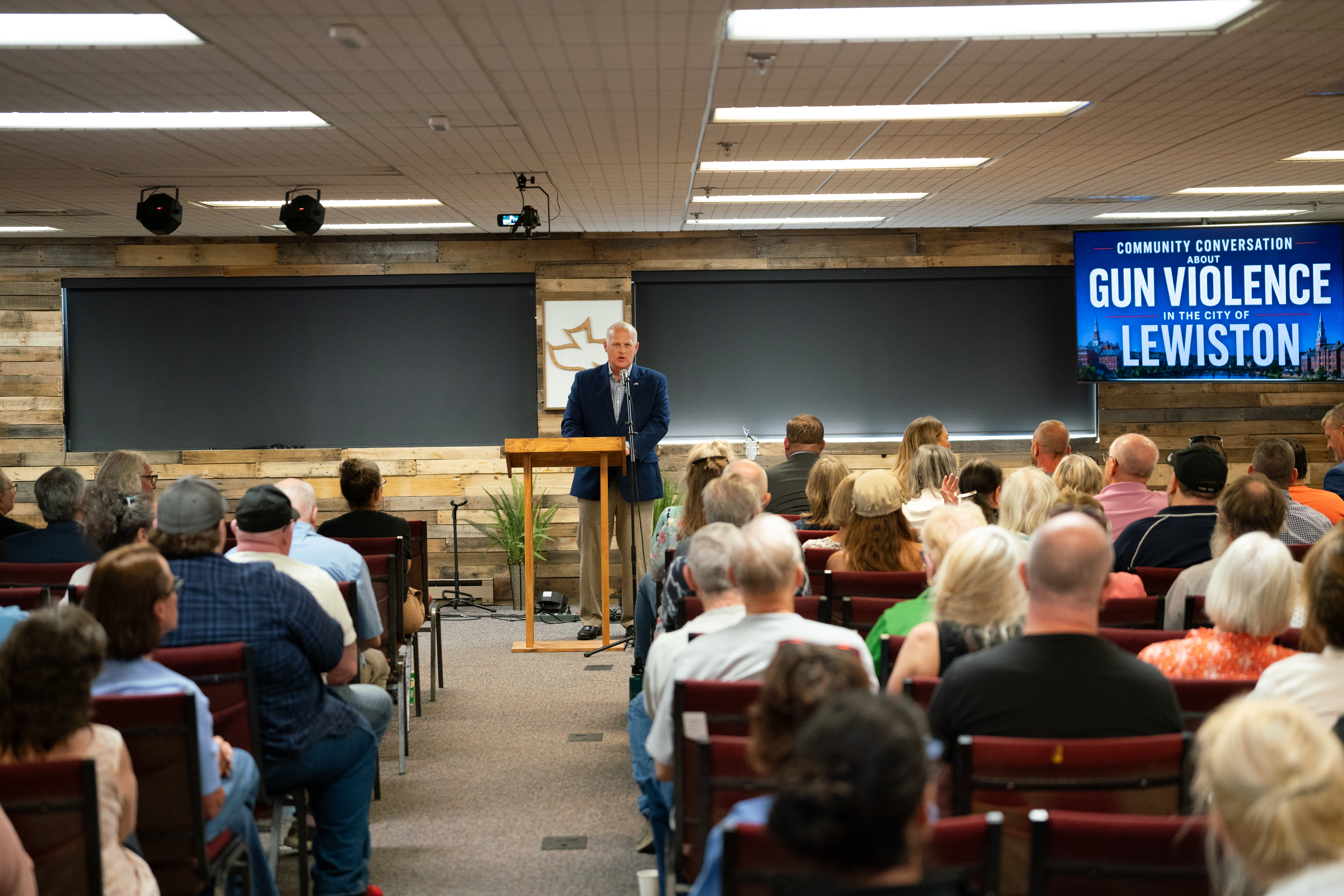
LEWISTON, Maine — More than a hundred residents, law enforcement officials, elected leaders, educators, and gubernatorial candidates gathered Wednesday night at Calvary Chapel of Lewiston for an emotional and often blunt community conversation about the growing wave of youth gun violence in the city.
The forum, organized by the Maine Wire and hosted by Calvary Chapel Pastor Aaron Davis, featured residents sharing stories of fear, frustration, heartbreak, and anger over repeated shootings involving juveniles in Lewiston.
Again and again throughout the evening, speakers returned to several recurring themes: a lack of accountability for violent juveniles, absent parenting, failures within Maine’s juvenile justice system, and frustration with state leadership in Augusta.
But speakers also repeatedly emphasized hope, community involvement, and the need for continued public conversations.
“This city is us,” Pastor Davis told the crowd during his opening remarks. “It is time that we come together, not to point fingers, not to decide who’s wrong and who’s right, but to decide how can we come together and how can we find some way to reach these kids, to reach our city, to take back our streets.”
Davis rejected accusations that the gathering was intended to target any one demographic or political group.
“I’ve heard some deception that this was going to be a meeting so that we could just hate on a certain demographic of people,” Davis said. “But the truth is that our streets are getting set on fire every single day and it doesn’t seem like there’s any stopping in sight.”
The meeting comes amid mounting concern in Lewiston after several recent shootings involving teenagers, including retaliatory gun violence and multiple incidents involving juveniles allegedly carrying firearms.
Jon Fetherston, of the Maine Wire opened the forum by praising the Lewiston police and calling for a citywide conversation.
“How we live in a world where children are shooting children is beyond my comprehension,” Fetherston said. “We’ve got to talk about this. We must have a conversation.”
Police Chief, District Attorney Defend Efforts
Much of the evening was centered around questions directed at Lewiston Police Chief Carly Conley and Androscoggin County District Attorney Neil McLean.
Both defended their agencies’ work while arguing that the larger criminal justice system in Maine is failing police, prosecutors, and communities alike.
“This is a broken criminal justice system,” Conley told residents. “The DA’s office for us, they’re our partner. They work with us day in, day out.”
Conley said Lewiston police continue working closely with federal agencies including Homeland Security, the FBI, ATF, DEA, and state police, but noted that federal authorities typically do not handle juvenile cases.
“The major issue that we’re having right now is specifically youth violence,” Conley said. “And that’s really not the federal government’s purview.”
McLean delivered one of the evening’s most detailed explanations of the challenges facing prosecutors and police.
“We are victims of the system as well,” McLean said. “Lewiston PD does an amazing job of finding people on the streets. They put together cases, they bring them to our office, and our office does our best to then take that case and move it through the system.”
McLean said his office recently created a dedicated prosecution unit focused specifically on violent gun crimes, assigning prosecutors Brianna White and Alex Winters to those cases.
But he warned that staffing shortages and state policies surrounding juvenile detention continue to undermine enforcement efforts.
“The juvenile system is even more broken,” McLean said. “You all should be upset. Change Augusta. You’ve got to change Augusta.”
According to McLean, his office is currently down five prosecutors while handling roughly 2,000 cases in Androscoggin County alone.
Residents Describe Fear, Frustration
Many residents described a city they no longer recognize.
“I’m embarrassed to call Lewiston my hometown,” one resident said. “Back then it was safe.”
Another longtime resident recalled growing up in Lewiston decades ago when police officers regularly walked neighborhood beats and knew local families personally.
“We used to be able to leave our vehicles unlocked, keys in it, and our doors open,” the resident said. “Now people don’t feel safe.”
Several speakers said they now fear allowing children outside or walking downtown at night.
One woman said she was preparing to leave Maine entirely because she no longer feels safe in Lewiston.
“It’s disheartening,” she said. “Lewiston is going to the dogs and I’m not going to go down with it.”
Another speaker warned that the city must recognize it is facing “urban problems.”
“Lewiston-Auburn is not Maine anymore,” the speaker said. “It’s an urban city. You have to answer the problems in an urban way.”
The crowd frequently applauded calls for stronger consequences for juveniles caught carrying firearms.
“We need to start treating them like adults,” one educator said. “You want to play adult games, you want adult weapons in your hands, let’s start treating you like an adult.”
Others called for parents to face criminal accountability when juveniles repeatedly commit crimes with guns.
“We need to start holding the parents accountable,” another speaker said. “If that’s what it takes, then so be it.”
Calls for More Community Involvement
Despite the anger and frustration expressed throughout the night, several speakers urged the audience to focus on long-term community involvement and outreach to young people.
One woman working in community outreach warned against demonizing troubled youth.
“These kids are not monsters,” she said. “Narratives matter. We tell kids that they’re monsters, they’re going to start believing it.”
She called for more investment in mentorship programs, violence interruption efforts, and emotional support for youth who grew up during COVID lockdowns and in the aftermath of the Lewiston mass shooting.
Others emphasized the need for recreational activities and positive role models.
“These kids have nothing to do,” one resident said. “We need to get these kids to do things around town instead of hanging out, drinking, smoking, shooting.”
Another speaker urged residents to continue organizing community forums and outreach efforts.
“This is the beginning,” the speaker said. “Let’s continue the conversation and keep building bridges.”
Politics and Accountability
The discussion also turned heavily political at times, with many residents criticizing Gov. Janet Mills, Mayor Carl Sheline, and Democratic leadership in Augusta.
Several speakers argued that state lawmakers have tied the hands of police and prosecutors through juvenile justice reforms and restrictions on detention.
State Rep. Quentin Chapman, R-Auburn, argued that one-party Democratic control in Augusta has contributed to the crisis.
“Having one group make all the decisions all the time is bad,” Chapman said. “You need to talk to your neighbors, get them registered, and vote.”
School Committee member and State House candidate Janet Beaudoin similarly argued that long-term political change would be required to address the crisis.
“The only way that we can untie the hands of this justice system, of our DA, of our police, is to support them and put people in power who are going to cut the red tape and support them,” Beaudoin said.
More Meetings Planned
By the end of the evening, organizers said the meeting would not be the last.
Fetherston acknowledged criticism that more outreach needed to be done to include and welcome members of Lewiston’s Somali community and pledged additional conversations in different locations moving forward.
“This isn’t the final conversation,” Fetherston said. “It’s the first conversation.”

The Mill’s/Augusta solution is blame Trump and raise taxes. Catch and jail. ( Adult crimes, adult punishment. )
FIRST ON FOX — The Department of Homeland Security (DHS) confirmed to Fox News Digital that a non-English-speaking naturalized U.S. citizen, during the Obama adminstration, from China accused of causing a Virginia crash that killed five people and injured dozens more Friday morning is now facing charges for driving under the influence and without a valid license.
Maybe Maine police should look at those NY Busses more closely this summer.
We need to bring ICE back and support their efforts. We need to enforce law and order. Not only are illegals downtown, they are in neighborhoods with multiple Somalis living in the same house, supposedly caring from one individual. It’s a safe place to hide. We will never make Lewiston great again until we stop being a sanctuary city. School population would normalize, hopefully , teaching well return to what it should be and not indoctrination,. There would be plenty of housing for everyone. Perhaps we can then be proud of our city. Until that happens, we will continue to spiral downwards.
Thanks to Calvary Chapel, The Maine Wire, Ben Midley and the community for sponsoring this. Unfortunately, we see who supports this in the community and who doesn’t. King Carl and anointed Chrissy Noble would rather create the problem than solve it. Thanks to the members who spoke up. It was suggested the community that should have been there was not there because it was too far or held in a church. Lame excuse. Hold it at Kennedy Park and see if they attend. They do not want solutions. Thanks to Representative Chapman for closing the session. Time to vote RED. Email Janet Mills and tell her Lewiston and the DA office need help. Augusta is the problem.
What is the attendance at LHS? Check on these kids each day. Bring back the old Truancy law that were eliminated by the old Democratic Governor.