

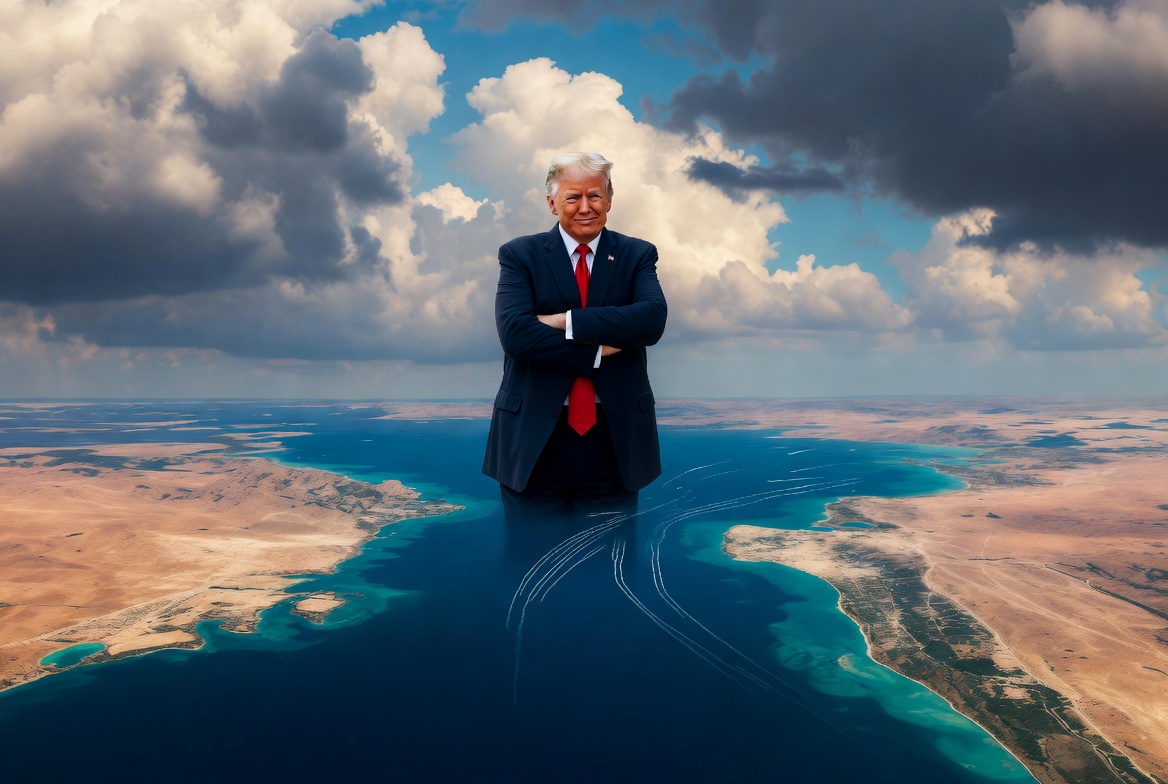
President Donald Trump declared Wednesday that the fragile ceasefire with Iran is “over,” plunging the United States and Tehran back into a dangerous cycle of direct military conflict after a major flare-up in the Strait of Hormuz.
The renewed hostilities followed Iranian attacks on commercial vessels traveling through one of the world’s most important energy chokepoints. The escalation quickly rattled global markets, sending Brent crude sharply higher and raising new concerns about fuel prices for American consumers.
Oil prices surged after the collapse of the truce, with Brent crude briefly climbing to $80.59 per barrel before settling at $78.02, a 5.2 percent daily gain, according to market reports. The spike marked a sharp reversal after prices had begun moving back toward pre-war levels.
The latest escalation began after Iran targeted three commercial trade vessels, including a liquefied natural gas tanker, as they transited the Strait of Hormuz. The waterway remains central to global energy security, and any disruption there carries immediate consequences for oil markets, shipping companies and consumers.
U.S. officials had believed a mid-June memorandum of understanding with Iran would allow the free flow of traffic through the strait. Tehran, however, has continued to assert its right to manage the waterway and has warned vessels against using routes it has not approved.
In response, U.S. Central Command carried out a second straight night of intensive airstrikes against Iranian military targets. The strikes reportedly hit roughly 90 targets, including air defense systems, coastal surveillance radars and missile storage sites along Iran’s southern coast.
Iran’s Islamic Revolutionary Guard Corps retaliated by launching missiles and drones toward U.S. military installations hosting American troops in Bahrain and Kuwait. Local air defenses intercepted several incoming threats, according to reports.
Speaking from a NATO summit in Ankara, Turkey, Trump said further talks with Iran would be a “waste of time” and signaled that the United States may fully reimpose its strict naval blockade. Trump also suggested the U.S. could expand its target list to include Iranian bridges, oil export hubs and other critical infrastructure.
“Let’s just finish the job,” Trump said.
The White House has also revoked temporary sanctions waivers that had allowed Tehran limited oil sales during the brief peace window. Those waivers had been offered as an incentive to keep Iran engaged in negotiations, but the administration now appears to be moving back toward maximum economic and military pressure.
The renewed U.S. strikes coincided with multi-day state funeral processions inside Iran for the late Supreme Leader Ayatollah Ali Khamenei, who was killed earlier this year during the opening phase of the war. Iran buried Khamenei on July 9 at the Imam Reza Shrine in Mashhad after a week of mass mourning and public calls for revenge against the United States.
The collapse of the ceasefire now leaves Washington and Tehran facing the prospect of a broader regional war, with U.S. troops, Gulf allies, commercial shipping and global energy markets all exposed to the consequences.
For American drivers, the impact may soon be felt at the pump. National gasoline prices have already crept higher, with reports placing the U.S. average near $3.80 per gallon as traders price in the risk of further disruption in the Strait of Hormuz.
The question now is whether the latest round of strikes remains a limited military exchange or becomes the start of a wider conflict that reshapes the region and the



Come on Donald .
Let’s get this over with .
You can’t make “ deals “ with these people .
When we finally send them back to the Stone Age maybe then they’ll decide to behave .
Until then …….don’t waste your breath .
Back in the 80s, Pacific Fleet Commander, Admiral “Ace” Lyons, petitioned Sec. of Defense, Caspar Weinberger, to turn Iran into an ashtray. Unfortunately, he was denied permission.
The Iranian mullahs are Shiite “Twelvers” who believe in Armageddon in order to usher in the return of the Mahdi. These “leaders” are religious fanatics. You can’t reason with them or their ideology. Trump should take them all out completely and do the 90+ million Iranians living under their thumbs and the rest of the world a huge favor.
Another Trump ceasefire with Iran crumbles.
“He must be trying for the record of how many times he can lose the sane war”.
The Intercept
Hahahaha!
Louisewood and kafirtwerp are really stupid people.
The USA has done nothing but lose in its attempt at fighting the Persians. Trump is embarrassing the USA on the world stage. The US Navy can’t go into Houthi controlled Red Sea or Persian controlled Persian gulf let alone keep shipping lanes clear.
Remember, Persian gulf was wide open before Trump made a fool out of himself and got a worse deal than the one he ripped up.
Kafirttwerp makes a really stupid racist faux news viewer comment. That poster is probably a dumb inbred jew. Muslims are very fine people. Muslims love Jesus. jews hate Jesus.
If you don’t want a war with them stay the F out of their countries. The USA is stealing oil from Iraq, Syria and Venezuela. It would like to steal it from Iran and Russia. It’s embarrassing. Iran has the moral high ground.
Louiswood, the USA cannot “win” with these stupid bombing’s on civilian infrastructure and girls schools. It’s a show. Iran destroyed 75+ US aircraft so far plus the US bases in the region are all severally damaged. That is more US aircraft destroyed by Iran in last year (dating back to last summer) than destroyed in both Bush gulf wars on Iraq.
The only way to “win” is “boots on the ground”. Probably a million troops or more. Iran is a country of 90 million plus with terrain like Colorado and Utah. Never gonna happen. USA with NATO help couldn’t even beat the Taliban.
Meanwhile, Trump drained US strategic oil reserve already which means jet fuel (fighters) and diesel fuel (Tractor Trailer’s) in jeopardy.
P.S
Bombing Iran “back to Stone Age” comment is funny. Persia was an empire back then. No Israhell, no Iraq, no Oman, no Syria, etc etc. It was all Persia!!
Hahaha!
Iran wants to kill every last American. The question is: Can we cut the grass every ten years or so; OR do we try to kill every last one of them now if we can?
This is honestly a disastrous decision, both economically and politically.
The longer the war in the Middle East continues, the higher gas prices are likely to climb. As fuel costs rise, transportation becomes more expensive, and those costs ripple through the economy, increasing the price of everyday goods. Trump was elected by many voters to end wars and improve the economy not to revive the kind of Middle East interventionism associated with the Bush era.
Beyond the economic consequences, this also hurts Republicans politically. From 2022 to 2026, I served as Chairman of the Bangor Republican Party. At ages 24–28, I was one of the youngest municipal party chairs in the state. Toward the end of my term in early 2026, I noticed a growing number of younger conservatives and independents becoming frustrated with Trump. Their concerns centered on the economy and the perception that Middle East affairs were being prioritized over domestic issues. I warned my fellow Republicans that this trajectory could become a serious political liability.
I hate being correct. Republicans in Maine now need to work even harder to keep the conversation focused on Governor Mills’ record while presenting credible, forward-looking solutions to the challenges facing our state. Trump’s Middle East misstep makes that task considerably more difficult.
You idiots can’t even take back Maine from the Muslim horde invasion and you think you can take Iran!? How’s Lewiston going? You sissy’s can’t even walk safely down your own city streets!! Hahaha!
Trump has made mistake after mistake. He has lost the illegal war he started. Remember, the straight was open with free passage before Trump thought he could bully Iran for show.
Trump attacked Iran over nuke weapons Iran was not building, missile defense Iran is entitled too, and support for allies in the region which Iran has a right to support. Now all we hear about is the straight that Iran is in complete control over. Embarrassing.
Egypt charges fees for Suez Canal, Panama charges for Panama Canal, Turkiy charges fees for straight of Turkiy. Get used to it. You have to pay if you want to play.
You uneducated faux news disciples better pray to your inbred jewish god that Iran doesn’t develop intercontinental missiles cause you can say goodbye to Bath Iron Works and Pratt and Whitney. Idiots.
Israhell is a bloodthirsty pariah. Just read the Old Testament / Torah. It is a written record of jewish war crimes against Persia and other peoples in the region.
USA does not have the moral high ground here. USA opened this illegal war by attacking a girls school with tomahawks from the sea.
Hey Trump hater;
Dumocrats… you cant make this shit up!
The drama over the Strait of Hormuz escalated on Wednesday with Donald Trump declaring the MoU with Iran is dead and vowed more attacks on Iran. Trump continues to insist that Iran has no right to interfere with any ship trying to transit the Strait of Hormuz, but the fact is that Iran is acting within its rights under the terms spelled out in paragraph five of the MoU (which I discussed in my previous post). The US attack on Iranian outposts along the shore of the Persian Gulf on Tuesday was a set up — i.e., the US coordinated with Qatar and Saudi Arabia to have their ships defy the Iranian protocol to register the voyage with the IRGC, which precipitated the Iranian attack on those vessels. While falsely claiming this was a violation of the MoU, Donald Trump hit Iran with bombs starting late Tuesday night/early Wednesday morning Iranian time.
Unlike the previous incidents on June 25 and June 26, where Iran hit non-compliant ships and the US did a one-off airstrike on Iranian positions on the shore of the Strait of Hormuz following each incident, Trump launched a new series of attacks on Iran on July 8 (Wednesday) even though Iran had not attacked another ship. Why did Trump do this? Was it retaliation for some anti-ship missiles fired at the US Carrier Strike Group operating 200 miles off the coast of Iran? That’s my hypothesis… One or more missiles hit one or more US vessels, causing some damage that has not been reported publicly.
Trump’s Wednesday strikes doubled the size of the ones he ordered on Tuesday. Iran, in response, launched ballistic missiles and drones at US bases in Kuwait, Bahrain, the UAE and Muwaffaq al Salti airbase in Jordan. I have no reports regarding physical battle damage. However, the Trump attack prompted an ominous warning from the spokesman for Iranian Parliament’s National Security Committee, who stated that a renewed US attack will be answered with a change in nuclear doctrine. He also said:
In any future confrontation, the enemy will face a comprehensive, all-out surprise offensive from the Islamic Republic of Iran.
We have many options available that were not used during the 40-day war.
Options such as withdrawal from the NPT, changing nuclear doctrine, and closing the Bab al-Mandab Strait alongside the Strait of Hormuz are on the table for review.
A bill for NPT withdrawal is also ready for review in parliament — and if Iran faces an existential threat, a change in nuclear doctrine could also be put on the agenda
Pressure is growing in Iran to withdraw from the MoU. The US has violated almost every section of the MoU while Iran has assiduously adhered to it — including keeping Hezbollah from going on the offensive against the Israelis. Trump’s Secretary of the Treasury announced on July 7 that the US would reinstate oil sanctions on Iran, which marks another clear violation of the MoU.
According to vesselfinder.com, the activity in the Strait of Hormuz as I write this article is scant, but the ships transiting the straight are abiding by Iran’s PGSA protocols. If Trump opts to continue attacking Iran on Thursday then I believe that Iran will expand the scope and severity of its retaliatory strikes. Without some immediate concessions from the US, I believe that Iran will agree with Trump — i.e., “The MoU is dead.”
Sonar21
LOL
IF you ever wanted to bait know it all Trump hating trolls to this site , just say the word TRUMP .
A picture will help set the hook .
THIS ONE not only has an advanced mental phobia , and definite case of advanced derangement syndrome …..
but he’s an intellectual and an sarcasm master as well .
LOL
I love listening to this AHole rant and rave ……Party On Dude !
If we’re going to fight, then fight to win. Unfortunately that may mean unintended casualties but get it dine and over.