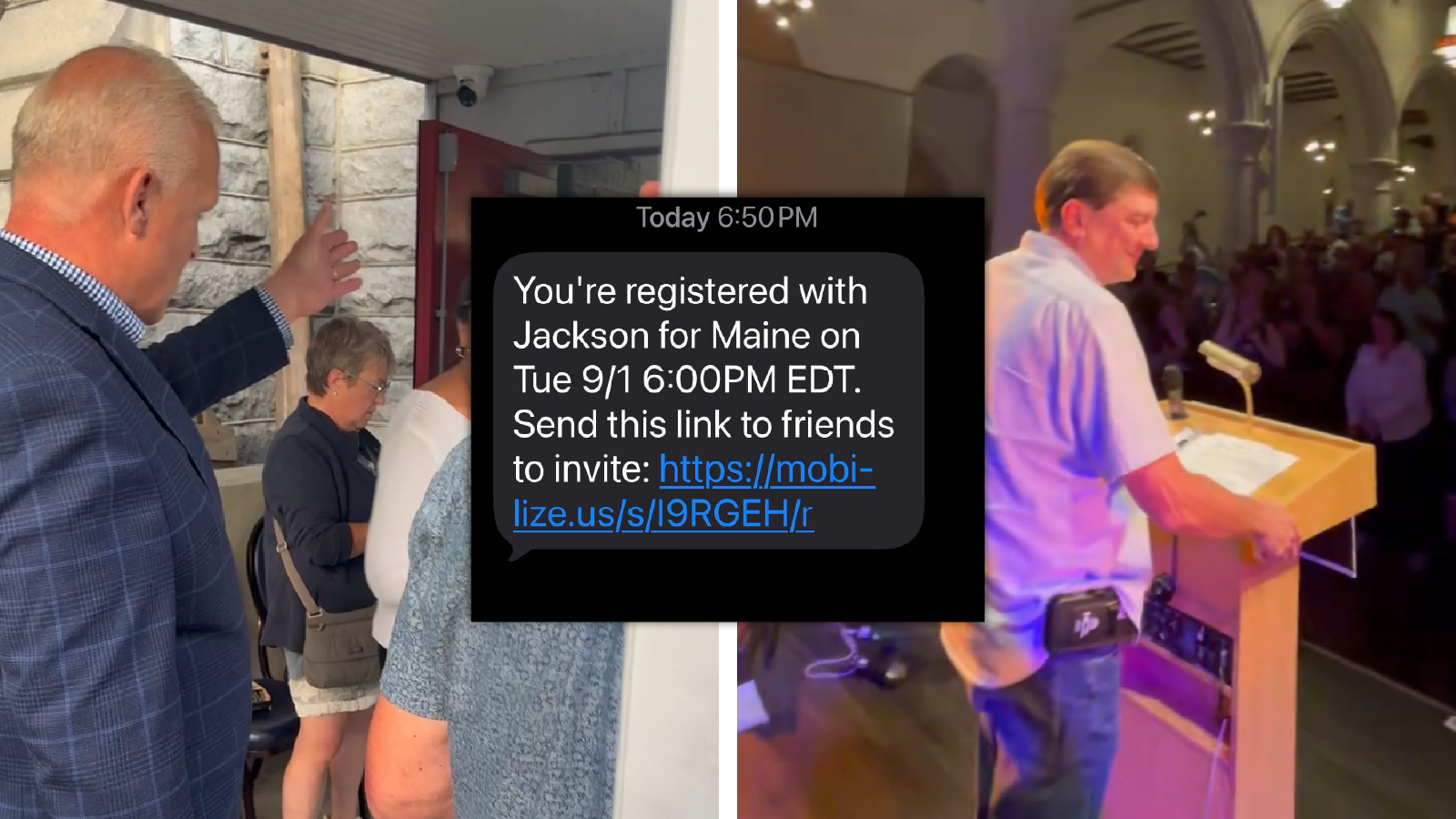
Democratic U.S. Senate candidate Troy Jackson kicked off his town hall campaign Tuesday evening at Lewiston’s Franco Center, drawing roughly 275 people to hear the former Maine Senate president make his case for representing Maine in Washington.
One news organization, however, was not permitted inside.
The Maine Wire.
The largely older crowd filled the historic Franco Center alongside members of the media, who were allowed into the event. The Maine Wire team arrived expecting to cover Jackson’s remarks and potentially ask the Democratic candidate questions afterward.
Initially, the reception was friendly.
As requested at the entrance, members of The Maine Wire team scanned a QR code and submitted personal information associated with attending the event.
Then someone identified us as being “from The Maine Wire.”
The atmosphere changed immediately.
Instead of being allowed into the venue with other reporters, we were told organizers needed to determine whether The Maine Wire would be permitted inside.
Eventually, an event representative came outside and informed us that we would not be admitted as press.
To her credit, she was polite and professional. She also found herself having to answer an uncomfortable question that should probably have been directed to Jackson or senior members of his campaign:
Why?
Why was The Maine Wire being denied access while other members of the press were admitted?
And if the campaign had no intention of allowing us inside, why were we first asked to scan a QR code and submit our information?
No meaningful explanation was provided.
Fine.
Political campaigns are free to make decisions about how they operate their events, and The Maine Wire does not need a reserved chair to cover Troy Jackson.
The event was available through C-SPAN, meaning Jackson’s remarks could still be watched and reported.
But the decision raises a more important question for a candidate campaigning on the importance of public town halls and accessibility.
What was Jackson’s campaign worried about?
Jackson has made Republican Sen. Susan Collins’ accessibility a central theme of his campaign. He has publicly challenged Collins to attend his town halls and criticized her for not holding the type of open public forums he says Mainers deserve.
That makes Tuesday night’s decision particularly difficult to reconcile with his message.
A candidate cannot credibly demand greater accessibility from his opponent while deciding which reporters are welcome to cover his own public events.
The Maine Wire has reported extensively on Jackson’s record, including issues that he may not particularly enjoy discussing. Those are precisely the circumstances in which access to candidates matters most.
Reporters are not supposed to ask only questions campaigns want to answer.
Jackson is a former Maine Senate president, a fifth-generation logger and now the Democratic nominee seeking one of only 100 seats in the United States Senate.
A difficult question from a reporter should not be an extraordinary event for someone seeking that job.
The Maine Wire remained outside the Franco Center hoping to speak with Jackson when the town hall concluded.
That opportunity never came.
Jackson left through another exit without speaking with The Maine Wire. His staff snuck him out the back door and loaded him in to his mini van by pulling up to the back door of the Franco Center.
Perhaps there is an innocent explanation for that. Perhaps Jackson had somewhere else to be, or campaign staff had already planned his departure that way.
But combined with the campaign’s decision to deny The Maine Wire press access, the optics were hard to ignore.
Jackson is asking Collins to come to his town halls and face Maine voters.
The Maine Wire showed up.
We registered as requested. We identified ourselves. We waited outside after being denied admission. And we remained there hoping to ask the Democratic nominee questions directly.
Jackson never came out to answer them.
That is the larger problem with what happened Tuesday night.
This isn’t about whether The Maine Wire deserves special treatment. We don’t.
It is about whether a candidate for the United States Senate believes press access should depend upon whether he likes the outlet asking the questions.
Jackson has every right to criticize Collins and demand that she appear before voters in a town hall setting.
But accessibility is a standard that works both ways.
If Jackson wants to make openness and accountability defining issues in this campaign, he should expect reporters, including reporters whose coverage he may dislike, to test him against that same standard.
Tuesday night offered him that opportunity.
His campaign chose the door instead.