A recent analysis of the data in Maine CDC’s Health Care Worker COVID-19 Vaccination Dashboard revealed that, while rates of vaccination among healthcare workers increased since Gov. Mills decreed that all Maine healthcare workers must be vaccinated for COVID-19 on August 12, this is not the whole story.
Maine CDC tracks five types of “designated healthcare facilities” related to this data; ambulatory surgical centers (ASCs), assisted housing, hospitals, intermediate care facilities (ICF/IID), and nursing homes.
Data show that total numbers of hospital, assisted housing, and nursing home staff reporting vaccination status dropped considerably over August and September while overall facility-based vaccination rates climbed. Maine’s healthcare workforce is 10% smaller than it was in July; the COVID vaccination rate for all healthcare facilities is about 9% higher.
July was the last month of reporting before Mills announced the mandate, even though enforcement was delayed until October 29. October data is expected to be released around mid-November.
From May, when the administration first started recording vaccination rates from healthcare facilities, the ranks of vaccinated staff across the state has risen by 1,279 overall. On the other hand, the number of unvaccinated workers reported dropped more than 10,000 over that same timeframe.
The differences in the raw totals likely reflect the number of people who left their jobs since the announcement, presumably because they were not willing to comply with the new mandate. This means the total workforce is down by more than 9,000 since May.
From the outset, it seemed like Mills expected most to comply with the mandate; if those professionals want to work in Maine healthcare, “there won’t be any places to go,” she said.
While many see the pursuit for 100% vaccination rates in healthcare facilities as a noble one, is it worth the unintended consequences? Has the mandate spurred (or coerced) more healthcare staff to seek vaccination, or has it pushed more workers out the door?
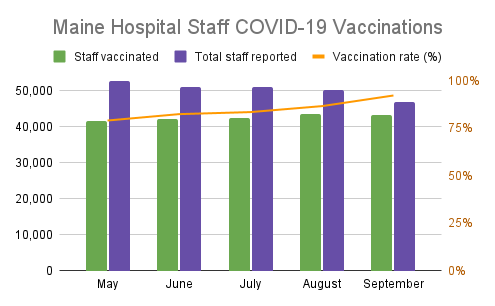
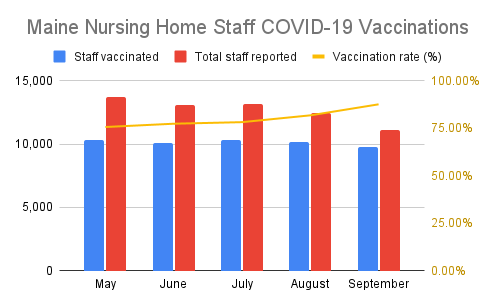
Since July, nearly 4,000 Maine hospital staff have left their job, almost 8% of the healthcare workforce. The ranks of vaccinated hospital workers rose 789 but more than 4,700 unvaccinated staff left since July. Nursing home staff dropped by nearly 16%—more than 2,000 people.
Administration officials and media have largely ignored reporting changes in the hard data, preferring to relay the perceived success of rising vaccination rates in the aggregate. They hastily rationalize the current acute care shortages as being a decades-long problem, or even one caused by the virus itself, even though Maine never reached these depths during the pandemic of the last two years.
Of course, many factors are at play when discussing the whole of the healthcare workforce. Many are contemplating life and career changes or early retirement during all of this. Healthcare is a stressful field; it takes special people to provide the high level of care we expect. That is why it is critical to understand how the timing of the mandate relates to this recent exodus.
Over August and September, more than 7,000 unvaccinated healthcare facility staff left their jobs. Almost all of them—98.8%—were unvaccinated. If this were mostly from pandemic burnout and early retirements, why are we just seeing it now?
In order to better answer this question, it is important to see how this recent trend relates to longer-term trends. If the acute care shortages Maine’s healthcare system is experiencing today can be explained by historical staffing shortages, as the governor claims, then we should see it in the data.

The Bureau of Labor Statistics (BLS) publish employment numbers by industry, the former by month and the latter by quarter. While these data do not line up perfectly with the total staff numbers in the Maine CDC healthcare worker vaccination dashboard, they are helpful in comparing trendlines.
In terms of hard numbers, Maine’s healthcare workforce has not rebounded from its pre-pandemic high of more than 112,000 but mounted a significant comeback in the last half of 2020.
In terms of growth, during the pre-pandemic period starting January 2019, BLS data show that the industry grew by more than 130 workers per month on average. From March 2020 to this September, the last month on record, employment faltered, losing 178 on average every month, but that was borne mostly during 2020, before vaccines were available. From January to September 2021, the monthly growth rate has been even, signaling a rebound from the depths of pandemic burnout.
Accounting for the 789 who presumably chose to be vaccinated since July, if no unvaccinated hospital staff left their job, the hospital worker vaccination rate in September would be nearly unchanged: around 85%. Yet, the published vaccination rate of hospital staff in September is over 92%.
About 4,000 out of nearly 51,000 hospital staff (7.8%) chose to leave their jobs rather than get vaccinated over the two months since the mandate was announced. The rising vaccination rate over that time reflects this phenomenon: the denominator shrunk by 8% while the numerator rose by less than 2%. Numbers from August to September bear this out as well.
If the unvaccinated hospital staff who reported in August were there in the September report (they’re not presumably because they resigned), the vaccination rate would be unchanged: ~86%
— Nick Murray (@NickMurr) November 1, 2021
The vax rate rose literally because staff left and the denominator shrunk #mepolitics
Is this another case of the Maine CDC obfuscating and cherry-picking data?
Either way, this much is clear: in the two months since she announced it, the governor’s gamble on a healthcare workforce vaccine mandate has not paid off. In fact, it has led to enormous numbers of essential healthcare workers leaving the industry, either finding one of the many jobs open in the state, or moving to another state where COVID-19 vaccination is not a condition of employment in their preferred field. It’s no wonder multiple Maine hospitals have announced care rationing, patient diversion, and department closures in the last two months.
For the thousands of unvaccinated workers who have already left their job, and potentially the healthcare field altogether, it is difficult to see how the state can coax them back to the front lines without a full repeal—or at least a substantial alteration of—this mandate.
At this point, Mills seems to be charging headlong into the consequences of this reckless policy choice with little to no regrets. Sadly, it will be the people of Maine who will bear the ultimate cost.