As the summer of 2020 progressed, the Maine Department of Education (DOE) continued communications with interest groups in the state, which had been ongoing since the start of the COVID-19 pandemic in March 2020, but the subject of communications changed. The DOE and its frequently contacted stakeholders, including the Maine Education Association (MEA) and the Maine School Management Association (MSMA), coordinated messaging and drafted guidance for schools during the first months of the pandemic. Emails sent in mid June through September focused more on enforcing, refining, and updating previously drafted guidance.
According to documents obtained by The Maine Wire as part of a Freedom of Access Act (FOAA) request, the MEA and other interest groups referred cases where guidance was not being complied with to DOE. In some cases, the DOE and MEA appear to have threatened to withhold Coronavirus Relief Funds (CRF), provided to the state by the federal government through the Coronavirus Aid, Relief, and Economic Security (CARES) Act, from noncompliant districts.
Organizations with which the DOE was in frequent communication include the MEA, the largest public teacher’s union in the state and an affiliate of the National Education Association, and the Mains School Management Association (MSMA), which describes itself as a “state-wide, nonprofit federation of local school boards and superintendents.” The organization contains the Maine School Boards Association and the Maine School Superintendents Association.
Additionally, the DOE regularly communicated with the Maine Administrators of Services for Children with Disabilities (MADSEC), a state-based nonprofit association representing special education educators and students; the Maine Curriculum Leaders Association (MCLA), a state-based nonprofit that supports professional educators and stakeholders; and the Maine Principals’ Association (MPA), also a state-based nonprofit representing principals and directing interscholastic sports.
On June 17, Dan Chuhta, then the DOE’s deputy commissioner, emailed a list of proposed agenda items to a group that included the MEA, MSMA, MADSEC, MCLA, and MPA ahead of a weekly meeting with educational organizations. Topics of discussions included updated guidance for summer athletic programs from MPA, as well as guidance on transportation and student exchanges.
Paula Voelker, the executive director of the MEA, responded and asked that additional topics related to clarification of DOE guidance on face masks be added to the agenda.

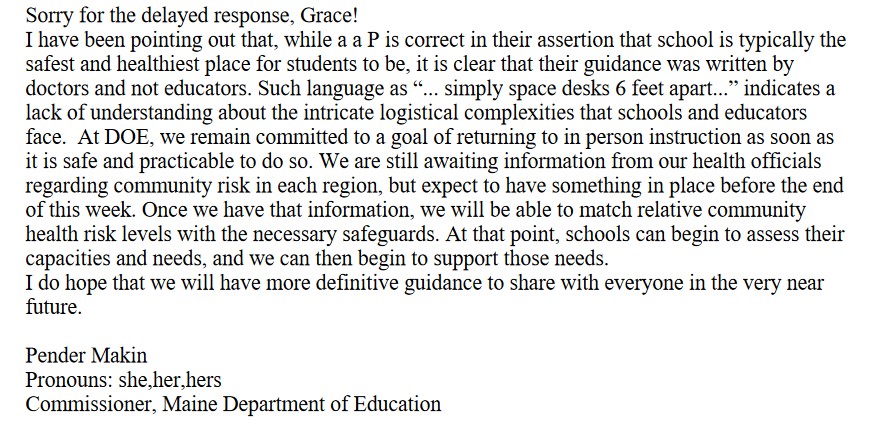
On June 24, Grace Leavitt, president of the MEA, emailed Chuhta, DOE Commissioner Pender Makin, DOE communications director Kelli Deveaux, MSMA executive director Steve Bailey, and MSMA deputy executive director Eileen King about questions she had for a meeting to be held the following day.
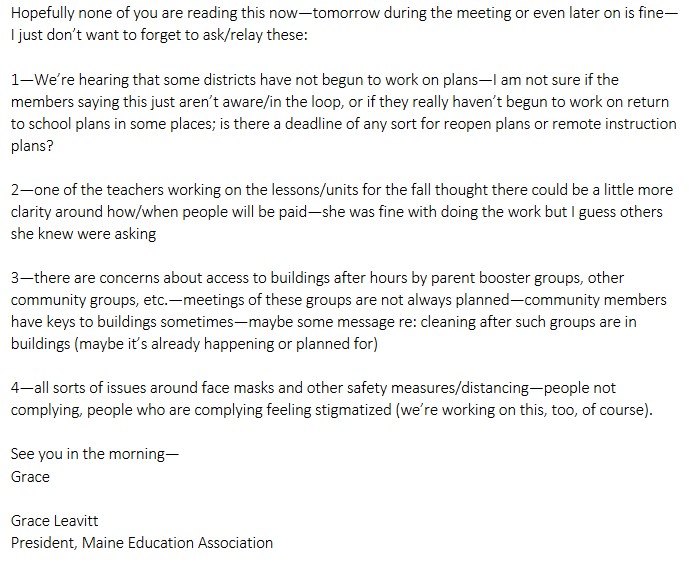
Makin responded the next day, saying the DOE would have answers by the meeting scheduled for that evening.
On June 25, Deveaux emailed summer activities guidelines put together by the MPA to a list of recipients that included Makin and representatives of the MEA, MADSEC, MCLA, MPA, and MSMA. Deveaux said the guidelines had been discussed in a meeting held that morning.
“[The guidelines] are aligned with the DOE and governor’s stages and many other states’ guidelines, and have involved community health experts in the preparation,” Deveaux wrote.
“These are for-profit athletic programs running, and there has been pushback with MPA guidance when these programs seem to be operating at full capacity with little to no precautions (such as at a 90 team basketball tournament held recently in Southern Maine), but MPA has been very deliberate, collaborative and thorough, and has based their decisions on best practice and science,” Deveaux continued.
The guidance included protocols for teams to follow for summer and pre-season conditioning sessions and provided sample checklists for precautions, like daily COVID-19 screenings. It also addressed procedures for locker rooms and on-field practices and play.
On June 30, Leavitt shared concerns around reopening guidance in an email to Makin, Chuhta, Deveaux, Bailey, King, MPA executive director Holly Couturier, MADSEC executive director Jill Adams and MCLA executive director Courtney Belolan.
Leavitt had two concerns, one related to recommendations produced by Gov. Janet Mills’ Economic Recovery Committee, instituted to develop public policy recommendations to stabilize the state’s economy after COVID-19, and one related to guidance from the American Academy of Pediatrics.
Leavitt’s first concern was related to language in a recommendation the Economic Recovery Committee released on June 26, 2020. That committee recommendation called on the governor to clearly state that a safe return to in-person instruction in fall 2020 should be the state’s top economic redevelopment priority.
In her email to the educational organizations, Leavitt wrote she was concerned this would put focus on reopening schools, not on safety.
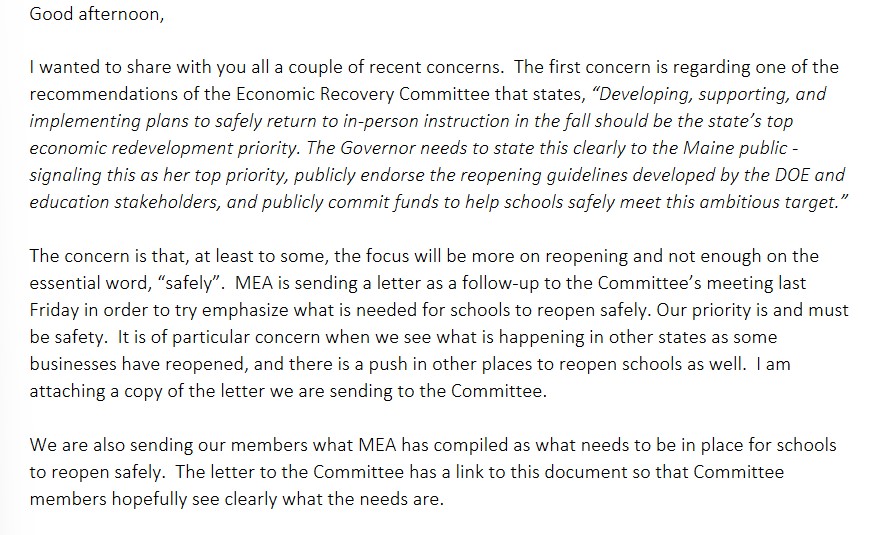
Leavitt also attached a letter the union intended to send to the committee addressing their concerns about emphasizing safety in addition to the union’s reopening guidelines.
Leavitt’s second concern was related to guidance released by the American Academy of Pediatrics (AAP) on June 24, 2020. Like the Economic Recovery Committee’s recommendations, the AAP guidance called for safe return to in-person learning.
Again, Leavitt worried the guidance might be “causing some districts that were planning staggered schedules or hybrid plans for reopening to reconsider those plans and instead revert to full in-person reopening due to the concerns regarding students’ social/emotional health as well as physical well-being when they are not back in schools.”
“Of course we share those concerns, too, but need to somehow address those issues while also keeping the primary focus on safety for both students and staff,” Leavitt continued. “I hope we can find a way to work together to address these issues if schools, as we likely all are anticipating at this point, do need to stagger schedules and have remote instruction for some or all students.”
Makin responded on July 1.
Leavitt emailed Makin again, as well as Chuhta and Deveaux, on July 8, on the subject of topics to be discussed at a meeting scheduled for the following day.
She asked whether DOE could release unified guidance on pausing evaluations for an additional school year, as well as unified guidance related to a need to give teachers adequate time to plan for the upcoming school year.
Leavitt also added that she had heard from one school district where teachers were overwhelmed with additional work.

A week later, on July 17, Leavitt emailed Makin, Chuhta, Deveaux, Bailey, King, and Voelker about additional concerns the MEA had about plans to reopening schools in the fall.

Makin responded minutes later, noting that the DOE’s soon-to-be-released guidance on reopening schools did not recommend fully reopening.
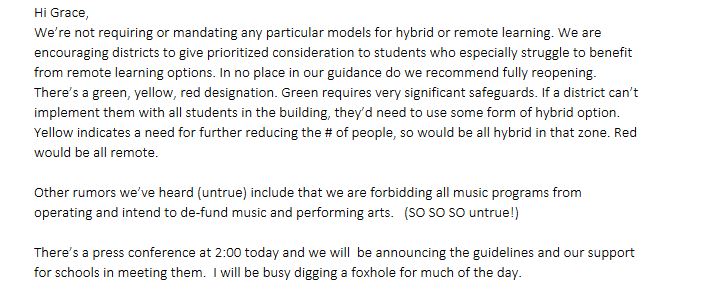
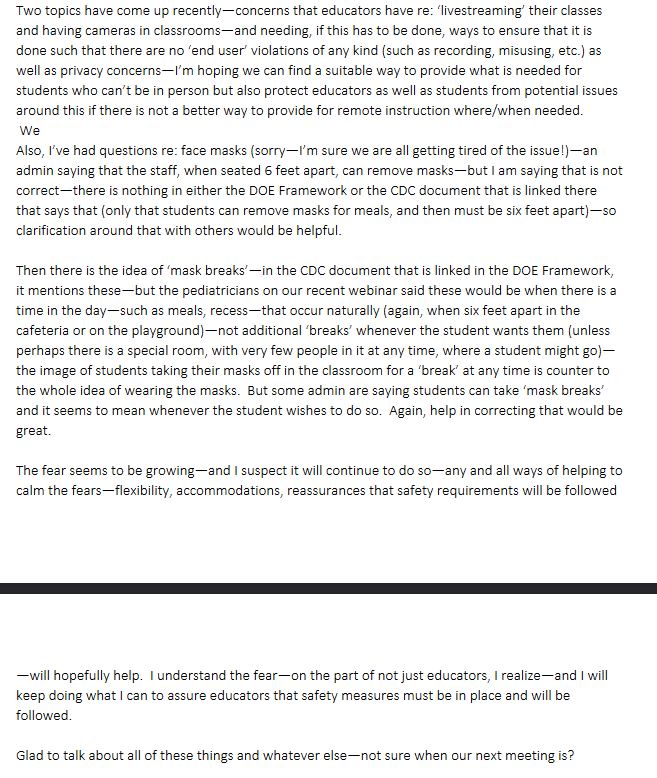
On July 20, Leavitt again brought concerns with the guidance to DOE’s attention, emailing Makin and Chuhta on July 20 about concerns about face masks.
“I am getting questions about face masks—I heard clearly they are required but at least some are still thinking that if 6 ft. can be maintained, they are not required. I heard clearly that the Governor, Dr. Shah, and you state these are safety requirements. That is what I have been saying to members that have raised the question. That may need some more clarity in the Framework document,” Leavitt wrote.
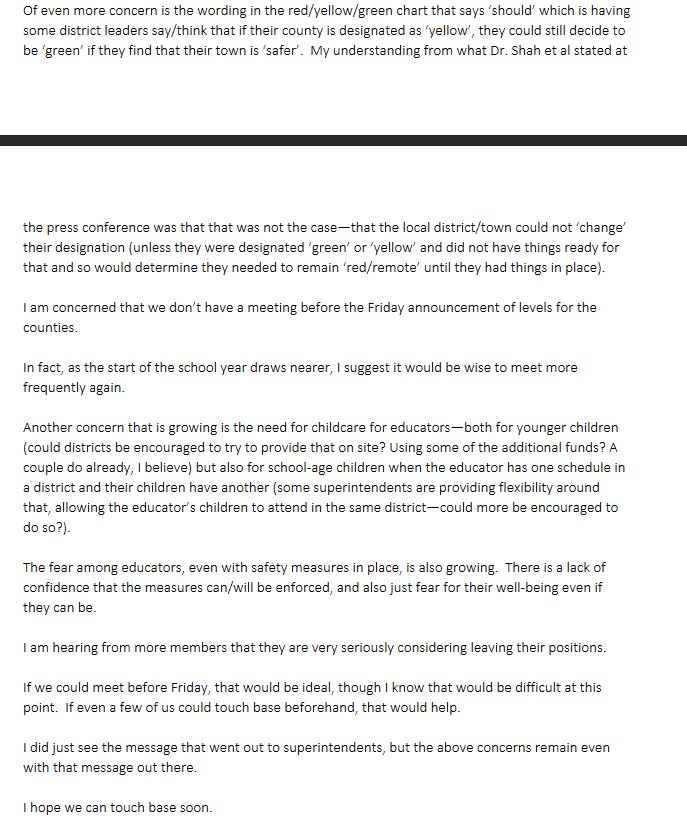
Concerns about shortcomings in the guidance were also the subject of a July 29 email Leavitt sent to members of the DOE, MEA, MCLA, MPA, MSMA, and MADSEC.
Leavitt wrote that MEA was hearing “from more and more educators” that safety requirements in the guidance for returning to in-person instruction were not clearly requirements.
Leavitt also expressed concern related to the color coded system the DOE was using to identify the COVID-19 transmission level in school districts.
Makin responded shortly, saying she agreed a meeting should be scheduled as soon as possible.
“I would like to meet as Grace has brought up many points that have been discussed among Superintendents as well. I have a long list of concerns coming from Superintendents that grows by the hour. Thank you Grace for putting this out there! If the whole group can’t meet then maybe a smaller group, just to get the conversation going?” King responded.
Following feedback from other email recipients, a meeting was scheduled for 2:30 that afternoon.
On August 4, Leavitt raised additional concerns about COVID-19 guidance in an email to King, Bailey, Couturier, Adams and which copied Makin and Chuhta.
Leavitt contacted Makin, Chuhta, King, and Bailey again the next day, on August 5, this time forwarding a message from a local MEA leader in Jefferson about a Jefferson School Committee member stating masking requirements were a school committee decision.
“The sticking point is one very local board member who refuses to recognize the requirement for masks or face coverings. His belief is that masks are a board decision. The community is 100% (minus one household) on board with an opening plan to require masks, but this one person is dug in and threatens the district’s ability to access CARES Act funding,” Leavitt’s forwarded message read.
Also included in the message was a link to a news story published on August 5 by the Lincoln County News, covering a vote by the Jefferson School Committee to return to full time in-person learning when school resumed that fall.
The story quoted Walter Green-Morse as saying that the school had received recommendations, rather than mandates, about face masks, and that the DOE’s framework for returning to classroom instruction was not a mandate.
“Greene-Morse said he agrees with 99% of the state’s recommendations but takes issue with others, including making students have lunch in their classrooms. He said the school cafeteria can be used in a way to ensure physical distancing and student safety,” the Lincoln County News reported.
It also noted that Green-Morse said he would comply with an executive order mandating students wear face masks if one was ordered.
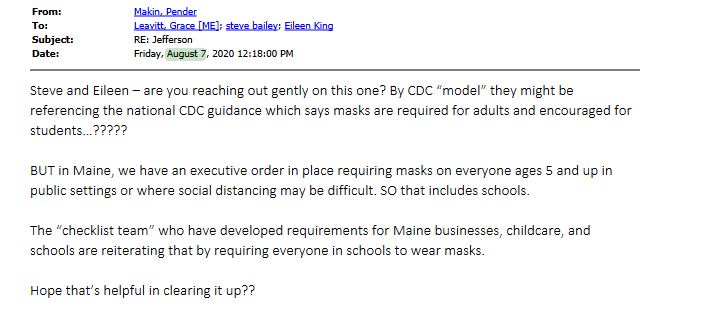
Mills issued Executive Order 6 FY 20/21 on August 1, 2020, which required face coverings for children aged 5 and older in public settings, including in school. Makin noted this in her response to Leavitt’s August 5 email, writing “Hopefully someone can let him know that face coverings are required statewide by all in public settings where physical distancing may be difficult, per executive order (not subject to local control/school board.”
Bailey also responded the next day, noting he had worked with the Jefferson school board and would be “glad to talk more about this” with Leavitt.
Jefferson’s reopening plans were also the subject of an August 7 email exchange between Leavitt, Makin, Bailey, and King.
Leavitt forwarded the district’s reopening plan and called attention to language changes within the document.

Makin responded later the same day, asking Bailey and King whether they were reaching out “gently” about the matter and noting Maine’s executive order requiring mask wearing.
King responded after speaking to superintendent Crag Jurgensen.
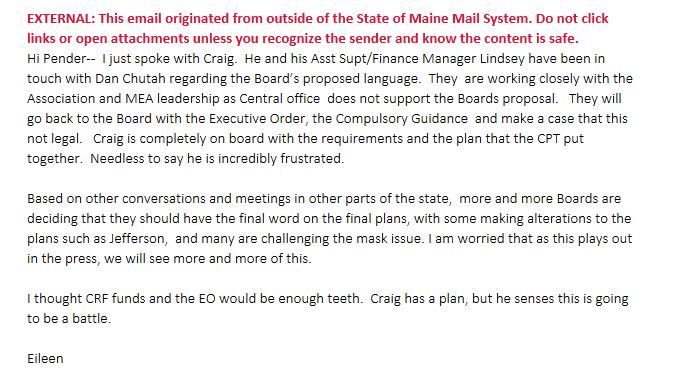
Bailey also added that he could speak to the school board’s chair.
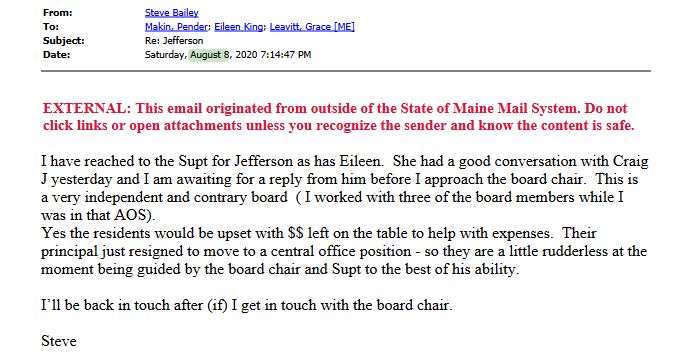
On August 8, Makin responded again, writing she believed taxpayers “would be upset if they heard the school boards were going to leave hundreds of thousands on the table in CRF.”

Bailey also responded again, noting that both he and King had spoken with Jurgensen.
The CARES Act provided $150 billion in CRF grants, awarded by the U.S. Department of the Treasury to states and eligible local government units to help cover expenses incurred as a result of COVID-19.
Per Treasury guidance, CRF grants could be used to cover necessary expenditures incurred due to the COVID-19 public health emergency; to cover expenses not accounted for in budgets most recently approved on March 27, 2020, the date the CARES Act was passed; and to cover expenses incurred between March 1, 2020 and December 31, 2021.
On July 17, 2020, Mills and Maine DOE allotted $165 million in CRF to schools to help cover costs associated with COVID-19. In applications for funding, DOE required applicants to attest to various conditions about the money’s use including that it would go towards expenses not previously planned or budgeted and would address “urgent needs caused by COVID-19.”
It also required applicants to agree “to implement the health and safety requirements identified by Maine [Centers for Disease Control and Prevention] CDC for safely reopening schools.”
It is this requirement that Makin, Bailey, and King appear to be referencing in their August 7 exchange about Jefferson’s reopening plan.
But whether DOE had the authority to withhold funds based on whether school districts followed reopening guidelines is uncertain.
According to the Treasury’s CARES Act guidance, states could only impose restrictions on the transfer of funds to local governments if those restrictions facilitated requirements with other laws, including section 601(d) of the Social Security Act, which establishes CRF grants can only be used to cover expenses incurred because of COVID-19 during a set amount of time.
“Other restrictions, such as restrictions on reopening that do not directly concern the use of funds, are not permissible,’’ the Treasury’s guidance states.
Earlier in the year, DOE officials including Makin had also noted that the DOE’s reopening framework was not meant to negate districts’ reopening plans.
On June 8, as DOE and stakeholders collaborated on school reopening guidance, Makin wrote this in response to an email from Leavitt, in which the MEA official passed on frustrations that the state had not yet released guidance.
“One VERY important note: The DOE’s framework does not replace or negate a district’s plan or for reopening. It is meant to be used as a guide – with considerations listed that may be helpful to the districts as a list of considerations for calibrating their own plans/models for reopening,” Makin wrote.
A working draft of the DOE’s guidance, updated on July 19, 2020, also noted that the states’ guidance was not intended to be a mandate for school districts.
“This framework provides options, ideas, and considerations for organizing the work of reintegrating back to in-person, classroom instruction. In general, these steps are not intended to be used as requirements or mandates, rather they should be viewed as customizable starting points and resources for school administrative units (SAUs) in the difficult work of planning for the fall….The pillars of this framework include safety, equity, and accessibility for all students and staff, and we encourage innovation and honor the professional integrity of Maine educators in the development of your district- and building-specific plans,” the draft framework noted.
The DOE did not return a request for comment about whether it believed its requirement that school districts fully comply with Maine CDC’s school reopening requirements was within the bounds of the law’s guidance.
On August 10, Leavitt again forwarded concerns about noncompliance with mask guidance in school districts to DOE officials, MSMA, and MPA representatives.

Leavitt reached out to the DOE on two separate matters on August 12.
The first email, sent to DOE, MSMA, and MPA representatives, addressed concerns about mask policies adopted by SAD 30.
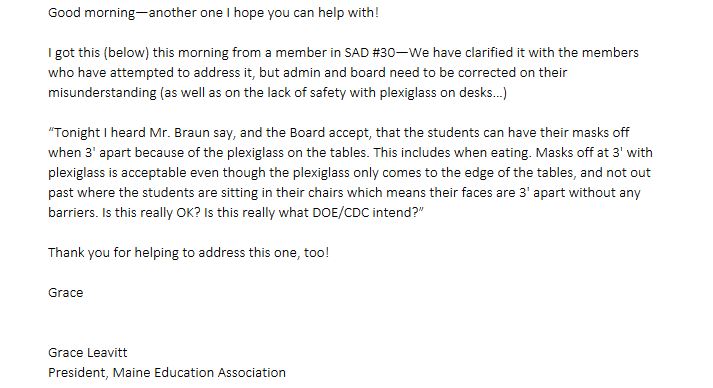
“I assume the team has debunked this one? We have put it in our FAQs that there’s no research supporting the use of dividers as a replacement for masks or for required distance,” Makin wrote in response.
King also responded on August 13, saying she and Couturier were “reaching out to different people” and hoped the situation would be resolved as soon as possible.
The second email, sent to Makin, Chuhta, and Deveaux, forwarded messages she had sent to MPA about school athletics and suggested including as a topic of discussion at DOE’s next meeting with its educational organization stakeholders.

“Yes, let’s discuss at our next meeting,” Makin wrote in response.
On August 13, John Kosinski, the MEA’s Government Relations Director, emailed Makin, Chuhta, and Deveaux, also copying Leavitt, and sought clarification about whether town academies were required to abide by distancing and masking requirements.
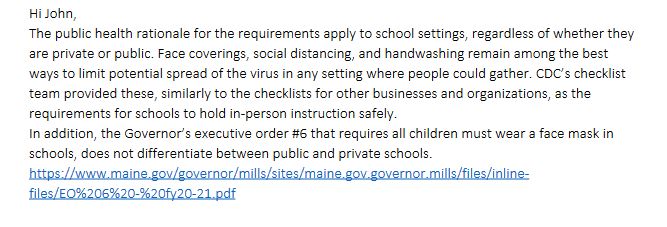
“Can you clarify for us if the 6 requirements in the framework also apply to town academies? Are town academies required to abide by the distancing, masking requirements, etc just like public schools? I see they are slated to receive CRF funds but I thought the town academies were outside of the DOE/state jurisdiction,” he wrote.
Deveaux responded, noting the same public health rationales applied to town academies and public schools, and also attaching Executive Order 6 FY 20/21.
Kosinski also asked for updated guidance on school transportation, which Deveaux provided.
Leavitt again emailed the DOE, MSMA, and MPA representatives about masking requirements on August 21.

“We will definitely work on something more specific and clear, Grace! There does exist guidance on what is safe and required… We’ll get that into people’s hands!” Makin wrote in response.
Two days later, on August 23, Chuhta also responded, forwarding language from Mills’ Executive Order 49 FY 19/20 about what met the description of a “cloth face covering,” which the order required to be worn.
The language defined a cloth face covering as a “protection that covers the nose and mouth; fits
snugly but comfortably against the side of the face; is secured with ties or ear loops; has multiple layers of fabric; allows for breathing without restriction; and is able to be laundered and machine dried without damage or change to its shape.”
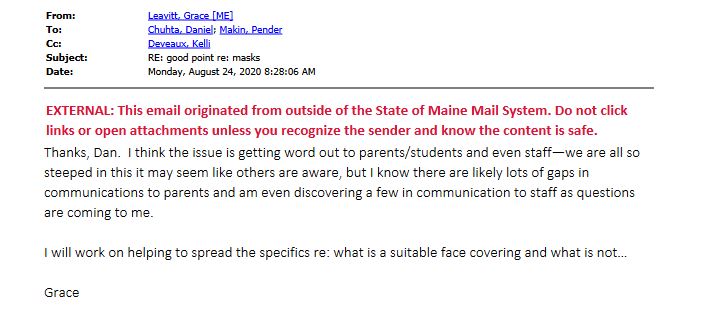
“You’ll see that gaiters (with lack of ties) don’t fit the definition,” Chuhta wrote in response.
Leavitt responded again the next day.
On September 3, Kosinski emailed Makin and Bethany Beausang, a senior policy advisor in the governor’s office, about language in the DOE’s standard operating procedure (SOP), first issued on August 26, 2020, for schools to use in case of a positive COVID-19 case.
Kosinski said he’d just had a conversation with MaryAne Turowski, also a senior policy advisor in the governor’s office, and wanted help with questions he had about the SOP. Both Turowski and Leavitt were copied on the email.
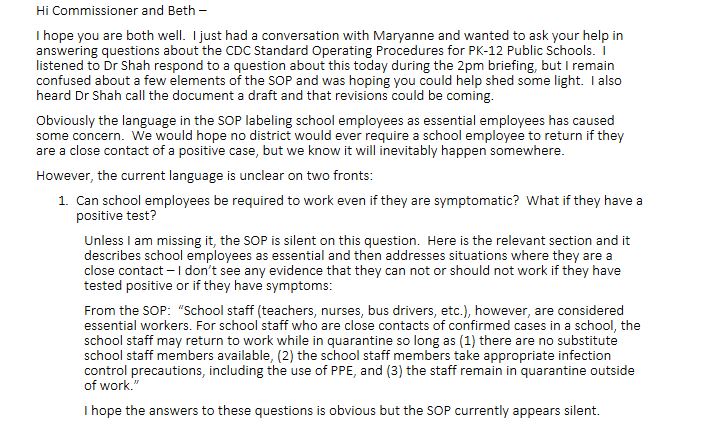
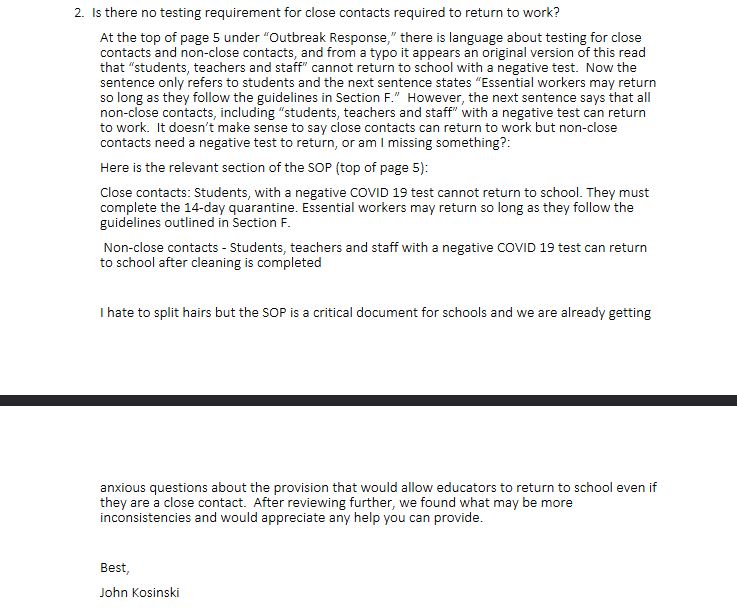
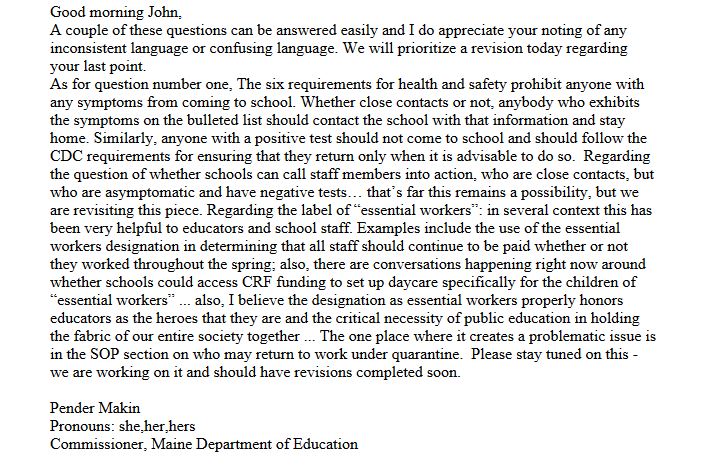
Kosinski sent an identical email to the same recipients on September 8. Makin responded roughly a half hour later.
Also on September 8, Leavitt emailed King, Couturier, Makin, and Bailey about an employee in SAD 75 believed to be violating quarantine.
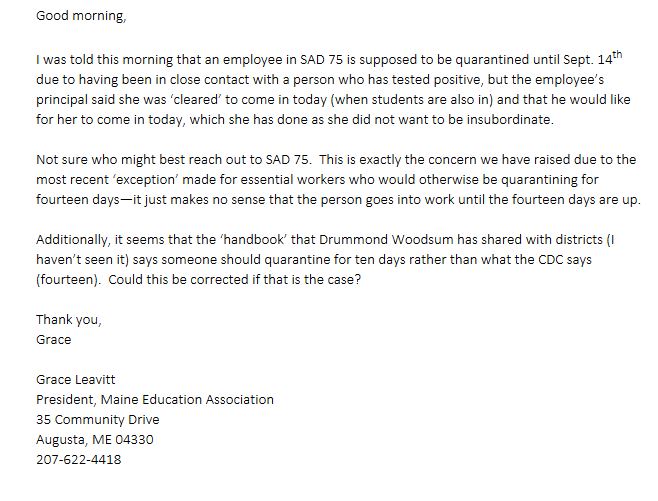
After King said she would reach out to the district’s facilities director, and Makin acknowledged this and encouraged Leavitt to call her cell phone with time sensitive matters in the future, Leavitt followed up later that evening.
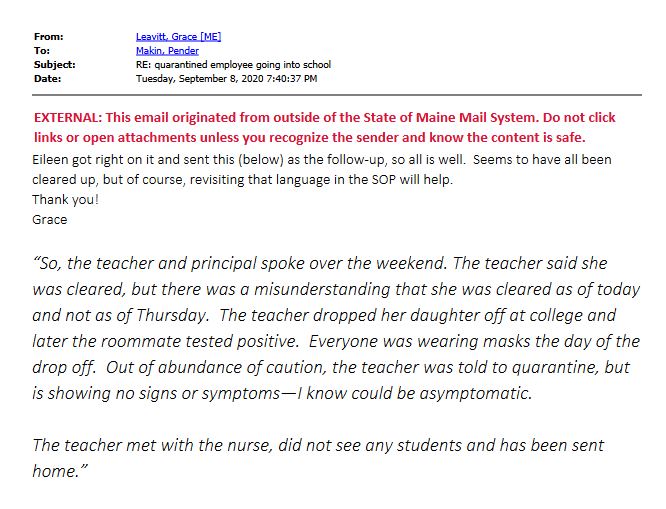
The following day, on September 9, Leavitt followed up again.
“Just want you to know all is well with the teacher in MSAD 75–she is back in quarantine, the principal apologized for the misunderstanding, and the teacher feels for the administrators who have been figuring this all out–” Leavitt wrote.
Kosinski emailed DOE officials on September 11 about a rumor the required number of student days would be waived.
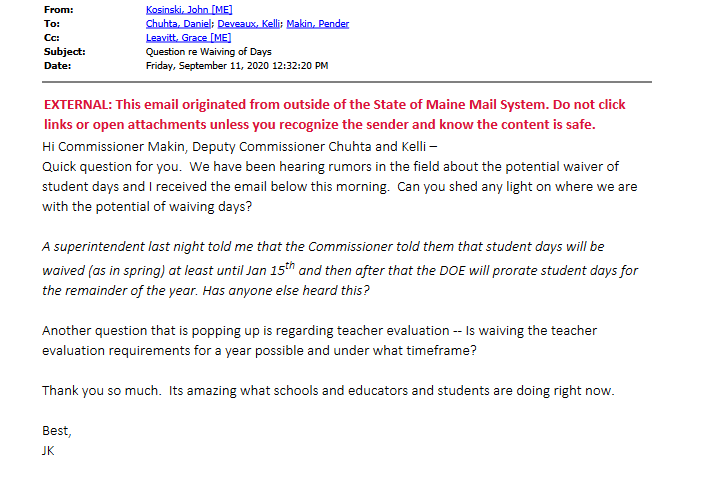
Chuhta responded, saying the language of LD 2167, which allowed Makin to waive the minimum number of school days the previous year, was in effect through January 15.
On September 17, Leavitt emailed Makin and Chuhta about safety concerns regarding specific schools, which she said had been brought to her.

“Wow – OK … let’s meet. I might have some time tomorrow early or late – what works for you? I am assuming people have already accessed the “complaint hotline” with these concerns? If not, they should. I have included Kelli who has info on how that works… But let’s still meet so we can better understand the scope of the concerns and find a supportive solution,” Makin wrote in response.
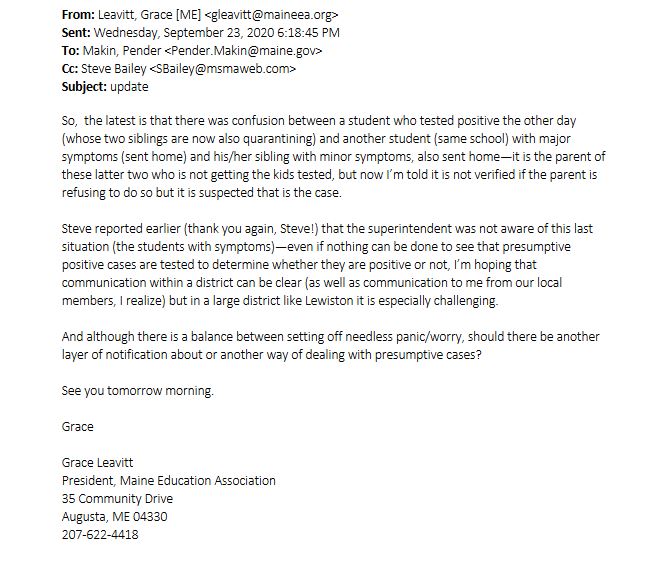
On September 22, Leavitt brought another case of quarantine guidelines allegedly being violated to the attention of Makin, Bailey, King, and Couturier.
“I was just told that a teacher in Lewiston who was positive–the class is quarantined, but the teacher, since they are ‘essential,’ is in school. Hoping this can be addressed quickly, as happened a few weeks ago in SAD 75 (and the teacher was sent home once the super was contacted),” Leavitt wrote.
King responded a few hours later, noting she had talked to Jake Langlais, Lewiston’s superintendent, on the phone.
“He is very aware of the situation. A student did test positive and the class is quarantined. The teacher self-identified as not having been in close proximity with the student at any time. Jake still offered the teacher the opportunity to quarantine, but the teacher said no. Jake left the offer to quarantine open ended and let her know that she could change her mind. There was never any discussion between Jake and the teacher about her being ‘essential’ and needing to be in school,” King wrote.
“A thought–if the teacher/staff person was in the classroom, even if they were not in close proximity, isn’t that defined as a ‘close contact’? I think I recall that being explained at one of our meetings. That may need clarifying,” Leavitt replied.
Makin responded next, noting that Maine CDC defined a close contact for the purposes of COVID-19 tracing as anyone within 6 feet of an infected person for more than 15 minutes.
“In order to help schools to not have to chart the intricate choreography throughout a school day,
they said they’d pull all students/staff who are in the same room for longer than 15 minutes with an infected person under that umbrella. Widening the net in this way was perceived as being helpful to simplify the process – and they realize that it will ultimately end up labeling more people as “close contacts” than would typically be the case…” Makin wrote in response.
“Thank you for clarifying–that was what I recalled having been said–perhaps a clarification with administrators would help with this situation and prevent others that may occur? I’ve relayed this back to our staff, too,” Leavitt responded next.
King responded again later that day, noting that the teacher had tested positive on a rapid test.
“When the teacher became aware that a student had tested positive yesterday, she left school.
Lewiston has an agreement with a health provider for teachers to get a rapid test. The test has come back negative yesterday which is why the teacher returned today. The teacher will be remote for the rest of the week, as her students are all quarantined as well. I wasn’t aware that the teacher had been tested and that it was negative. So, I think we are all set in this case,” King wrote.
Leavitt provided another update on quarantining within Lewiston the following day, on September 23.
Through the remaining days of September, Leavitt, King, and Makin exchanged emails about issues with access to personal protective equipment (PPE) within Portland Public Schools. The scope of The Maine Wire’s FOAA ended on September 30, 2020.
All of the materials The Maine Wire received as a result of this FOAA can be viewed here.