State Rep. Deqa Dhalac, the former assistant executive director of Gateway Community Services, has become ensnared in a congressional investigation into Medicaid fraud spanning Minnesota and Maine.

House Oversight Chairman James Comer (R-Ky.) is demanding briefings from the Justice Department and Treasury over Minnesota’s ballooning social-services fraud scandal.
Comer’s sweeping requests expand and escalate an already explosive investigation targeting industrial-scale Medicaid fraud carried out primarily by members of the Somali diaspora in Minnesota. But in the fine print, he flags a Maine Medicaid contractor already under intense scrutiny: Gateway Community Services and its Somali-American founder, Abdullahi Ali.
In a Dec. 22 letter to Treasury Secretary Scott Bessent, Comer requested Suspicious Activity Reports, or SARs, and related material tied to suspected fraud-linked money movement — including transactions routed through Minnesota and into foreign jurisdictions.
Comer’s request also sought SARs tied to Gateway and its similarly named 501(c)(3) arm, specifically naming Ali and state Rep. Deqa Dhalac (D-South Portland). Dhalac listed herself as the assistant executive director of Gateway Community Services’ for-profit arm from 2022 to 2024, and she is listed in the 501(c)(3)’s Form 990 tax filings as a director.

In addition to financial records, Comer also requested a briefing from the Justice Department.
In a letter to Attorney General Pamela Bondi, Comer said the House Committee on Oversight and Government Reform is investigating reports of “widespread fraud” in Minnesota programs and faulted state leadership for allegedly failing to stop it. Comer cited public statements from federal prosecutors estimating the fraud totals “well in excess of $1 billion,” and warned that “half or more” of $18 billion in federal Medicaid claims paid to 14 Minnesota “high-risk” programs since 2018 may have been fraudulent.
Dhalac and Ali are both naturalized U.S. citizens. However, each has maintained deep ties to Somalia, as well as to Turkey and Azerbaijan.
In January 2024, Dhalac was filmed deplaning in Puntland to a royal welcome. That summer, Ali and Dhalac joined other Maine officials on a junket to Turkey and Azerbaijan paid for by the Azerbaijani government. The pair took glamour shots for their Instagrams posing in Nagorno-Karabakh, an area from which Armenian Christians were forcefully expelled in 2023.
Neither Dhalac nor Ali has publicly said why they visited Azerbaijan.
In February, the Russian news outlet Sputnik reported that Azerbaijani officials were hoping to supply military equipment to Somalia. A few months after the Azerbaijan junket, Ali appeared in multiple Somali-language interviews regarding his candidacy for the Jubbaland presidency. In those interviews, Ali said he had funded troops and munitions for a paramilitary group he aimed to deploy against his political opposition.
If Ali was telling the truth in his Somali-language interviews, then U.S. Treasury officials should find indications that money flowed from accounts controlled by Ali into international sources to support his militia.
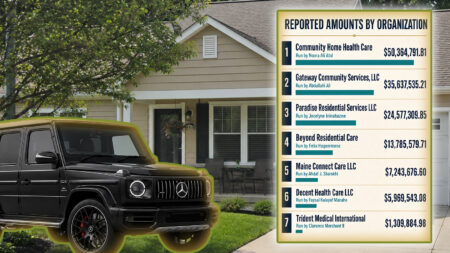
From 2019 to 2024, Gateway billed Medicaid — known in Maine as MaineCare — roughly $5 million per year. In that same period, Gateway received two audit findings from the Department of Health and Human Services alleging it had overbilled the program. The agency is still fighting one of those audit findings through an administrative process.
Comer’s letters do not accuse Gateway or Ali of a crime.
But the SARs would show any financial transactions made by Ali, Dhalac, or other employees linked to Gateway, including unusual bank deposits or withdrawals, and wire or ACH payments. If Ali, Dhalac, or other individuals associated with Gateway used regulated payment systems to transfer money back to Somalia, that would show up in the suspicious activity reports.
Gateway’s appearance on a congressional list of “organizations of interest” lands squarely in the middle of a long-running Maine controversy that The Robinson Report first reported on in March. State officials have acknowledged a financial dispute involving Gateway’s billing in response to national media picking up the story nine months later.
Maine DHHS has said audits found overpayments, and that recoupment is underway, with one appeal still in process. DHHS has also said suspected fraud concerns are referred to the attorney general’s office.
Attorney General Aaron Frey (D), a close ally of Gov. Janet Mills (D), has declined to investigate the allegations against Gateway.
In June, Frey’s “Recovery Council” awarded Gateway a $400,000 grant funded by opioid settlement money — an award made after The Robinson Report revealed that Ali had funded militia groups in Jubbaland.
By naming Gateway, Ali, and Dhalac in a request for Treasury’s most sensitive anti-money-laundering reporting, House investigators have effectively pulled a politically charged Maine Medicaid fight onto the national stage.
The letter almost certainly foreshadows more time in the spotlight for Maine and greater scrutiny of the state’s fastest-growing and largest-spending program: MaineCare.
Editor’s Note: The Bangor Daily News still hasn’t covered the Gateway story.