

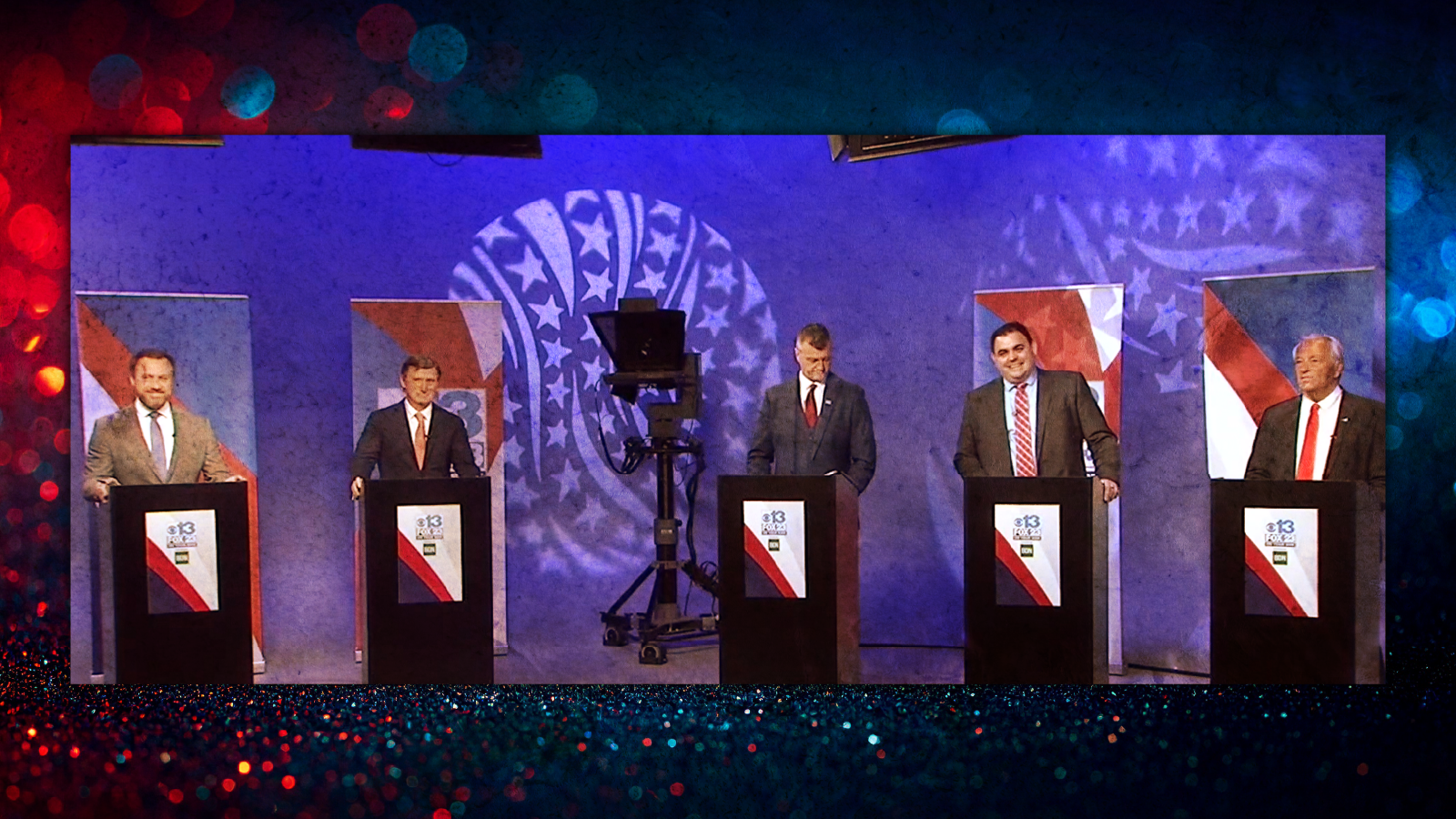
PORTLAND, Maine – The 2026 Republican gubernatorial primary debate opened with two notable absences Thursday night, as CBS 13 moderator Greg Lagerquist said Robert Wessels did not meet the debate’s polling threshold and Bobby Charles qualified but chose not to attend.
The candidates on stage were former Senate Majority Leader Garrett Mason, healthcare executive Jonathan Bush, former fitness executive Ben Midgley, tech entrepreneur Owen McCarthy, and real estate businessman David Jones.
The debate quickly turned unpredictable when Jones used his opening statement to announce a ranked-choice voting alliance with Midgley.
“If you are voting for me, please give me your first vote and give him your second,” Jones said.
Midgley returned the favor, saying Jones “would make a great second vote.”
The candidates spent the hour clashing over who is best positioned to reverse nearly a decade of Republican losses in Maine. Mason leaned on his record in Augusta, saying he is the only candidate on stage who has been part of a Republican governing majority and helped cut income taxes.
Bush, Midgley, McCarthy, and Jones each argued that Maine needs a CEO-style governor from outside the political class.
Bush said Maine needs to “shrink taxes, shred crazy laws, and shrink Augusta,” while Midgley said the state needs “a seasoned and experienced chief executive officer.” McCarthy pointed to his “Maine 2040” plan, and Jones said Maine needs “strong structural changes.”
The sharpest early exchange came when Mason challenged Bush’s outsider credentials.
“No, Jonathan, you can’t honestly say that you’re a political outsider when your last name is Bush,” Mason said.
Bush responded that his career has been in entrepreneurship, not politics, saying he built a company from his basement and created jobs in Maine.
The debate also covered taxes, with candidates differing on whether income taxes or property taxes should be the top target. Bush called for a $1 billion tax cut. McCarthy said his long-term goal is eliminating the income tax. Jones said property taxes are the ore urgent crisis for homeowners.
On health care, candidates pointed to MaineCare costs, rural hospital struggles, telemedicine, insurance competition, and fraud concerns. Bush called health care “my jam” and said fraud is “rampant.” Mason emphasized rural health care funding and suggested using the National Guard to help fill gaps in care. Midgley and McCarthy both discussed creating bridges for people moving off MaineCare without immediately losing benefits.
Education produced another round of agreement, with candidates criticizing falling test scores, administrative costs, and ideological programming. Jones, Mason, and Bush called for removing DEI, SEL, CRT, or “woke” programs from schools. McCarthy focused heavily on literacy and phonics, while Midgley called for efficiency through shared regional education services.
The debate closed with candidates making their final pitch ahead of the June 9 primary.
Mason framed himself as the proven conservative. Bush argued CEOs deliver while lobbyists lobby. Midgley pointed to his business record and political team. McCarthy said he is the only candidate with roots north of Augusta and a detailed strategy. Jones said voters should pick the candidate who “will get it done.”
Primary day is Tuesday June 9.

The Maine Democrat criminal organization has only gone after Mr. Charles via the artist currently known as Troy Jackson and Bangor Daily Lies courtesy of Herr Loftus. This should be a sign to all of us.
I don’t know how Mason can frame himself as a conservative when he stated $4 billion could not be cut from the state budget without crashing the Maine economy. Maine increased its budget by $5 billion and the economy is currently crashed with GDP growth negative
Mason thinks state spending grows the economy. I don’t know if Charles can pull it off, but cutting $4 billion will NOT crash the state economy. Milei slashed Argentinia’s and it grew. Mason is a creature of state government and thinks he and it are important; government is the problem.
No Republicans should vote for Bobby Charles in the primary, since he refused to engage in debate with all the other candidates.
Charles is the product of BIG government, not sure how that would play out if he is lucky enough to make it out of the primary.
But Delia says don’t vote for him, that is a ringing endorsement to vote for him, IMO.
Being afraid to show up for a debate, in front of the people, is not a good look. Makes one think the candidate is weak, or without any plan for all the promises they’ve made. May have to rethink my stance……