

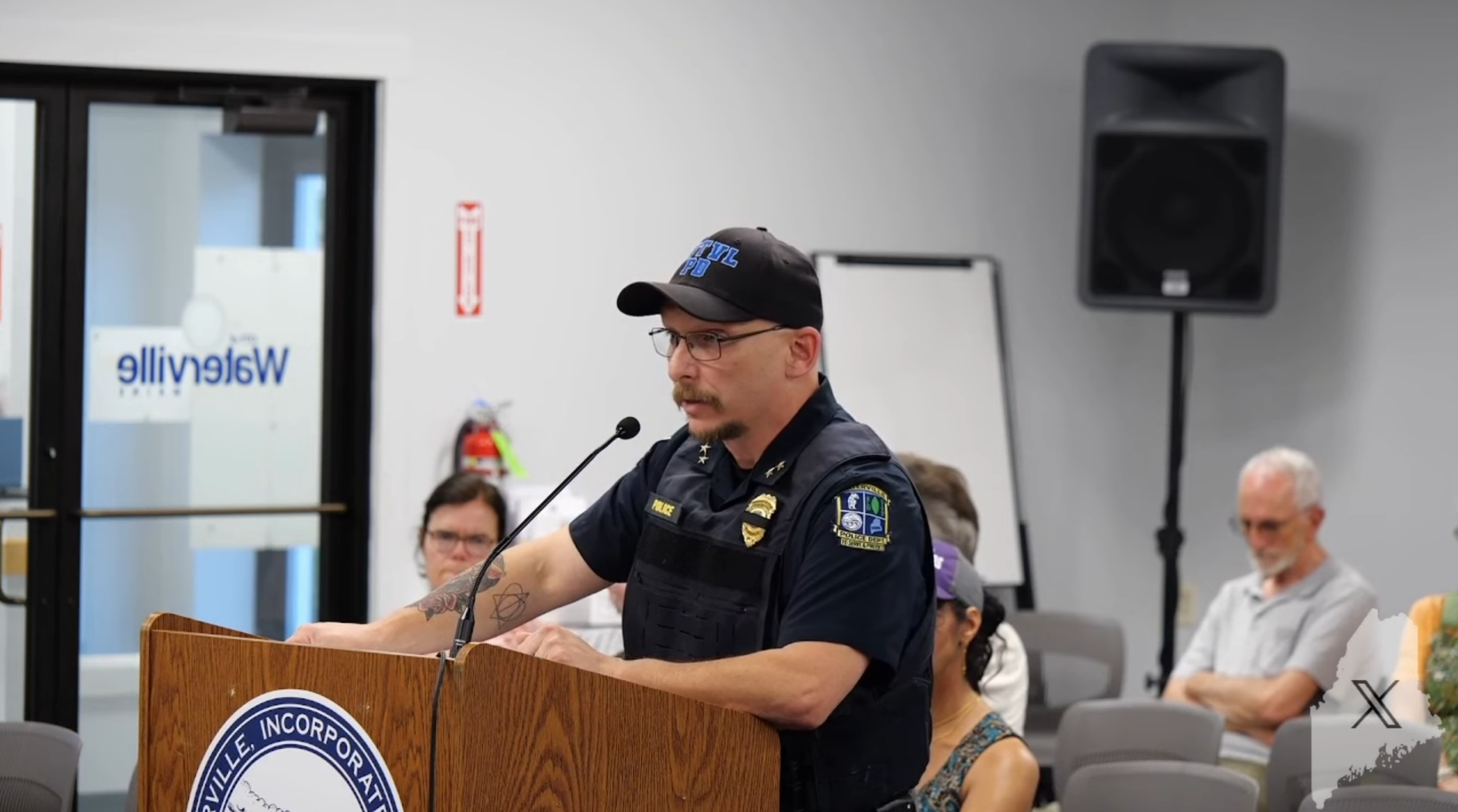
WATERVILLE, Maine – Waterville Police Chief Bill Bonney told The Maine Wire in an interview Tuesday morning that his opposition to a proposed sanctuary city ordinance is rooted in one concern above all others: officer safety.
As the Waterville City Council prepares for a second vote on the ordinance next Tuesday, Bonney said uncertainty surrounding federal funding could have serious consequences for police operations, communications infrastructure, and public safety in the city.
“This is not an us versus them issue,” Bonney said. “My job is the safety of my officers and public safety, and that’s what I’m laser focused on.”
The proposed ordinance comes as communities across Maine continue debating policies related to Immigration and Customs Enforcement cooperation, following similar controversies in Portland and Lewiston.
Bonney said his primary concern is that adopting a sanctuary-style policy could put federal funding at risk under President Donald Trump’s Executive Orders 14159 and 14287, which address federal funding for jurisdictions with sanctuary policies.
“That is my understanding, and that is my concern,” Bonney said. “No attorney has been able to tell me there is a zero percent chance that we’ll lose funding if the city adopts a sanctuary policy.”
Although portions of the executive orders are currently facing court injunctions, Bonney said the unresolved legal fight leaves Waterville in an uncertain position.
“The courts have said Congress appropriates the money, not the president,” Bonney said. “But that becomes a question as it works its way through the court system, who wins that? I don’t know the answer to that. That’s why I’m concerned.”
The chief said he has asked city officials not to support the ordinance, warning that the issue may take a long time to be resolved in court.
Bonney also pointed to LD 1971, saying Maine law already limits certain communications between law enforcement agencies. He said further restrictions could negatively affect officer safety.
“Federal, state, and local law enforcement got much better at communicating with each other, and that’s a good thing,” Bonney said. “I hate to see that erode.”
Bonney said the department depends on federal grant funding to help support operations and purchase equipment. Over the past five years, Waterville Police have received roughly $66,000 in federal JAG grant funding.
While that figure may not appear large compared to the city’s overall budget, Bonney said every dollar matters in a department where most spending is tied to personnel.
“Our budget this year is $6.1 million, and traditionally it’s around 91 percent labor,” Bonney said. “There’s not a lot of fat in our budget.”
The chief said grant funding often helps the department purchase equipment such as radios, laptops, and other tools officers rely on in the field.
“When you have a very small operating budget like we do, any little bit helps,” he said.
Bonney identified communications as one of the department’s most pressing officer safety issues. He said Waterville has spent years trying to address communications problems through smaller grants and equipment upgrades.
“Our biggest priority in the last several years has been working on this communications issue,” Bonney said. “That is probably the biggest officer safety issue that I have right now.”
The department has previously secured grant funding for new portable radios, but Bonney said losing access to federal funding streams could make it harder to continue addressing those needs.
“Oftentimes with the JAG grant, we will buy police equipment,” Bonney said. “That could be laptops, radios, anything that helps officers stay safe on the street.”
Bonney said the city also receives other forms of federal funding beyond the police department, and he is concerned that the ordinance could have broader consequences for Waterville operations.
The debate is unfolding during budget season, with the new fiscal year set to begin July 1. City officials are expected to finalize the budget in the coming weeks.
Bonney said he plans to attend next Tuesday’s meeting but does not expect to speak unless councilors ask him questions.
“At this point, I don’t think there’s anything more I can say,” Bonney said. “I’ve said what I had to say.”
Despite the political intensity surrounding the issue, Bonney emphasized that he is not attacking the mayor, the council, or supporters of the ordinance.
“For me, this is about officer safety and public safety,” Bonney said.
He said the department has had some ICE presence in Waterville, though not a large amount, and said the ordinance has become a recent focus after previous discussions on the issue.
Bonney said he has received positive feedback from members of the community since the debate gained broader public attention, but he stressed that he does not view the matter as a fight between police and city officials.
“I want to make Waterville a safe place to live, work, and play,” Bonney said.
Still, the chief acknowledged the difficulty of speaking publicly on a complex and politically charged issue.
“When we have these hard, complex issues, I just go up and try to say what I think is the right thing,” Bonney said. “I can go home and sleep at night when I do that.”



Too bad Democrats don’t understand common sense or upholding the law