

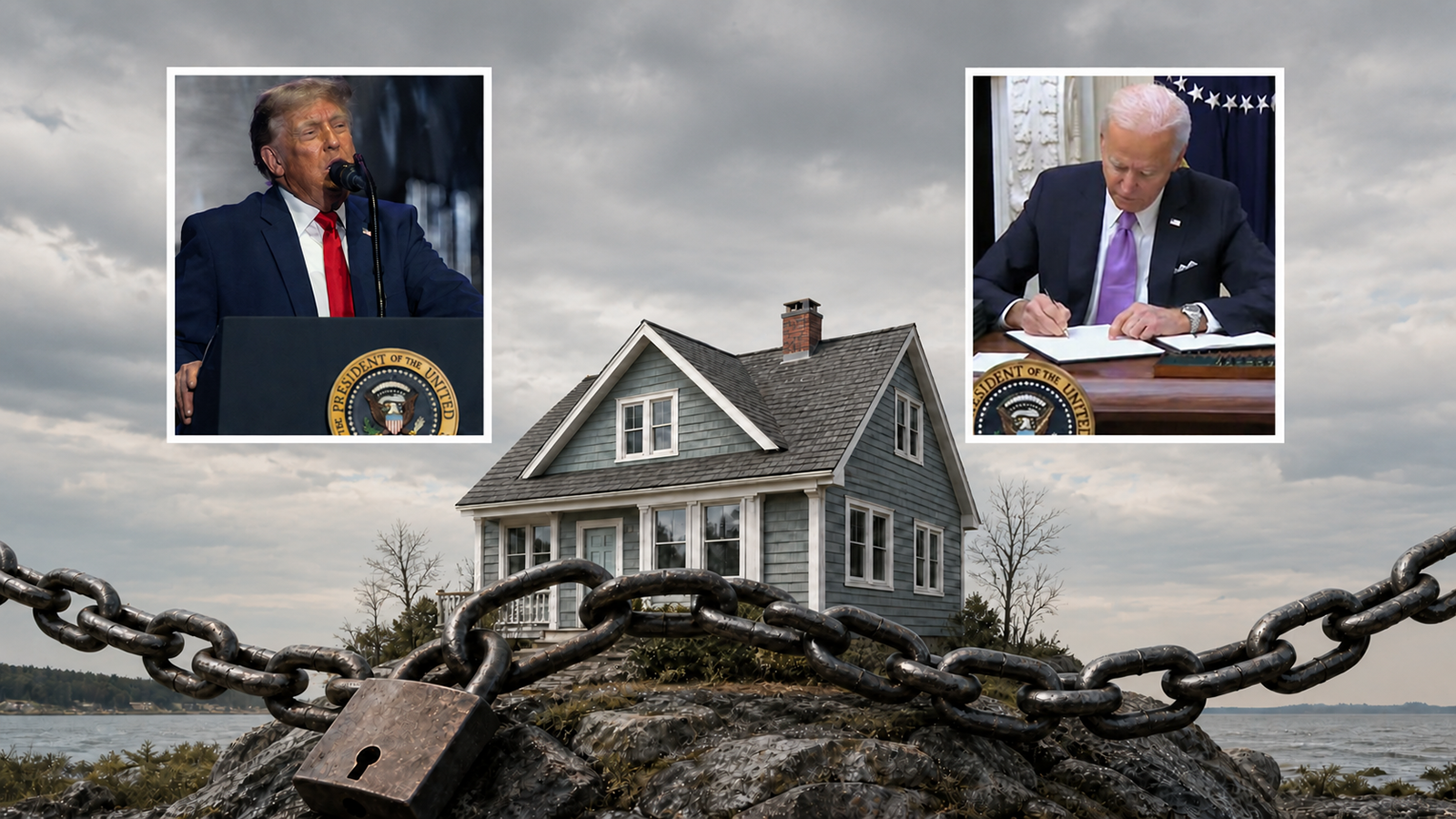
Maine – For years, Maine families have watched the cost of buying a home move further out of reach.
Home prices have climbed to record levels. Rents have surged. First-time homebuyers increasingly find themselves competing against dozens of other buyers for a shrinking inventory of available homes, while renters face historically low vacancy rates and rapidly increasing monthly costs.
Those increases coincided with one of the largest immigration surges in modern American history.
Between 2022 and 2024, the Biden administration dramatically expanded several immigration pathways, including the CHNV humanitarian parole program, which allowed more than 530,000 Cubans, Haitians, Nicaraguans and Venezuelans to enter the United States legally under executive parole authority.
At the same time, the administration continued Temporary Protected Status (TPS) for hundreds of thousands of foreign nationals already living in the United States.
The timing has fueled an increasingly heated national debate.
While economists generally agree that years of underbuilding, inflation, higher interest rates and rising construction costs remain the primary drivers of America’s housing shortage, a growing body of research suggests the rapid increase in population also placed additional pressure on an already strained housing market.
Now, with President Donald Trump moving to terminate the CHNV parole program and the U.S. Supreme Court allowing his administration to end TPS protections for certain groups, policymakers are asking whether reduced immigration could eventually ease pressure on housing or whether it will create new workforce shortages in states like Maine.
Maine’s Housing Crisis Predates the Immigration Surge
Maine’s housing shortage did not begin with the Biden administration.
For more than a decade, the state has struggled to build enough homes to meet demand.
According to MaineHousing, limited inventory, rising land prices, higher construction costs, labor shortages and increasing mortgage rates have all contributed to today’s affordability crisis. The agency continues to identify increasing housing production as the state’s long-term solution.
But while housing supply remained constrained, demand continued to grow.
Since 2021, Maine’s median home price has increased dramatically, while rents across much of southern and coastal Maine reached record highs. HUD estimates that the income needed to purchase a median-priced home in Maine has risen far faster than household incomes, placing homeownership beyond the reach of many working families.
The CHNV Program
One of the Biden administration’s most significant immigration initiatives was the CHNVhumanitarian parole program.
Created under the executive branch’s humanitarian parole authority, the program initially applied to Venezuelans before expanding in January 2023 to include Cubans, Haitians and Nicaraguans.
Applicants were required to have a financial sponsor in the United States, pass security and background screening, and travel directly into the country after approval. They were generally granted two years of humanitarian parole and became eligible to apply for work authorization.
More than 530,000 migrants entered the United States through the program before the Trump administration announced it was terminating CHNV and ending related work authorization.
The CHNV program is distinct from both TPS and the H-2B visa program.
TPS protects certain foreign nationals already in the United States from deportation because of dangerous conditions in their home countries.
H-2B visas are legal seasonal work visas used extensively by Maine businesses in tourism, hospitality, landscaping and seafood processing.
Immigration and Housing Demand
The central question is whether rapid immigration added measurable pressure to an already constrained housing market.
Recent research suggests it did.
A 2026 working paper by economists at the Federal Reserve Banks of Dallas and San Francisco concluded that the large increase in unauthorized immigration between 2021 and 2024 increased housing demand in many local markets while producing little measurable increase in housing supply.
The researchers estimated those population increases contributed to higher home prices and rents in affected communities.
The study did not conclude that immigration caused the nation’s housing crisis. Rather, it found that increased population growth placed additional demand on markets where housing was already in short supply.
That distinction is important.
Housing economists continue to identify years of underbuilding as the primary structural cause of America’s housing shortage. However, in markets where too few homes already existed, additional population growth increased competition for available housing.
For Maine families trying to buy their first home or secure an affordable apartment, that additional competition occurred during the same period home prices and rents reached historic highs.
Trump Administration Reverses Course
Since returning to office, President Trump has moved quickly to reverse many of the Biden administration’s immigration policies.
The Department of Homeland Security announced it was terminating the CHNV parole program, ending work authorization for many participants and encouraging parolees to voluntarily depart the country.
The administration argues that humanitarian parole was intended for exceptional individual circumstances, not broad population-based programs involving hundreds of thousands of migrants.
Administration officials have also argued that reducing illegal immigration and limiting temporary immigration programs will relieve pressure on housing markets, schools, healthcare systems and taxpayer-funded public services.
Supreme Court Clears Path to End TPS
The debate shifted again after the U.S. Supreme Court ruled that the Trump administration could proceed with terminating Temporary Protected Status for certain groups while litigation continues.
TPS allows eligible foreign nationals from designated countries to live and work legally in the United States when conditions in their home countries make return unsafe.
If those protections expire and recipients do not obtain another lawful immigration status, many could lose work authorization and eventually become subject to removal proceedings.
For housing markets, the economic theory is straightforward: if fewer households are competing for the same number of homes and apartments, demand may ease over time.
Whether that translates into meaningful reductions in home prices or rents remains uncertain and will depend on local housing supply, economic conditions and how many people ultimately leave the country.
For Maine, where the TPS population is relatively small compared with larger states, any direct housing impact is expected to be modest.
A Different Challenge: Home Health Care
While reducing housing demand may provide some relief over time, Maine could also face another challenge.
The state has one of the oldest populations in the country and already struggles to recruit enough home health aides, certified nursing assistants, personal support specialists and direct care workers.
Immigrant workers have become an important part of the healthcare workforce in many communities.
If TPS recipients, CHNV parolees or other legally authorized immigrant workers lose work authorization, home care agencies could face additional staffing shortages.
That could translate into longer waitlists for elderly Mainers seeking in-home care, fewer available caregivers and additional pressure on nursing homes and hospitals already operating with workforce shortages.
At the same time, supporters of stricter immigration enforcement argue that immigration policy should not be driven primarily by workforce shortages and that employers should focus on recruiting, training and paying American workers.
The debate highlights the competing challenges facing policymakers: reducing demand for scarce housing while maintaining an adequate workforce in critical industries.
A Policy Debate with Long-Term Consequences
Housing affordability has become one of the defining economic issues facing Maine.
Republicans generally argue that immigration policy should be considered alongside housing policy, contending that slowing population growth can reduce pressure on limited housing inventory while allowing infrastructure and new construction to catch up.
Democrats generally argue that expanding housing production, encouraging new development and increasing affordable housing investments remain the most effective long-term solutions.
The available evidence suggests both supply and demand matters.
Years of underbuilding created Maine’s housing shortage. Rising construction costs and higher interest rates worsened it. Recent economic research also indicates that rapid immigration increased demand in housing markets that were already struggling to keep pace.
Whether the Trump administration’s efforts to end the CHNV parole program and terminate TPS protections ultimately produce measurable improvements in housing affordability remains to be seen.
What is clear is that federal immigration policy is now playing a larger role in conversations about Maine’s housing market than at any point in recent memory. As policymakers weigh housing affordability against workforce needs, the effects of those decisions will likely shape Maine’s economy and the lives of thousands of Maine families, for years to come.


At least the Cubans will probably vote for conservatives.
This state defines The Island of Misfit Toys. I feel all of this, with the exception of elder care, could all have been avoided. Maine put all its eggs in one basket, a basket where 3 maybe 4 months a year are profitable for very few. The basket is labeled, “Vacation land”.
Had the cities in this state fought hard for business to move in after failing mills due to Dems exporting all the jobs it would have been a lot different up here. 12 months of prosperity state wide instead of 3 to 4. This vacation land model has run its course and left a path of desperate miserable dependent on government workers and slackers in its path. It’s to late now Maine. Your dark blue and environmental wakos now run all facets of your state. Your circling the drain and no plumber will be able to fix this clog.
The article left out the fact that native born Taxpayers are being taxed to provide housing for Democrat imported illegal alien savages.
You cannot expect that cannot define what a woman is to define the word temporary.
Send them all back, with all the training and education the taxpayers have provided them they will make their own countries great
Immigrants are not the reason for housing crisis.