

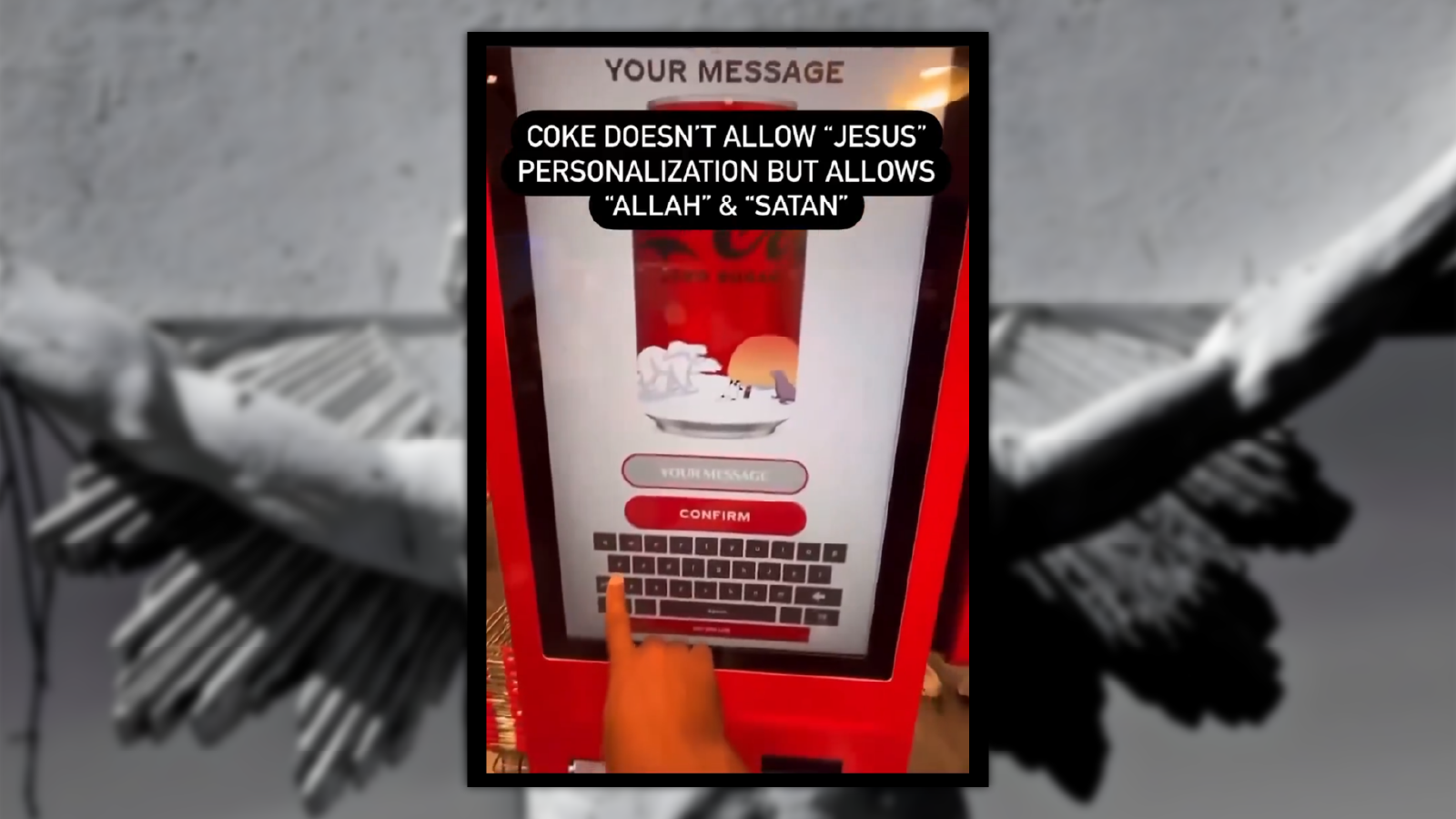
“Jesus Is King” was rejected while “Allah Is King” and even “Satan Is King” were reportedly allowed to advance through Coca-Cola’s personalization system, according to a viral video that has ignited accusations of anti-Christian bias against the beverage giant.
Is Coca-Cola anti-Jesus?
It is a provocative question, but one the beverage giant is now being forced to confront after its personalized “Share a Coke” program became the center of a growing controversy over what customers can — and cannot — put on a Coke can.
A video reviewed by The Maine Wire appears to demonstrate dramatically different results depending on which religious phrase a customer enters into Coca-Cola’s online customization system.
In the demonstration, “Jesus Is King” is rejected by the system.
But “Allah Is King” is reportedly permitted to advance to the company’s review process.
So is “Satan Is King.”
The system reportedly also rejected other explicitly Christian references, including “Holy Trinity,” “Virgin Mary” and “Holy Spirit.”
Perhaps even more striking, testing reported by The Daily Wire found that the system would generate previews containing “Jesus is bad” and “Jesus is evil,” while rejecting positive Christian references.
The results have sparked a backlash among Christians and conservatives who are questioning why a company that built an advertising campaign around personal expression apparently created a system capable of rejecting affirmations of Christianity while allowing derogatory references to Jesus to pass through.
The controversy centers on Coca-Cola’s “Share a Coke” campaign, which allows customers to personalize Coke products with names and short messages.
Coca-Cola has described the campaign as a way for consumers to make connections and create personalized keepsakes. The company brought the iconic campaign back for a new generation in 2025, saying it wanted customers to use personalized cans and bottles as a way of connecting with friends, family and their communities.
But Coca-Cola’s automated moderation system determines which messages customers are allowed to submit.
And that is where things became complicated.
Independent Testing Finds More Inconsistencies
The viral video is not the only evidence raising questions about Coca-Cola’s filtering system.
A separate Fox News Digital investigation published this weekend tested a wide range of religious, political and social phrases on Coca-Cola’s personalization platform and found significant inconsistencies.
That testing found that “Jesus is Lord” was prohibited.
“Allah is Lord” was also prohibited.
But “God is Dead” and “Atheist Pride” were permitted.
The religious greetings or expressions “Shalom” and “Buddha Bless” were also reportedly accepted.
When Coca-Cola’s system rejected a submission, customers were informed that names and phrases could be prohibited for several reasons, including if they were religious or political in nature.
That explanation raises an obvious question.
If religion itself is the problem, why were some religious expressions apparently permitted while others were prohibited?
And if Coca-Cola’s system was designed to protect religious sensitivities, why could an anti-religious statement such as “God is Dead” make it through while “Jesus is Lord” could not?
The inconsistencies extended far beyond religion.
Fox’s testing found that “Make America Great” was blocked, as were the names of political leaders and various racial or identity-based pride messages.
“Defund the Police,” however, was reportedly permitted.
“Stand with Israel” passed the filter while “Free Palestine” was blocked.
More disturbingly, investigators reported that the customization system allowed phrases associated with pedophilia and that rudimentary changes involving spaces or numbers could circumvent some of the platform’s restrictions.
The system was apparently not simply controversial.
It was inconsistent.
Coca-Cola Responds
Coca-Cola has now acknowledged there was a problem.
A company spokesperson said Coca-Cola created the personalization feature so customers could celebrate connections with one another but acknowledged a “technical issue” affecting the preview tool.
The company said it disabled the preview feature and paused new personalized product orders while it reviews the problem and takes corrective action.
That response is important because the evidence does not establish that Coca-Cola executives deliberately instructed programmers to discriminate against Christians.
Nor does the available evidence prove that Coca-Cola, as a corporation, is “anti-Jesus.”
There is also important historical context.
In 2024, Reuters investigated a similar viral allegation claiming Coca-Cola allowed “Allah” but prohibited “Jesus.” Reuters independently tested the customization tool at the time and found both religious names were prohibited.
Coca-Cola told Reuters then that its rules prohibited religious, political, trademarked and celebrity names from customized products.
That makes the newest results even more curious.
Whatever Coca-Cola intended its rules to accomplish, the latest testing suggests its automated system was not applying them consistently.
A Technical Glitch — Or Something More?
That leaves Coca-Cola with questions that cannot simply be dismissed by pointing to an algorithm.
Algorithms do not write their own corporate policies.
Someone establishes the rules they are expected to enforce.
Someone decides what categories of speech should be restricted.
And when a system rejects “Jesus Is King” while reportedly allowing “Satan Is King” to advance, Christians are understandably going to ask why.
Coca-Cola may ultimately demonstrate that the entire controversy resulted from poorly designed automated moderation rather than religious hostility.
The company’s decision to disable the feature and pause personalized orders suggests it recognizes something went seriously wrong.
But the controversy also highlights a larger problem facing major American corporations that increasingly rely on automated systems to decide which expressions are acceptable and which are forbidden.
When those systems begin making distinctions involving religion, politics and deeply held beliefs, a “technical issue” can quickly become something much bigger.
Coca-Cola’s own history makes the episode particularly ironic.
The “Share a Coke” campaign was built around an extraordinarily simple idea: put something personal on a Coke and share it with someone who matters.
For millions of Christians, few names could possibly be more personal than Jesus.
Yet for at least some customers attempting to use Coca-Cola’s own personalization system, that was apparently the name the computer didn’t want on the can.
So, is Coke anti-Jesus?
The evidence does not establish that.
But when “Jesus Is King” gets rejected while “Satan Is King” reportedly gets through, Coca-Cola should not be surprised that its customers are asking the question.



Its very simple Vote with your Wallet stop buying the product.This works everytime.
TrannyLite part Deux…..
Coke is about to experience its very own “ bud light “ moment .
Good . Serves them right .
Sam’s Club is HALF the price and better tasting anyway .
But, Allah IS Satan