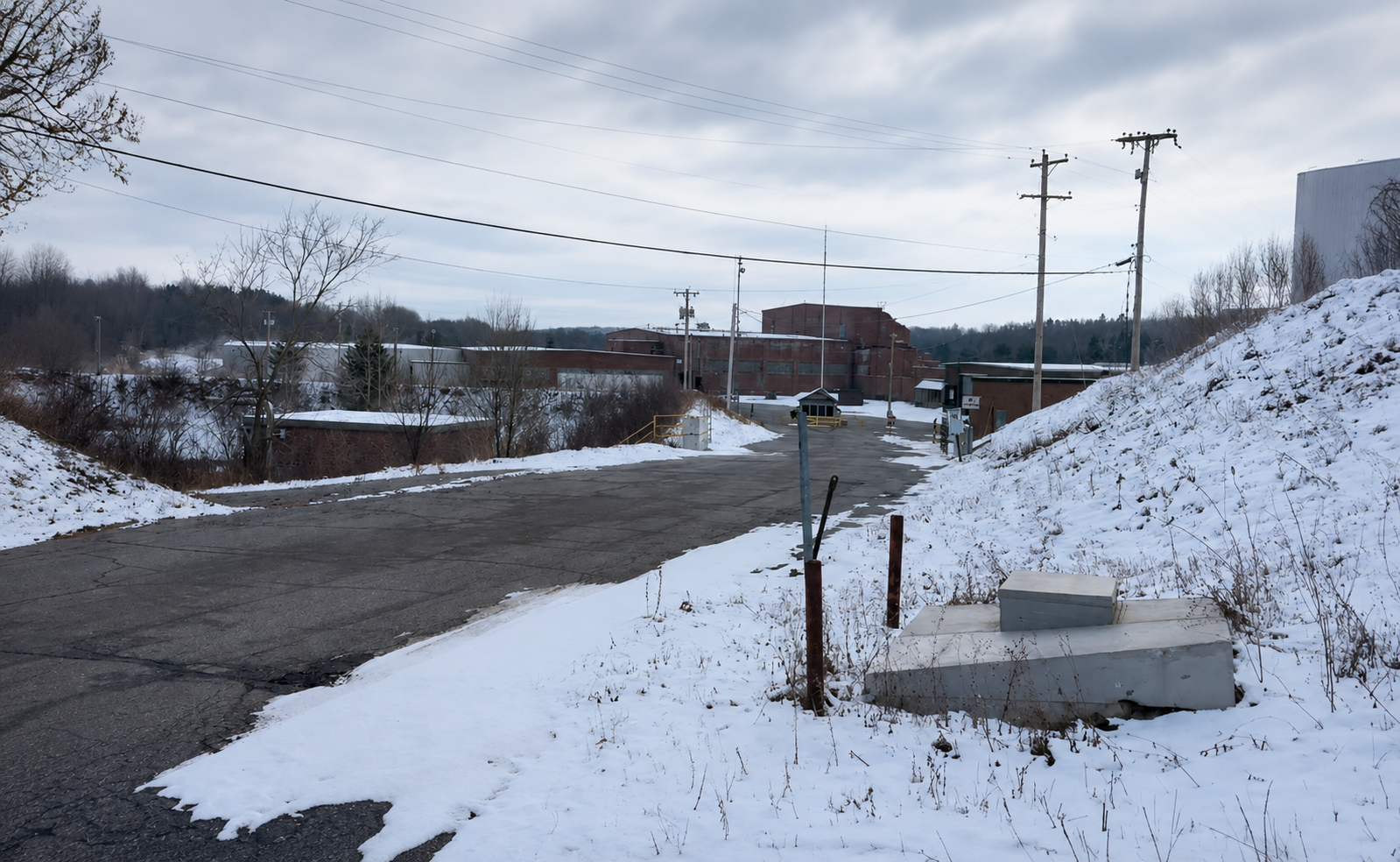
For years, the sprawling former Great Northern Paper mill site in Millinocket has represented something increasingly rare in rural Maine: the possibility of bringing large-scale industry, and good-paying jobs, back to a community that lost thousands of them.
Now one of the site’s most ambitious redevelopment projects has been put on hold, and the reason reaches far beyond Millinocket.
Great Northern Salmon has paused plans for a roughly $300 million land-based Atlantic salmon farm at the 1,400-acre One North industrial site, citing uncertainty surrounding President Donald Trump’s escalating trade dispute with Canada and the cost of imported equipment needed to build the facility.
The decision offers perhaps the clearest Maine example yet of the economic stakes surrounding Washington’s latest tariff fight.
The company had already secured its aquaculture license, completed planning and design work, and finished roughly 80 percent of initial site preparation, according to CEO Marianne Naess. Engineering work had been expected to begin this fall, followed by construction next spring.
Instead, the project is stopping.
“But we decided we need to postpone it and see what happens, to ensure we have a more stable and predictable environment,” Naess told Maine Public.
The problem, according to Naess, is not Maine.
It is uncertainty.
Much of the sophisticated equipment required for a recirculating aquaculture system contains steel components and must be imported because the United States does not have a large domestic aquaculture equipment industry.
“This has nothing to do with Maine,” Naess said. “This has everything to do with the more unpredictable environment that we’re in right now.”
For Millinocket, however, the consequences are very much local.
A Project Years in the Making
Great Northern Salmon’s facility was expected to become a major piece of the economic redevelopment of the former Great Northern Paper property.
The proposed operation would use a recirculating aquaculture system to raise Atlantic salmon on land, with fish hatched, grown and ultimately processed at the Millinocket site.
Earlier plans called for approximately 70 to 80 permanent full-time jobs when the facility reached full production, with positions ranging from fish handling and processing to wastewater treatment, maintenance, technical operations and administration.
Construction itself was previously projected to employ approximately 100 to 120 workers.
The facility was eventually expected to produce about 7,500 metric tons of salmon annually.
Those numbers may sound modest compared with Maine’s largest employers, but they carry significantly more weight in a community that spent generations dependent on Great Northern Paper.
At its peak during the 1960s and 1970s, Great Northern employed roughly 4,400 workers. Millinocket’s population climbed above 7,700, and manufacturing wages in town once significantly exceeded the statewide average.
That world disappeared piece by piece.
Large layoffs began in the 1980s. Ownership changed repeatedly. The Millinocket mill ultimately closed permanently in 2008.
The shutdown idled hundreds of workers and left behind an enormous industrial property that has spent much of the past two decades searching for a new economic purpose.
That is what makes the Great Northern Salmon pause more significant than a routine corporate delay.
This was supposed to be part of Millinocket’s comeback.
Public Money Already Invested
The project has also benefited from substantial government-backed economic development efforts.
In 2024, the U.S. Environmental Protection Agency awarded a $5 million grant to Our Katahdin to remediate roughly 26 acres of a former wastewater lagoon and prepare the property for the salmon facility.
That came in addition to $1 million from Maine’s Department of Economic and Community Development for the same effort.
More recently, Great Northern Salmon said it received another $2 million in development funding from the Maine Technology Institute.
The company has also identified the Finance Authority of Maine, Northern Border Regional Commission, Eastern Maine Development Corporation and other public and quasi-public entities as partners in the development effort.
That means at least $8 million in specifically identified EPA, state development and MTI funding has been tied directly to advancing or preparing for the project, separate from millions more spent rebuilding infrastructure across the wider One North industrial property.
One North itself has received extensive investment in roads, electricity, water, wastewater, rail and other infrastructure designed specifically to bring industrial employers back to Millinocket.
The property offers 1,400 acres of developable industrial land, rail access and as much as 126 megawatts of renewable hydroelectric power.
The salmon company was not simply an idea on a drawing board.
Great Northern Salmon announced this year that it had secured a six-year sales agreement with Stavis Seafoods and contracted with Morgan Stanley for capital-raising and advisory services. The company also selected major aquaculture technology and construction partners.
Then the trade environment changed.
Maine’s $1.3 Billion Canadian Connection
The economic stakes become considerably larger when the Millinocket project is viewed against Maine’s dependence on Canadian trade.
According to the Office of the United States Trade Representative, Maine exported approximately $3.2 billion in goods worldwide in 2025.
Canada alone purchased $1.3 billion of them.
That means approximately 41 percent of everything Maine exported went to Canada — making the country, by an enormous margin, Maine’s largest international market.
Maine’s second-largest export market, Malaysia, purchased just $120 million in goods.
Canada bought more than ten times that amount.
Maine exported approximately $2.2 billion in manufactured goods worldwide in 2025, while exports supported an estimated 11,000 Maine jobs in the most recent available federal employment estimate.
The trade relationship also runs in the other direction.
U.S. Sen. Susan Collins said Maine imports approximately $2 billion in non-petroleum products from Canada every year, meaning Maine companies do not simply sell products north of the border, many rely on Canadian materials, machinery and supply chains to operate here.
That distinction is critical in Millinocket.
Great Northern Salmon’s problem is not primarily whether Canadians will buy its fish.
The problem is whether a company can confidently calculate the cost of building a $300 million American manufacturing-style operation when major pieces of its equipment must cross an increasingly uncertain international trade system.
$170 Million in Maine Goods at Risk
Collins on Friday placed another number on Maine’s exposure.
Approximately $170 million worth of Maine goods remain subject to Canada’s announced retaliatory tariffs, she said in a letter to Commerce Secretary Howard Lutnick and U.S. Trade Representative Jamieson Greer.
Roughly 62 percent of those goods come from Maine’s forest products industry, an economic sector that Collins said supports approximately 30,000 jobs and contributes more than $8 billion to the state’s economy.
“Two of Maine’s paper mills, which are the largest employers in their towns, have already contacted me about the crushing increased costs that they will incur and the potential impact on their employment levels,” Collins wrote.
There was one significant piece of good news this week.
Canada removed American seafood and fish products — including lobster — from its planned retaliatory tariff list.
That spared Maine’s lobster industry from what Collins said could have amounted to more than $200 million in tariffs throughout the supply chain.
But the broader dispute remains unresolved.
Collins said even Maine municipalities could feel the effects because many communities purchase Canadian road salt. She cited Frenchville, where local officials are expected to pay roughly $10,000 more for road salt because of the new tariffs.
The Argument for Tariffs
The Trump administration has defended tariffs as a tool to protect American workers, rebuild domestic manufacturing and force trading partners to negotiate more favorable terms with the United States.
That argument has significant appeal in places like Millinocket.
Few Maine communities understand the consequences of losing American manufacturing better.
For generations, Great Northern Paper provided thousands of workers with stable, well-paying jobs. Global competition, changing markets, corporate restructuring, high production costs and repeated ownership changes eventually helped dismantle an industrial economy that once appeared permanent.
Trump’s central argument is that America should make more of what it consumes, rely less on foreign supply chains and use access to the enormous U.S. market as economic leverage.
Rep. Jared Golden, a Democrat who represents Maine’s 2nd Congressional District, has supported Trump’s broader tariff strategy, arguing that Canada has more to lose in a prolonged trade confrontation and that the United States should rebuild its own industrial capacity.
But the Great Northern Salmon situation exposes the difficult part of that transition.
Building American production can itself require foreign equipment.
If the domestic suppliers Trump wants to create do not yet exist, companies trying to build new American facilities can find themselves paying tariffs before an American alternative is available.
In Millinocket, a project intended to manufacture a food product in Maine, employ Maine workers and replace imported salmon is now stalled partly because some of the equipment necessary to create that domestic production must first be imported.
That is the economic paradox playing out at One North.
What Happens Next?
Great Northern Salmon has not abandoned Millinocket.
But it has not established a date for restarting the project either.
Naess said the company and Our Katahdin hope the development can eventually move forward. She also acknowledged that the company cannot indefinitely prevent the industrial site from being offered to another employer if another serious opportunity develops.
That leaves Millinocket waiting once again.
The larger question is whether Great Northern Salmon is an isolated casualty of short-term trade turbulence or an early warning about something much larger.
Maine’s economic relationship with Canada is not peripheral.
It touches paper mills, forest products, agriculture, construction materials, municipal road salt, seafood processors, machinery and manufacturers.
Canada buys 41 percent of Maine’s exported goods.
Maine imports roughly $2 billion in non-petroleum Canadian products each year.
Approximately $170 million in Maine goods could be caught in Canada’s retaliatory tariffs.
And now a $300 million project designed to put dozens of people back to work on the grounds of one of Maine’s most famous fallen industrial giants is on hold.
For Washington, tariffs are part of a global economic strategy.
For Millinocket, the debate is considerably less theoretical.
It can be measured in construction equipment that is not arriving, jobs that are not yet being created and a former paper mill site still waiting for its next industrial chapter.