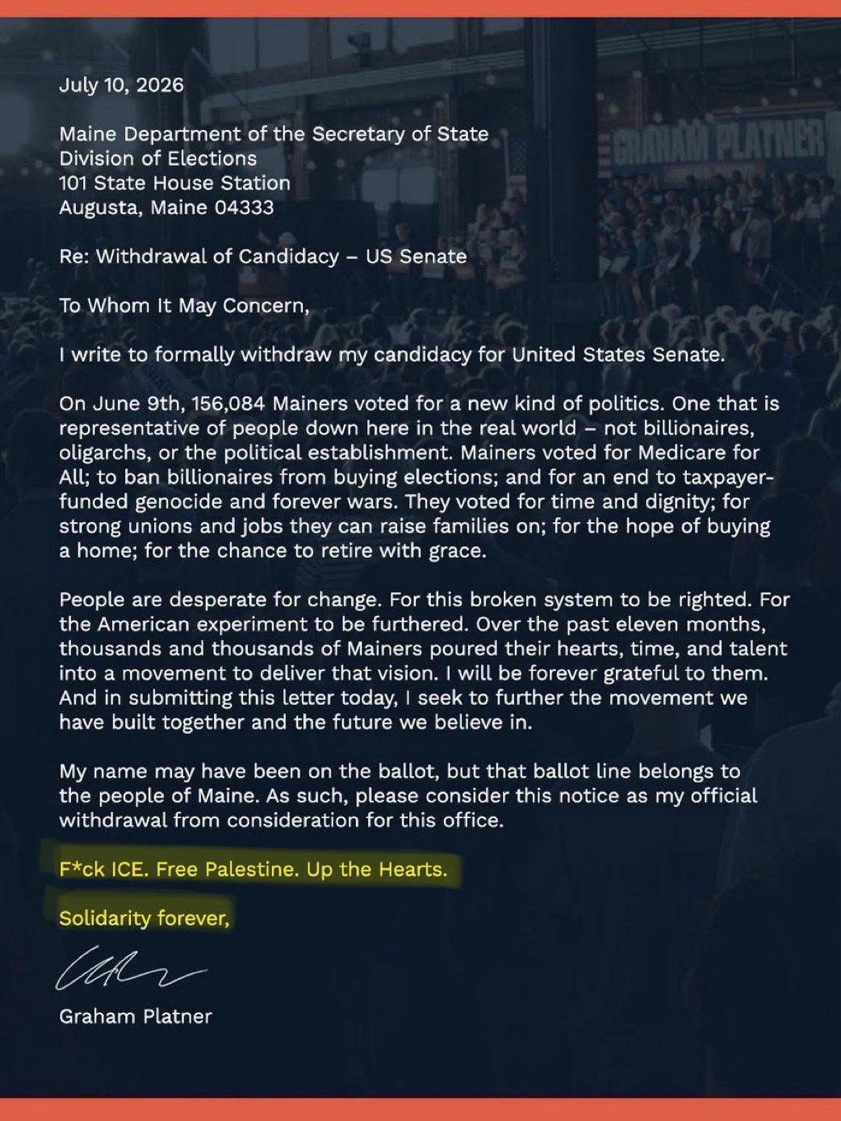
AUGUSTA, Maine — Democratic U.S. Senate nominee Graham Platner officially withdrew his candidacy Friday afternoon, submitting a formal letter to the Maine Department of the Secretary of State ending a campaign that collapsed after multiple allegations of sexual misconduct led to a mass exodus of political support.
The withdrawal, dated July 10, formally removes Platner from consideration for the office and clears the way for the Maine Democratic Party to begin selecting a replacement nominee through its recently announced convention process.
In his letter, Platner reflected on the June Democratic primary, noting that 156,084 Mainers voted for his campaign and arguing those votes represented support for his political agenda rather than his candidacy alone.
“On June 9th, 156,084 Mainers voted for a new kind of politics,” Platner wrote, describing a platform centered on Medicare for All, organized labor, affordable housing, campaign finance reform, and opposition to what he called “forever wars.”
Platner thanked supporters who spent months building his campaign, writing that “thousands and thousands of Mainers poured their hearts, time, and talent into a movement.”
“My name may have been on the ballot, but that ballot line belongs to the people of Maine,” he wrote in closing.
The letter ended with the politically charged sign-off:
“F*ck ICE. Free Palestine. Up the Hearts.”
The filing comes after more than a week of mounting political pressure following public allegations of sexual assault and sexual misconduct made by former partners. Platner has repeatedly denied the allegations.
His campaign quickly unraveled as prominent Democratic leaders, including U.S. Sens. Bernie Sanders, Elizabeth Warren, and Chuck Schumer, withdrew their endorsements. The Democratic Senatorial Campaign Committee also signaled it would not invest in the race unless Platner stepped aside.
The official withdrawal now shifts the focus entirely to the Maine Democratic Party, which has adopted rules allowing a convention of party delegates to choose a replacement nominee before the statutory deadline for certifying the November ballot.
The process has already generated controversy. Critics argue that although more than 156,000 voters selected Platner in the Democratic primary, including many unenrolled voters who chose to participate in the Democratic contest, the replacement nominee will now be selected by a relatively small group of party delegates rather than through another statewide election.
With Platner’s withdrawal now official, attention is expected to turn quickly to the growing list of Democrats considering bids for the nomination as the party works to preserve one of its highest-profile races heading into November.