
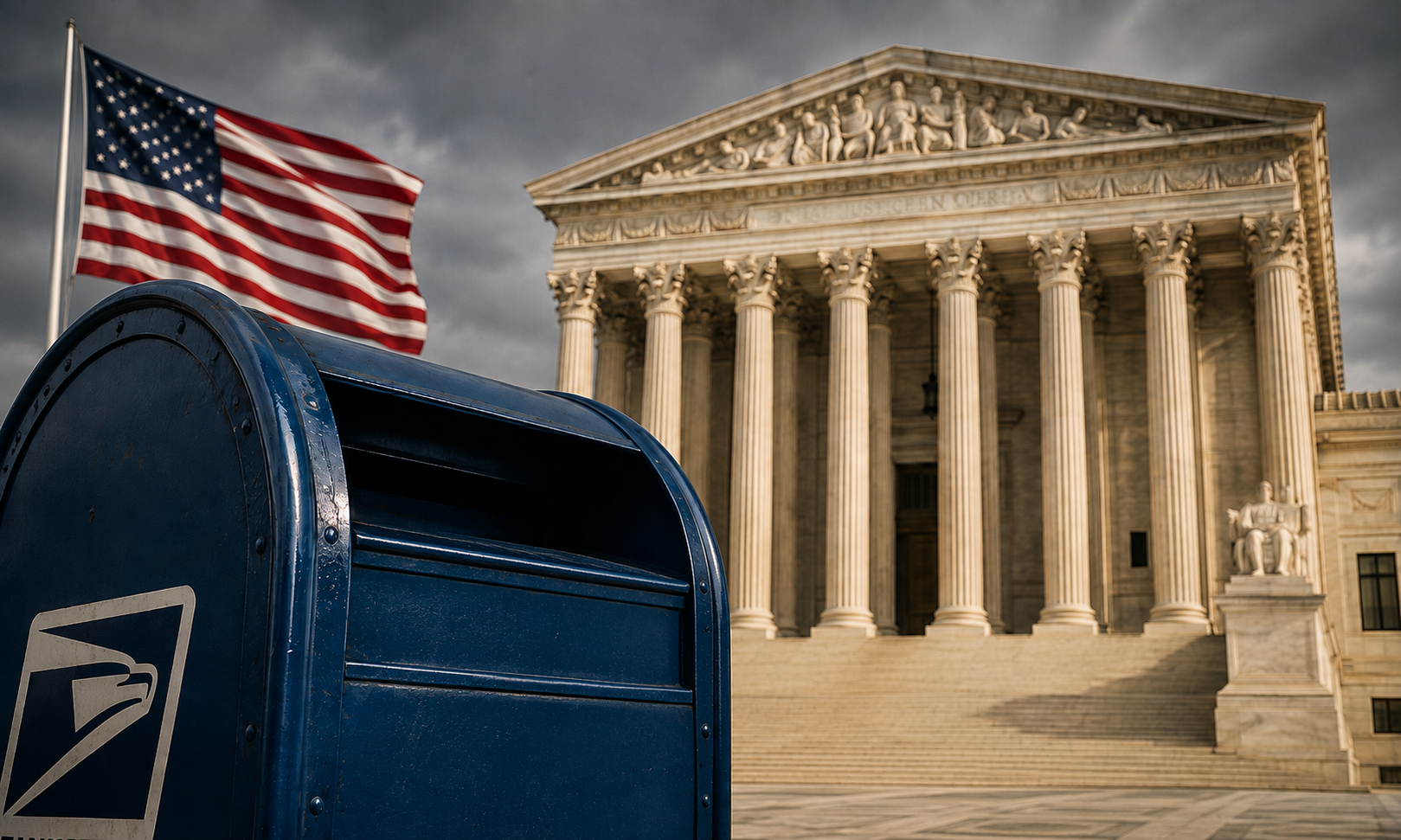
The United States Supreme Court issued an order Monday clearing the way for the federal government to begin implementing parts of an executive order intended to tighten mail-in voting procedures ahead of the midterms.
But with Election Day fast approaching, it is unclear how many of its provisions could reasonably be implemented before voters begin casting ballots.
This order does not, however, mean that the executive order can be enacted in its entirety.
According to CNBC, an injunction issued earlier this month in a case brought by a voting rights group will prevent the Postal Service from implementing the parts of the order related to its operations for the upcoming November elections.
Although Monday’s ruling is a victory for the administration, the Court did not rule on the order’s legality itself. Instead, the Justices found that it was too early for a challenge to be brought because the order simply tells federal agencies to develop policies and does not directly impose them on the states.
In other words, the Justices found the states had not yet suffered the concrete injury required to bring this kind of challenge.
“The Court’s disposition of this application does not mean that any measure taken by the Government to implement the Order will necessarily be lawful,” the majority wrote. “On that score, time will tell.”
This order comes after the federal government filed an emergency appeal in July, asking the Justices to lift the block on President Donald Trump’s executive order to strengthen mail-in voting procedures.
Under this order, the Department of Homeland Security was directed to compile state-specific citizenship lists to verify voter eligibility.
It also directs the U.S. Postal Service to develop procedures for delivering mail-in ballots, including limiting their distribution to voters on state mail-in voting lists derived from those federal records.
[RELATED: Trump Administration Asks Supreme Court to Revive Mail-In Voting Order Ahead of Midterms]
A coalition of 23 Democratic-led states and the District of Columbia challenged the order earlier this year, arguing the Constitution delegates election administration to the states and Congress, not the executive branch.
In June, U.S. District Judge Indira Talwani ruled that, at this stage, the states had grounds to challenge the directive and blocked enforcement of most of the order, rejecting the federal government’s argument that the challengers’ claims were not yet “ripe,” or ready for review.
Last month, the First U.S. Circuit Court of Appeals denied the administration’s request to lift the injunction, concluding the states had “no practical choice but to respond to the [executive order] now.”
In an unsigned order Monday, the Supreme Court stayed the injunction, as a majority of the Justices agreed with the federal government’s argument that the challengers likely lacked standing and that the government would suffer irreparable harm if the injunction remained in effect while litigation continued.
The majority described the part of the order related to the Department of Homeland Security as “an internal directive from the President to a subordinate” that does not involve the states, so the provision cannot harm them.
Similarly, regarding the portions involving the U.S. Postal Service, the majority argued that Talwani’s “conclusion that this internal directive inflicts” the injury required for the states to sue “necessarily rests on an ‘attenuated chain of inferences.’”
Justices Sonia Sotomayor, Elena Kagan, and Ketanji Brown Jackson dissented. Justice Kagan joined Justice Sotomayor’s brief dissent, but Justice Jackson wrote a lengthy dissent of her own.
While Sotomayor and Kagan argued that the Court’s decision “merely postpones adjudication of those challenges,” Jackson contended the ruling “violates well-established precedents concerning this Court’s equitable discretion and needlessly injects chaos and uncertainty into the upcoming midterm elections.”
According to the Associated Press, neither the Postal Service nor the White House responded to requests for comment.