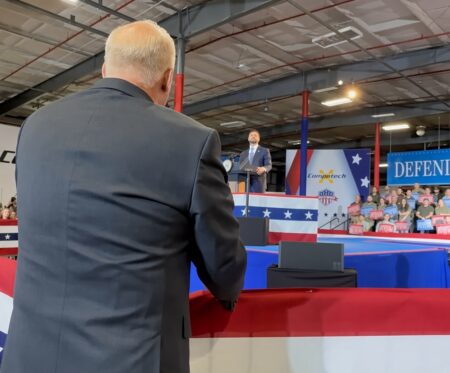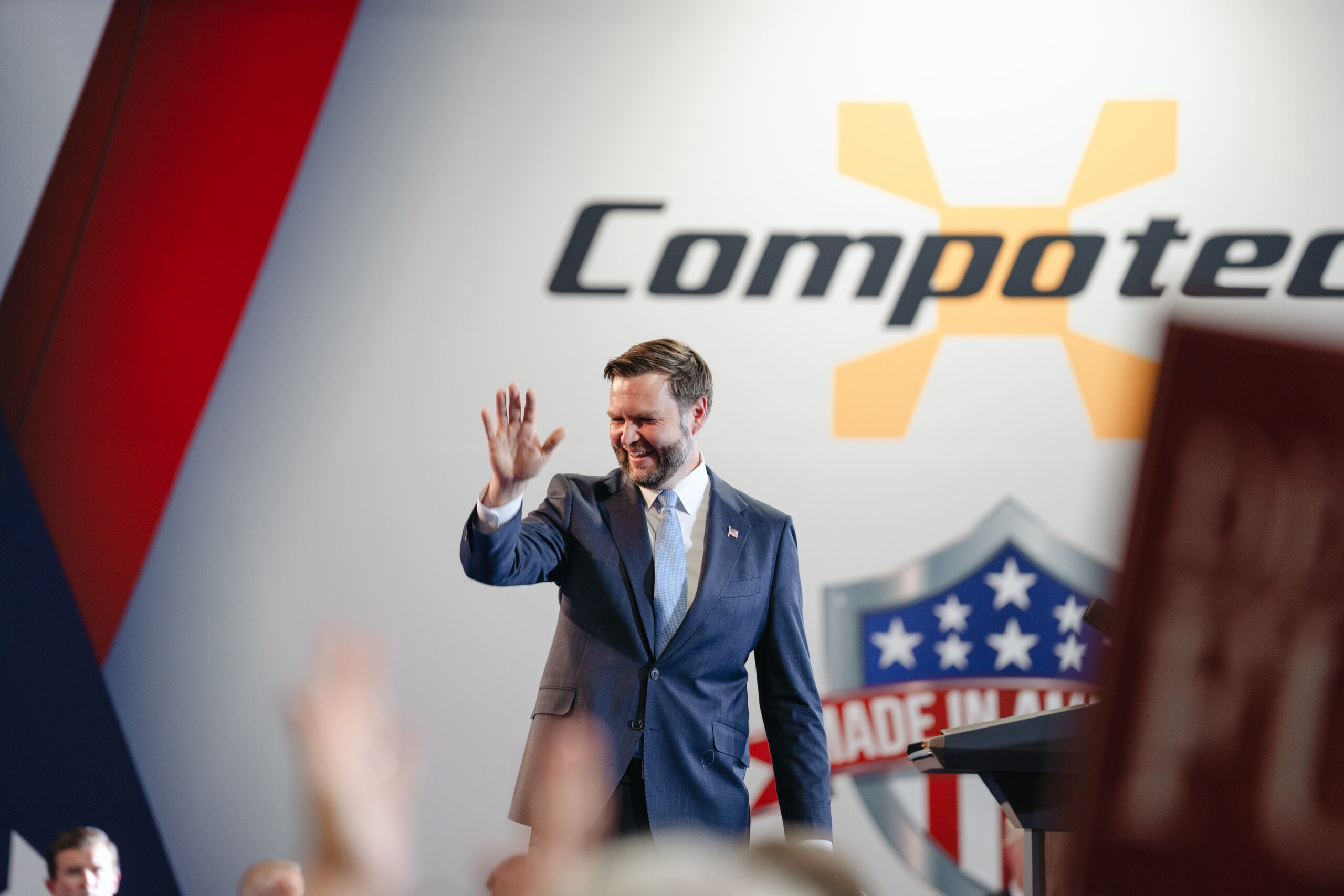
BREWER, Maine — Vice President JD Vance returned to Maine on Monday with a message that blended manufacturing, border security and the Trump administration’s economic agenda with an increasingly aggressive warning over alleged fraud involving taxpayer-funded programs in the state.
Speaking from the floor of CompoTech in Brewer, Vance repeatedly praised former Gov. Paul LePage, who is running for Congress in Maine’s 2nd Congressional District, while accusing Maine’s Democratic leadership of failing to adequately confront fraud.
The vice president also offered unusually direct comments about the administration’s efforts to work with Gov. Janet Mills and Attorney General Aaron Frey on fraud investigations, saying some officials have been responsive, but that he has little confidence state leaders will fully embrace the federal effort.
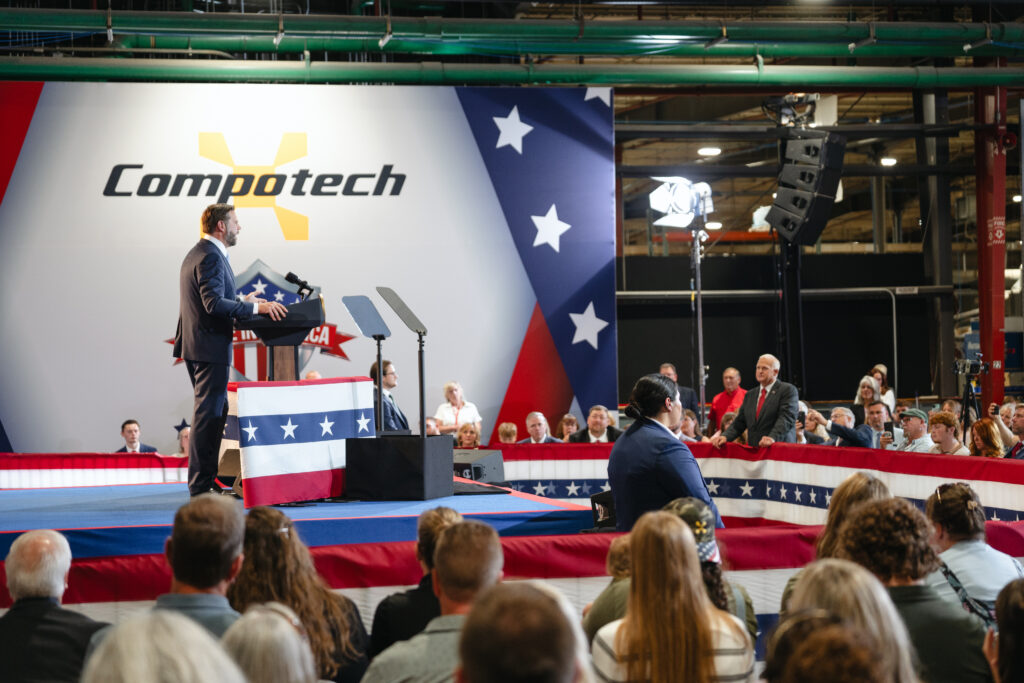
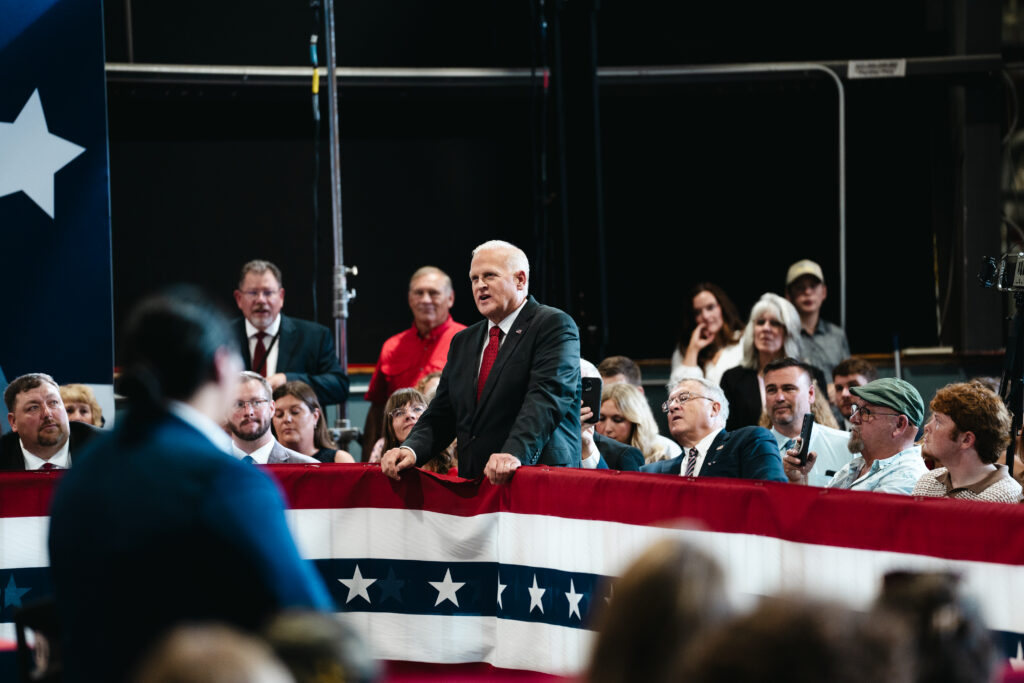
“We’ve reached out to the governor, to the attorney general,” Vance said during a question-and-answer session following his remarks. “We’ve gotten, you know, some people in their office have been responsive, but I hate to say that after a few months of working with these guys, I don’t have a great amount of confidence that they’re going to lean into this anti-fraud effort.”
Vance added that the administration’s offer remains open.
“What I’d say to the governor and the attorney general of the state: We continue to have open arms,” Vance said. “Come and work with us. Fight against the fraud. Fight for your own people. We’d love to work with you.”
The remarks came during Vance’s second visit to the Bangor-area region this year and followed his May trip across the Penobscot River, where fraud involving government programs was also a central focus.
Vance responds to Maine Wire on fraud
During Monday’s press availability, The Maine Wire asked Vance what Mainers should expect in terms of accountability following concerns raised about fraud in taxpayer-funded programs and the recent visit to Maine by Centers for Medicare and Medicaid Services Administrator Dr. Mehmet Oz.
Vance said federal officials are increasing prosecutions and taking a harder line even on cases involving comparatively smaller amounts of money.
“If you look at the number of anti-fraud prosecutions you’ve already seen, we set up a special position within the Department of Justice — an anti-fraud guy within the deputy attorney general, who’s just going after fraud,” Vance said. “That’s his 100 percent day-to-day job, and we’ve massively ramped up the prosecutions.”
Vance said the administration has also rejected what he characterized as a longstanding tendency by the federal government to overlook lower-dollar fraud.
“No fraud is too small,” Vance said. “If you are defrauding the American taxpayer, we’re going to do everything we can to put you in prison and send a message to the other fraudsters: the gig is up.”
Vance singled out health care programs as an area of particular concern, pointing to Medicare and Medicaid as programs intended to serve elderly and low-income Americans rather than fraudulent providers.
“You see people saying that they’re providing health care services, collecting a whole lot of money, but not doing a single bit of health care,” Vance said. “It’s got to stop.”
LePage becomes centerpiece of Vance’s message
LePage was never far from the center of Vance’s remarks.
The vice president portrayed the former two-term governor as an ally in the administration’s effort to combat fraud and repeatedly urged voters to send him to Washington.
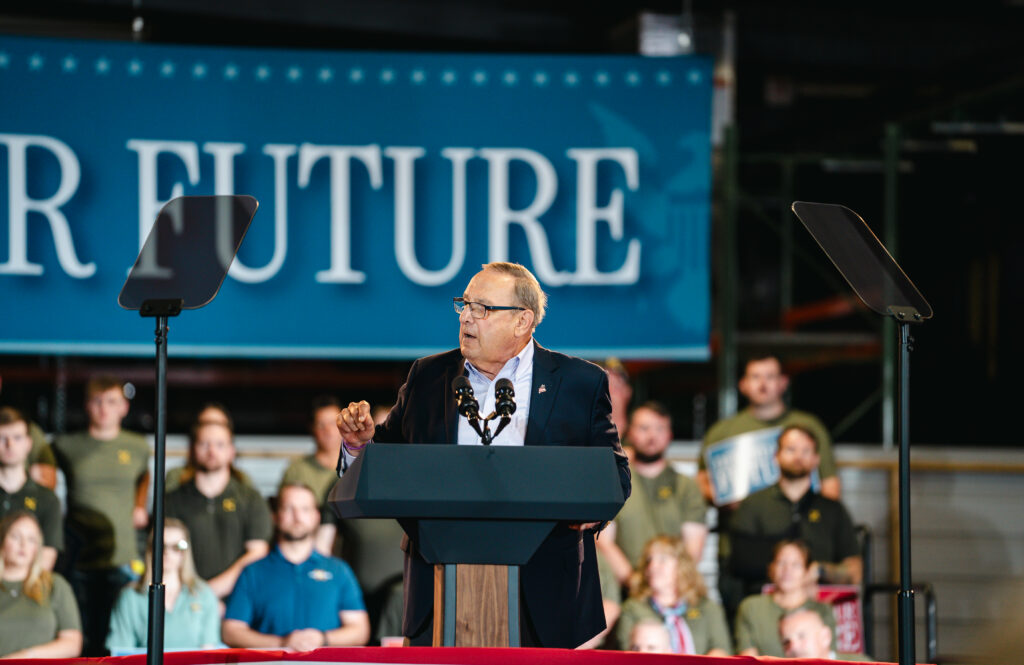
“Paul LePage has been the biggest advocate in state or federal government, anywhere in the state of Maine, at protecting your tax dollars and protecting these programs,” Vance said.
Vance contrasted LePage’s record with Maine’s current leadership, arguing that LePage increased the resources devoted to welfare-fraud investigations while in office.
The vice president also took aim at State Auditor Matt Dunlap, criticizing his qualifications and suggesting that Maine’s handling of fraud should become an issue in the 2026 elections.
Vance ultimately framed LePage’s congressional campaign around a straightforward question: whether Maine voters believe the federal government should prioritize taxpayers and legitimate recipients of public programs over those who exploit them.
“If we’re going to fight for Maine, we’re going to fight for Paul LePage,” Vance said.
Collins gets praise — and some ribbing
Vance also offered extensive praise for Republican U.S. Sen. Susan Collins, joking about the Maine senator’s well-known independence.
“As you know, Susan is the most independent member of the United States Senate,” Vance said. “And as the president of the United States Senate, she sometimes makes my job a little bit harder.”
But Vance said his interactions with Collins have convinced him that her focus remains intensely centered on Maine.
He said Collins has visited the vice president’s residence at the Naval Observatory roughly half a dozen times and described her as relentlessly focused on how federal decisions affect her constituents.
“She’s always asking, ‘What does this do for Maine? How is this good for Maine? How is this bad for Maine?’” Vance said.
“She comes to work every single day and she fights for the great people of Maine.”
Manufacturing takes center stage at CompoTech
Although politics and fraud dominated significant portions of the event, the setting was no accident.
Vance used CompoTech as a backdrop for the Trump administration’s broader argument that federal economic policy should encourage companies to manufacture products in the United States rather than move production overseas.

The Brewer company produces advanced composite structures, including technology with defense applications.
Vance described the company as an example of the kind of domestic manufacturing resurgence the administration wants to encourage.
“This is exactly what I love to see in states like Maine,” Vance said. “We want companies that buy American, that hire American and that invest in American communities.”
Vance said the facility itself represented the economic changes that have taken place in the region.
He recalled that a previous employer at the location shut down operations in 2010, eliminating roughly 100 jobs. CompoTech, he said, has since grown from a handful of employees to approximately 85 workers, including some people who previously lost jobs at the site.
Vance gave a personal shoutout to maintenance manager Jamie Beers, a northern Maine native who Vance said learned his trade while working his way through high school.
The vice president also congratulated Beers on his recent marriage to Danielle, another CompoTech employee.
The exchange provided one of the lighter moments of a speech otherwise dominated by economic and political themes.
Vance ties Brewer to his Ohio upbringing
Vance closed by connecting Brewer’s manufacturing history with his own upbringing in Middletown, Ohio, a steel town whose decline became central to the story that propelled him into national politics.
He recalled growing up around parents and grandparents who believed their children would have to leave their hometown to find opportunity.
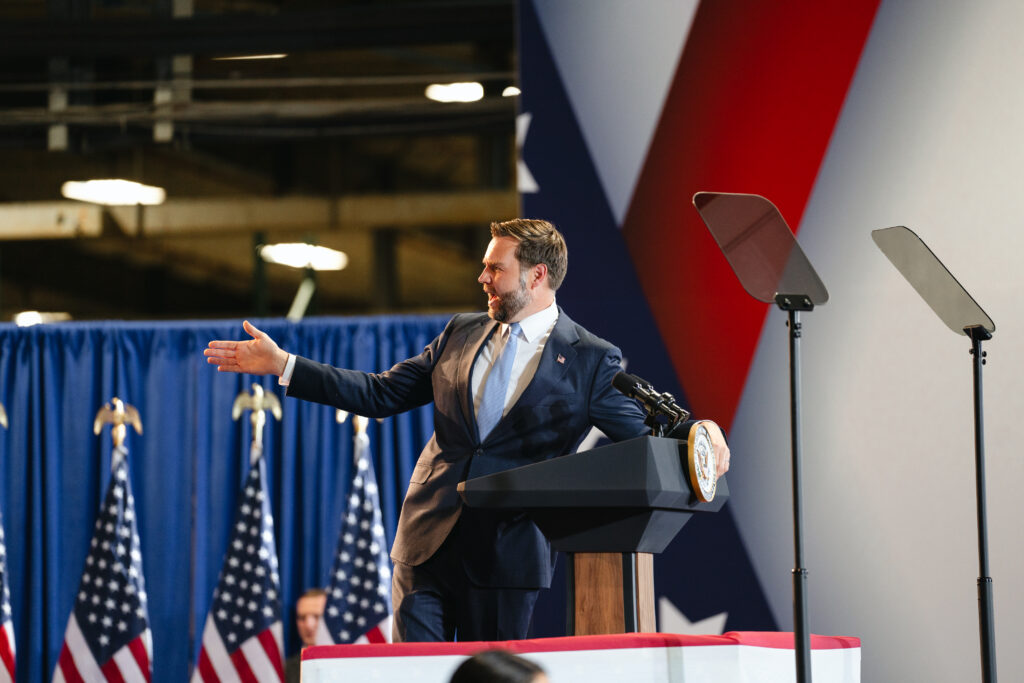
“How heartbreaking is it for a mom or a dad or a grandpa or a grandma to invest in this community, to love this community, to raise their kids in this community, but to not believe that there is any opportunity in the future in this community that they love?” Vance said.
He argued that places such as Brewer should not have to accept that decline as inevitable.
“I don’t want you to look at your own community as something that needs to be left behind,” Vance said. “I want you to recognize that there is a great American future for your children, for your grandchildren, for your entire family right here in Brewer, Maine.”
Canada tariffs draw questions
Vance was also pressed about the Trump administration’s escalating trade dispute with Canada, an issue with particularly significant consequences in Maine because of the state’s extensive economic relationship with its northern neighbor.
Vance acknowledged those concerns.
“We’re very mindful of the fact that Maine is a border state with Canada,” he said. “There’s a lot of cross-border transaction between Maine and Canada.”
But he defended the administration’s hard line, arguing that Canadian tariff and non-tariff barriers have disadvantaged American producers.
Vance pointed specifically to dairy products, arguing that Maine producers can face extraordinarily high Canadian tariffs under certain circumstances while Canadian products enter the United States at significantly lower rates.
“What we’re trying to do here is just make sure that Maine actually gets a fair game,” Vance said.
He said negotiations remained ongoing and suggested he believed an agreement had previously been within reach before what he described as unreasonable Canadian demands emerged late in the process.
“I frankly thought we had a deal,” Vance said. “I think that we should have a deal.”
His message to Canadian Prime Minister Mark Carney was less diplomatic.
“Stop taking advantage of America,” Vance said. “It’s over. We expect fairness in our trade policy.”
Vance addresses fatal Biddeford ICE shooting
Vance also addressed the fatal July shooting involving an Immigration and Customs Enforcement agent in Biddeford, pushing back against Democratic criticism that the Trump administration has failed to properly investigate the incident.
“That’s not true,” Vance said.
The vice president said federal authorities investigate law-enforcement shootings and stressed that he did not want to prejudge the facts of the Biddeford case.
“I’m not going to prejudge all the details,” Vance said. “Everybody has to follow the law in the United States of America.”
Vance acknowledged that the man who was killed was not the original target of the underlying immigration enforcement action.
“I believe the person who was shot was not part of the underlying investigation,” Vance said.
He said the circumstances surrounding what happened next remain subject to investigation and that any potential criminal case should be decided through the justice system rather than political rhetoric.
“We’re investigating that case,” Vance said. “They’re being dishonest if they say that we’re not investigating that case.”
The comments followed a Democratic “shadow hearing” held in Biddeford last week that focused on the shooting and broader concerns about federal immigration enforcement.
Border enforcement and Maine overdoses
Vance nevertheless used the Biddeford question to pivot back to the administration’s immigration agenda, arguing that border enforcement is also about stopping fentanyl and other illegal drugs from reaching communities such as those in Maine.
He cited declines in Maine overdose deaths and credited the administration’s border policies as part of the broader effort to reduce the flow of illegal narcotics.
“Our border enforcement is not based in fear or hatred of anybody else,” Vance said. “It’s based on a love of our countrymen.”
Vance also argued that immigration enforcement affects housing, wages and employment, contending that reducing illegal immigration eases pressure on the housing supply and helps direct job growth toward American workers.
Fraud emerging as a defining Maine issue
But Vance repeatedly returned to fraud.
His comments Monday suggest the issue that brought him to the Bangor area earlier this year is not going away — and could become an increasingly prominent part of the Trump administration’s involvement in Maine politics ahead of November.
The administration has already dispatched some of its most recognizable figures to Maine, including Oz, while federal scrutiny of MaineCare providers and other taxpayer-funded programs has intensified.
Monday, Vance made clear that the White House believes the next stage must include accountability.
And despite his criticism of Mills and Frey, the vice president said the door remains open for Maine officials to work alongside the administration.
“We don’t want the anti-fraud issue to become partisan,” Vance said. “We really don’t.”
His argument was ultimately simpler than the politics surrounding it.
“Tax dollars of the people in this room ought to go to what they paid for,” Vance said, “not to the fraudsters.”