

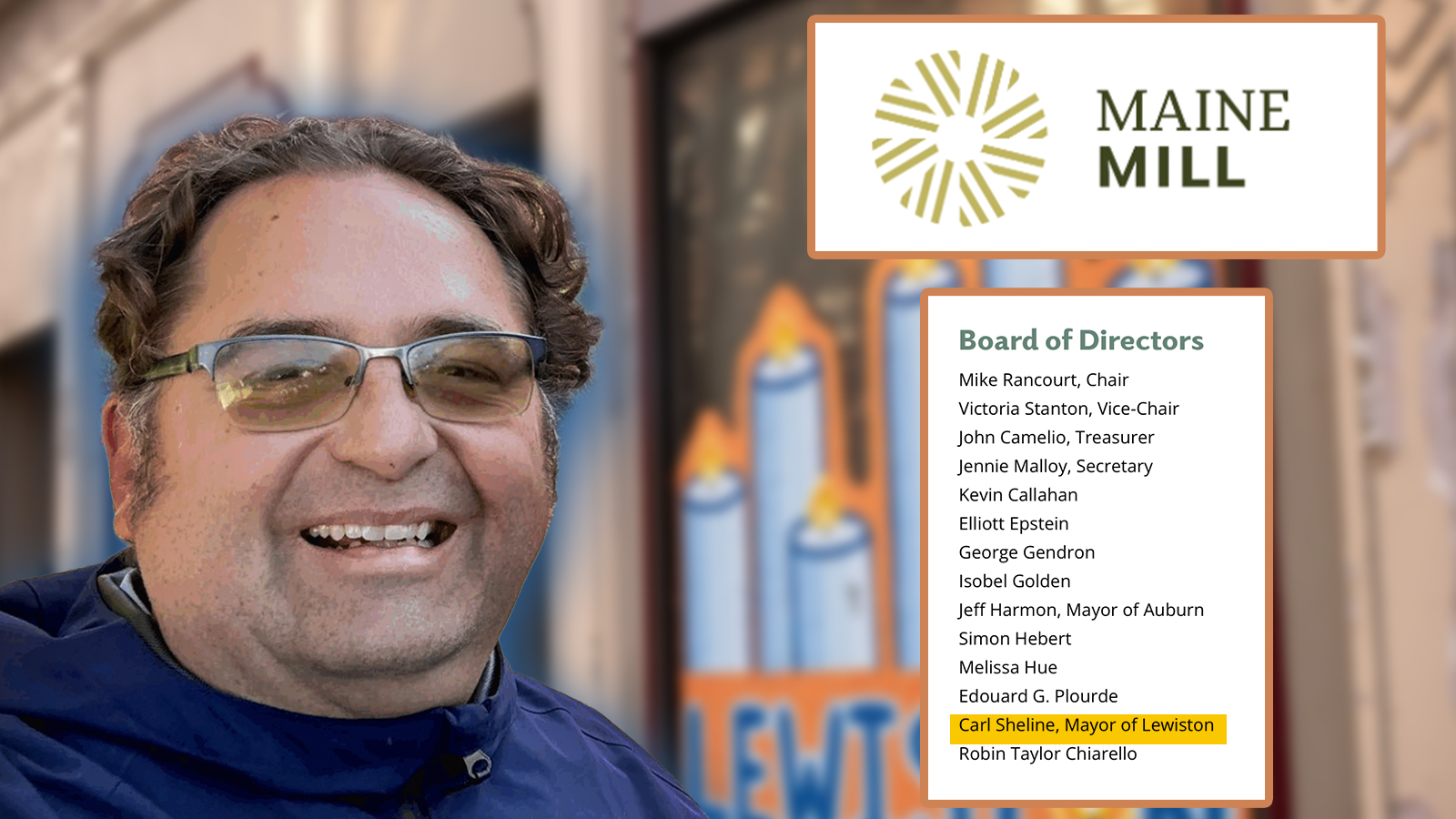
Nearly three years after Maine’s deadliest mass shooting, controversy over millions of dollars donated in the tragedy’s aftermath continues to follow Lewiston, and is now drawing renewed scrutiny in Augusta.
At the center of the latest questions is Lewiston Mayor Carl Sheline, who serves on the Board of Directors of Maine MILL, one of 29 nonprofit organizations that each received approximately $65,522 from a Maine Community Foundation fund established following the Oct. 25, 2023 shootings.
Maine MILL’s current website lists Sheline among its directors and specifically identifies him as “Carl Sheline, Mayor of Lewiston.”
MaineCF distributed approximately $1.9 million from its Lewiston-Auburn Area Response Fund’s Broad Recovery & Organizations Fund in April 2024. The foundation says all 29 recipient organizations received equal grants of $65,522. Maine MILL was among them.
There is no evidence that Sheline personally selected Maine MILL to receive the grant, served on the MaineCF steering committee that chose recipients, or personally benefited financially from the award.
But Sheline’s simultaneous roles as mayor and a director of a nonprofit that received shooting-related recovery money raise questions about disclosure and the appearance of a conflict at a time when victims and survivors have repeatedly demanded greater transparency surrounding the funds.
Those questions could become even more significant this month.
The Maine Legislature’s Government Oversight Committee is scheduled to take up the Maine Community Foundation matter on Sept. 16 at 9:30 a.m. in Room 220 of the Cross State Office Building in Augusta.
According to the committee’s official agenda, lawmakers will consider a request for an Attorney General’s legal opinion concerning whether the Office of Program Evaluation and Government Accountability, or OPEGA, has authority to examine MaineCF’s “collection, management, and distribution of donated funds” following the Lewiston massacre.
The Attorney General’s Office has been invited to participate.
The committee has not yet authorized a full investigation. The Sept. 16 discussion is expected to focus first on whether Maine’s legislative watchdog has legal jurisdiction to review the private foundation and the funds involved.
Millions Raised After Maine’s Deadliest Shooting
On Oct. 25, 2023, Army reservist Robert Card opened fire at Just-In-Time Recreation and Schemengees Bar & Grille, killing 18 people and wounding 13 others.
In the days that followed, millions of dollars poured into Lewiston from donors across Maine and around the country.
MaineCF established separate funding tracks under its Lewiston-Auburn Area Response Fund.
The foundation ultimately distributed approximately $4.75 million through its Victims & Families Fund to 162 beneficiaries directly affected by the shootings.
Another $1.9 million was distributed through the Broad Recovery & Organizations Fund to 29 nonprofits.
Among the recipients were hospitals, social-service organizations, immigrant-service nonprofits, community organizations and Maine MILL.
MaineCF says donors were given the ability to choose which fund they wanted to support.
But the distinction between the two funds has become one of the central points of contention for victims and advocates, some of whom have argued that fundraising conducted in the emotional aftermath of the shootings led donors to believe their money was primarily helping the people who were killed, wounded or present during the attacks.
Victims Say Controversy Is Re-Victimizing Them
The disagreement has repeatedly spilled into Lewiston City Council meetings.
Official minutes from the council’s March 3 meeting show residents raising concerns about ongoing medical expenses, future surgeries and potential conflicts involving members of the MaineCF steering committee and nonprofits that received grants.
The city minutes state that speakers said the continuing situation was “revictimizing the survivors all over again.”
That anger has grown as survivors and relatives of those killed have continued to face long-term financial and medical consequences nearly three years after the shootings.
For some victims, the controversy is no longer simply about how a charitable foundation structured a grant program.
It has become a broader fight over donor intent, transparency and whether institutions that raised money after the shooting gave sufficient priority to the people who were actually shot, injured or left grieving.
Sheline Called Process Transparent
As scrutiny increased earlier this year, Sheline defended MaineCF’s process.
“The facts are clear and the process was transparent,” Sheline told the Sun Journal in February.
“Maine Community Foundation offered two options to donate: either to the victims or to the community. Donors made their choices and the funds were dispersed accordingly.”
What has received less public attention is Sheline’s position with Maine MILL.
The museum is one of the organizations that benefited from the Broad Recovery fund Sheline was defending.
Again, there is no evidence that Sheline participated in MaineCF’s decision to award the museum money.
The question is instead whether his board affiliation should have been more prominently disclosed as he publicly weighed in on the controversy.
Maine MILL says its work following the shootings included preserving memorial material and documenting the community’s response to the tragedy.
Its efforts to collect and preserve that history may fall squarely within the mission of a museum.
But for victims who have questioned why nonprofits received more than $65,000 each while they continue to deal with the long-term consequences of the shootings, the distinction has not ended the controversy.
The Root Cellar Returned an Equivalent Amount
One nonprofit recipient has already taken a different approach.
The Root Cellar, which also received $65,521.79 through MaineCF’s Broad Recovery fund, announced in March that it was transferring an equivalent amount to VictimsFirst, a national organization that assists survivors of mass-casualty crimes.
Root Cellar Executive Director Joel Furrow said his organization had properly used its original grant for trauma-healing programs but later learned more about the financial challenges still facing shooting survivors.
“There are continuing medical needs for those who were injured, creating lifelong challenges,” The Root Cellar said in explaining its decision.
VictimsFirst subsequently reported collecting and distributing more than $84,000 to Lewiston families and survivors, including money inspired by The Root Cellar’s action.
The organization said the money went toward food, rent, utilities, transportation, childcare, dental bills, mental-health needs and other continuing expenses.
The Root Cellar’s decision intensified public pressure on other organizations that received the same grants.
Maine MILL has not announced a similar move.
Maine MILL and City Hall Have Other Connections
Sheline’s connection to Maine MILL extends beyond the shooting-recovery grant.
In 2024, Lewiston city officials considered the disposition of a portion of city-owned property at 49 Beech Street involving Maine MILL and Beech Street Properties.
A Finance Committee recommendation called for allowing the city administrator to negotiate directly with Maine MILL and Beech Street Properties for the identified portion of the parcel for $100,000.
That does not establish wrongdoing or show that Sheline improperly participated in the transaction.
It does, however, make his precise role in city decisions involving Maine MILL a legitimate matter of public interest.
Sheline has also publicly championed infrastructure and economic development near the museum.
In March 2024, he celebrated federal funding for the Simard-Payne Park and Beech Street area, which included improvements benefiting access to the Camden Yarns Mill site that would become Maine MILL’s new home.
“Developing the riverfront is a top priority for our city,” Sheline said at the time.
Later that year, after the Maine MILL project received Planning Board approval, Sheline praised the museum as an economic-development opportunity that could attract tourism dollars and help revitalize the riverfront.
None of those statements are inherently unusual for a mayor advocating for redevelopment in his city.
But his position on Maine MILL’s board makes transparency regarding his involvement in municipal matters affecting the museum particularly important.
Steering Committee Already Under Scrutiny
The broader MaineCF controversy involves questions that go well beyond Sheline.
MaineCF’s own announcement identifying the 29 grant recipients also identified the volunteer steering committee that selected them.
Several individuals on the committee had professional connections to organizations that ultimately received funding, including United Way of Androscoggin County, Gateway Community Services Maine, the Maine Association of the Deaf, the Somali Bantu Community Association and Tree Street Youth.
Lawmakers calling for additional scrutiny have alleged those overlapping relationships created at least the appearance of conflicts of interest.
No state agency or court has determined that those relationships constituted unlawful self-dealing.
Still, lawmakers’ concerns helped push the matter toward the Government Oversight Committee.
Sept. 16 Could Determine What Happens Next
The Sept. 16 meeting could determine whether the controversy receives the independent state review victims and lawmakers have requested.
The committee agenda specifically asks whether OPEGA has authority to examine MaineCF’s collection, management and distribution of donated money following the Lewiston shootings.
That legal question matters because MaineCF is a private nonprofit organization.
If lawmakers determine OPEGA has jurisdiction, particularly because public funds or municipal transactions intersected with MaineCF’s administration of the response fund, the committee could have a clearer pathway toward additional investigation.
If OPEGA lacks authority, lawmakers may have to consider another route.
Either way, Sept. 16 places the controversy back before state government.
For Sheline, it may also bring renewed attention to an issue that has largely remained in the background: while serving as Lewiston’s mayor and publicly defending the transparency of the fund process, he has also served as a director of Maine MILL, one of the nonprofit organizations that received more than $65,000 through that process.
There is no evidence Sheline selected Maine MILL for the grant.
There is no evidence he personally received any of the money.
But those facts do not erase the legitimate transparency questions created by the overlapping roles.
And for the victims who continue showing up at City Hall nearly three years after the shootings, the controversy has moved far beyond an accounting debate.
Their own testimony says the prolonged fight over the money has left some feeling victimized all over again.
On Sept. 16, Maine lawmakers will begin deciding whether the state has the authority to look deeper into why.




“Nothing to see here. Move along. Step lively, now.
Yet, the scumbag is still the mayor.
He needs to go straight to prison
Oh let’s all lighten up ….
There’s a list of “ Non Victims “ over a mile long …..why shouldn’t old Carl get a little taste too . ?
Being a “ public servant “ is a big job …
It takes a lot of gas and pizza money . …..
Sarcasm here please .