The Maine Wire
  • News
  • Commentary
  • The Blog
  • About
  • Support the Maine Wire
  • Store
Facebook Twitter Instagram
Trending News
  • Robert Wessels Tells Maine GOP Convention: Winning the Blaine House Won’t Be Enough Without House and Senate Majorities
  • Breaking: Shots Fired Disrupt White House Correspondents’ Dinner, Prompting Evacuation and Panic. President Trump and Attendees Reportedly Unharmed.
  • Somali Pirate Arrested Near Canadian Border After Entering United States Illegally In Arizona
  • DOJ Report Affirms Importance of Capital Punishment, Affirms Federal Use of Firing Squad Executions
  • Mills Vetoes Moratorium on Data Center Construction and Bill to Automatically Unseal Criminal Records
  • Texas Law Requiring Public School Classrooms to Display the Ten Commandments Upheld by 5th Circuit Court of Appeals
  • Former Maine Senate Democrat Candidate Admits Damaging Mount Desert Signs
  • Maine Destroyer Fired Five Warning Shots At Iranian Ship Before Going For Broke
Facebook Twitter Instagram
The Maine Wire
Sunday, April 26
  • News
  • Commentary
  • The Blog
  • About
  • Support the Maine Wire
  • Store
The Maine Wire
Home » News » News » Budget agreement suggests lawmakers may have learned lessons from the pandemic
News

Budget agreement suggests lawmakers may have learned lessons from the pandemic

Nick LinderBy Nick LinderJune 29, 2021Updated:June 29, 2021No Comments3 Mins Read
Facebook Twitter Email LinkedIn Reddit
Share
Facebook Twitter LinkedIn Email

A new bipartisan budget agreement might prove that lawmakers learned a valuable fiscal lesson from the fallout of the pandemic, though there’s still potential for future and additional supplemental budgets.

The newest budget deal from Augusta, after much finagling and compromise, tops out at $8.5 billion, which would only grow spending by about $200 million more than the majority budget passed in March, and about $300 million less than the supplemental budget proposed by Gov. Janet Mills.

The most recent revenue forecasts suggest Maine will see a $940 million surplus over the next biennium, signaling a significant change in the way Maine plans its finances from just over a year ago.

Having already planned to spend nearly all of its expected revenues, the state had to pivot sharply when the pandemic hit last year. It found itself lacking spare cash while desperately needing to increase spending to help manage COVID-19. The governor even signed a curtailment order amid the pandemic to ensure the state could keep its budget balanced and pay its bills on time. 

It seems lawmakers in Augusta have learned their lesson and have planned to not spend nearly all of the state’s projected revenues over the next biennium before those revenues materialize.

The budget agreement passed unanimously in the Legislature’s Appropriations Committee on Sunday, but it did not come without compromise on both sides. 

The new budget will pay $300 per person in COVID-19 relief payments to approximately 500,000 Mainers who filed a W-2 last year— a compromise on a Republican effort to provide income tax relief to most Maine workers— with the aim of rewarding essential workers who did not stop working during the pandemic.

The payments will cost roughly $150 million themselves with $500,000 for their administration. Republicans had originally sought $300 million or more in tax breaks.

Also, a proposal to replace revenues lost due to the state’s proposed flavored tobacco ban, roughly to the tune of $32 million, was nixed from the final agreement. 

A compromise addition raised reimbursements for direct care workers to 125% of the minimum wage and another set aside $20 million for nursing homes still reeling from the pandemic.
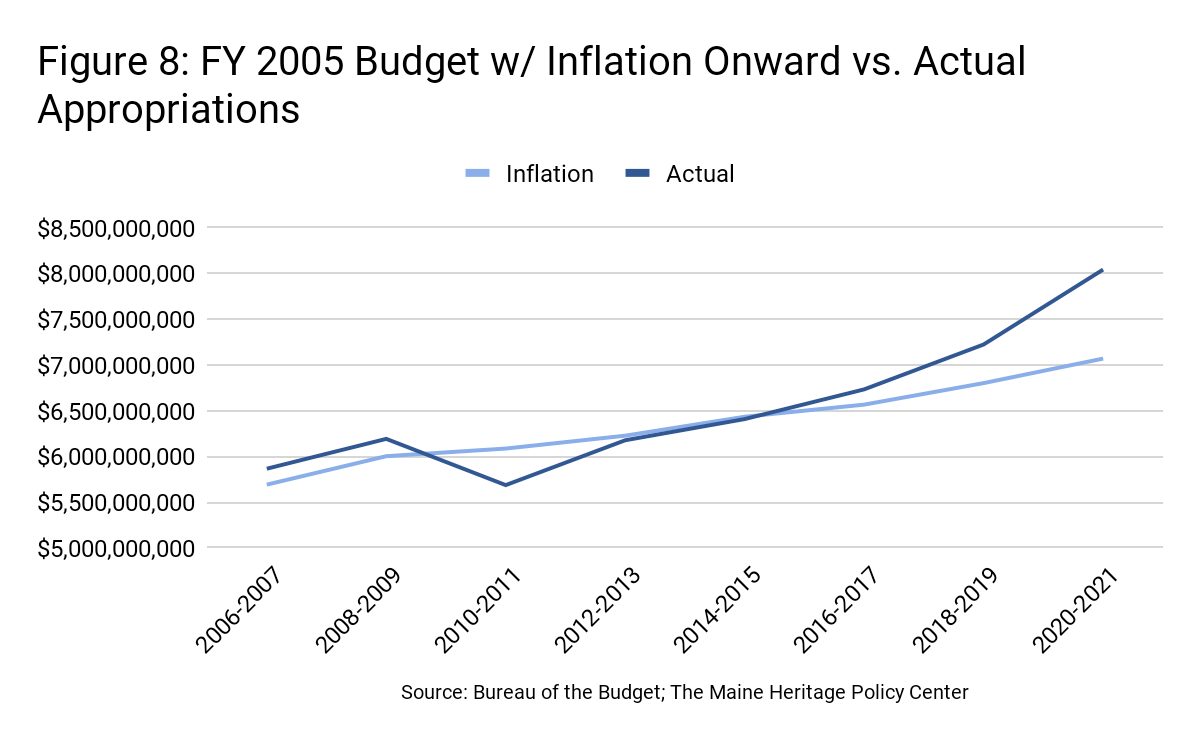
Still, $8.5 billion is a tough pill to swallow. As illustrated in the above graph from Maine Policy Institute, the gap between the value of Maine’s fiscal year 2005 budget (adjusted for inflation) and real appropriations has only grown in recent years, to more than $1 billion.

The new budget would also meet the state’s school funding goal of 55% of education costs for the first time since it was required by a 2004 referendum. It would also send 5% of state tax revenues to cities and towns through revenue sharing. 

Mills praised the bipartisan deal Sunday night, saying that it made “important, meaningful, and historic progress.”

The budget will go for a full vote before the legislature on Wednesday.

Augusta Biennial Budget bipartisan budget Commentary compromise COVID-19 Featured flavored tobacco ban governor janet mills Janet Mills Maine Policy Institute Opinion pandemic relief republicans surplus
Previous ArticleSystemic tax reform is better than one-time gimmicks
Next Article Mills’ veto stops new graduated real estate transfer tax
Nick Linder

Nicholas Linder, of Cincinnati, is a communications Intern for Maine Policy Institute. He is going into his second year of studying finance and public policy analysis at The Ohio State University. On campus, he is involved with Students Consulting for Nonprofit Organizations and Business for Good.

Latest News

Robert Wessels Tells Maine GOP Convention: Winning the Blaine House Won’t Be Enough Without House and Senate Majorities

April 25, 2026

Somali Pirate Arrested Near Canadian Border After Entering United States Illegally In Arizona

April 25, 2026

DOJ Report Affirms Importance of Capital Punishment, Affirms Federal Use of Firing Squad Executions

April 25, 2026

Comments are closed.

Recent News

Robert Wessels Tells Maine GOP Convention: Winning the Blaine House Won’t Be Enough Without House and Senate Majorities

April 25, 2026

Somali Pirate Arrested Near Canadian Border After Entering United States Illegally In Arizona

April 25, 2026

DOJ Report Affirms Importance of Capital Punishment, Affirms Federal Use of Firing Squad Executions

April 25, 2026

Mills Vetoes Moratorium on Data Center Construction and Bill to Automatically Unseal Criminal Records

April 25, 2026

Texas Law Requiring Public School Classrooms to Display the Ten Commandments Upheld by 5th Circuit Court of Appeals

April 25, 2026
Newsletter

News

  • News
  • Campaigns & Elections
  • Opinion & Commentary
  • Media Watch
  • Education
  • Media

Maine Wire

  • About the Maine Wire
  • Advertising
  • Contact Us
  • Submit Commentary
  • Complaints
  • Maine Policy Institute

Resources

  • Maine Legislature
  • Legislation Finder
  • Get the Newsletter
  • Maine Wire TV

Facebook Twitter Instagram Steam RSS
  • Post Office Box 7829, Portland, Maine 04112

Type above and press Enter to search. Press Esc to cancel.