



In a turn of events, Gov. Janet Mills has vetoed three bills sponsored by Senate President Troy Jackson (D-Allagash) in another move against her own party.
To date, Mills has issued 16 vetoes against the 130th Legislature, despite it being controlled by her own party.
The first of three vetoes against Sen. Jackson, though, came on June 25 and was against his LD 125, which would have banned the spraying of aerial herbicides on trees. In her veto message, Mills points out that the bill would only ban one method of herbicide application, not the actual chemical it was supposedly trying to prevent being used, glyphosate.
She also says that aerial application of herbicides is extremely limited in Maine’s forest, and so the bill would not have accomplished its main goal of helping the environment.
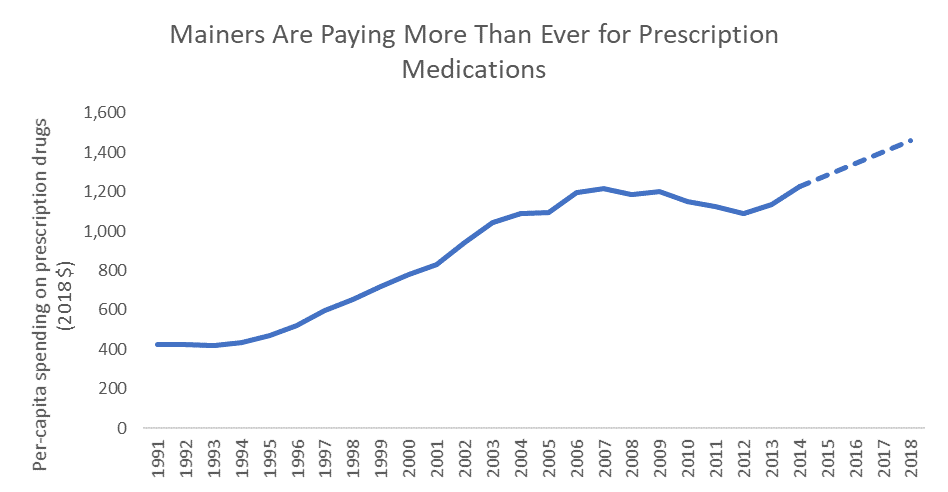
The next two vetoes were against measures aimed at curbing rising prescription drug costs. As illustrated in the above graph from the Maine Center for Economic Policy, prescription medications are becoming more expensive than ever.
Though high costs are a severe issue facing both Maine and the nation alike, Mills made the right choice in kiboshing these bills, as they were misguided solutions that would not have cured the problem.
The first bill, LD 675, sponsored by Jackson, would have required the Maine Prescription Drug Affordability Board (MPDAB) to compile a list of up to 12 drug manufacturers that imposed “unsupported price increases” on drugs to then be passed on to the State Treasurer, who would then levied fines against them.
The bill is overly complex and sets out to lower drug prices in a very inefficient, confusing, and costly manner.
In her veto message, Mills expressed her doubts about the bill’s ability to hold up against Constitutional scrutiny, her concerns with the costly litigation it would bring, and the lack of impact it would have on drug accessibility for Mainers.
The funds generated through the fines imposed by LD 675 would not be available to use to benefit consumers or offset healthcare costs until 2027 or 2028. For these reasons alone, she was right to veto it.
The final blow against the Senate President was her veto of LD 1117, also sponsored by Jackson, which aimed to prevent price increases for generic prescription drugs sold in Maine. The bill would have used the Attorney General to steward fines and litigation against drug companies for “excessive price increases.”
Again, Mills cited lack of Constitutional backbone, invoking a law in Maryland, HB 631, which was similarly aimed at curbing price gouging and was found to have violated the Commerce Clause of the US Constitution, as the affected transactions occurred outside of the state’s boundaries.
Mills, being a former Attorney General herself, crafted two sound legal arguments against the market-restricting and unconstitutional bills.
These last two bills were two-fifths of the “Making Health Care Work for Maine” package proposed by Senate Democrats earlier this year.
In response, Jackson released a scathing rebuke of the Governor, saying she “did not have the courage” to stand up for Mainers suffering from unaffordable prescription drug price increases. The feud between the Senate President and Governor is not a new one, as Mills has opposed similar price gouging bills in the past.
Her vetoes came just days before former Gov. Paul LePage announced his bid for a third term as governor on Monday. It’s clear Mills is already feeling the heat of an upcoming election and experienced challenger, who will be scrutinizing her for the next 18 months.
These moves are more of a moderate shift than some of her previous ones, like expanding Medicaid coverage day one of the job.
Though she has sharply increased state spending from the LePage years, Mills has held the line on taxes and other more progressive reforms.
The rebuke of a leader within her own party spells a more calculated, tactful approach to governing as Mills heads into a reelection cycle, and these vetoes, among some of her other recent ones, are a welcome check on ever-expanding state power and restrictions of free markets.
Photo credit: Dora646566, CC BY-SA 4.0 https://creativecommons.org/licenses/by-sa/4.0, via Wikimedia Commons.


