In another attempt to “follow the science,” a pediatrics group has issued guidance that does the exact opposite.
The American Academy of Pediatrics (AAP) said Monday that all children in schools who are older than two should wear a mask, regardless of vaccination status, when returning to school this fall. Clearly, this guidance contradicts the well-known recommendations from the U.S. Centers for Disease Control and Prevention (CDC) which state fully vaccinated individuals can go without a mask.
As of now, the COVID-19 vaccines have been granted emergency use authorization for individuals 12 and older. Though the Food and Drug Administration (FDA) said last week that the authorization could be expanded to younger children, that likely won’t come until at least early-to-mid-winter.
Why should a vaccinated teenager have to wear a mask in school when he or she can go without a mask in every other situation? Why should a young child who is at lower risk for catching, transmitting or dying from the virus, be required to do the same?
The new guidance from the AAP is extra-scientific, plain and simple.
Few truly enjoy wearing a mask, but it was something we were all asked to do (albeit sometimes in situations where it was unnecessary). The problem with issuing guidance like this from the Academy is that it can cause more people to be hesitant about receiving the vaccine. People will ask themselves why they should get vaccinated if doing so means they still have to wear a mask and have other freedoms curtailed by the government. It contributes to the same vaccine hesitancy that public health officials are trying to eliminate.
In addition, children ages 11 and younger, the ones who cannot yet get vaccinated, have consistently been found to be at lower risk for contracting, transmitting, and dying from COVID-19.
Children between the ages of five and 12 can still contract COVID-19, but their risk of developing serious symptoms and of transmitting the disease is significantly lower than older individuals.
A study released by the CDC last October found that “incidence of COVID-19” in children five to 11 was half that of children aged 12 to 17. And, as noted by the CDC in a report from January of this year, “Children and adolescents have had lower incidence and fewer severe COVID-19 outcomes than adults.”
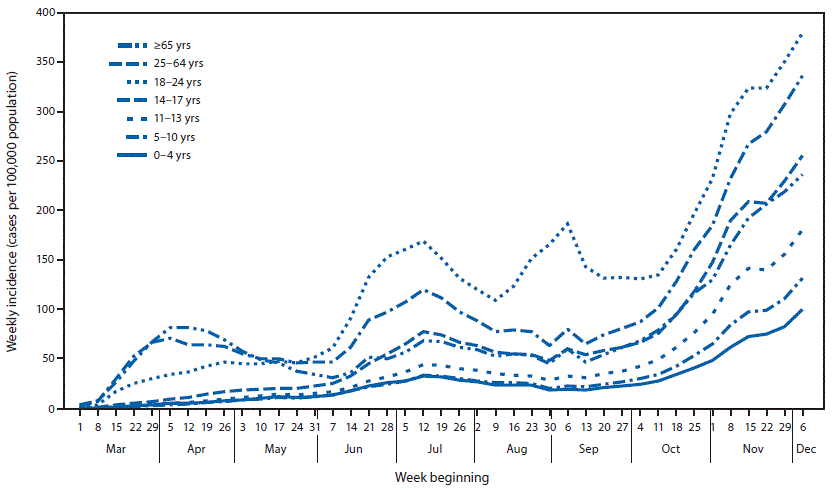
Included in the CDC study, this graph shows the relatively low frequency of COVID-19 incidence among children through December 2020.
So the question remains, why must the segment of the population least affected and least at-risk by the disease continue to mask up?
If a child wants to continue to wear a mask for sake of comfort, or if they live with someone who is more at risk, then that should be their prerogative. But it’s time school back away from the one-size-fits-all mandates.
Maine schools should follow the lead of the Bonny Eagle School District, which recently announced it is making masks optional when students return to school this fall.
“The families have been rather pleased to know that we’re going to be giving them the choice, making those decisions, as opposed to mandating decisions that are [based on] recommendations,” MSAD 6 Superintendent Paul Penna told WGME 13.
Choice. What a concept.
Of course, the AAP’s recommendations, like most recently issued guidance, does not account for natural immunity derived from having contracted COVID-19, which is believed to put the U.S. level of immunity at a significantly higher level.
The new AAP guidance also comes with an added layer of irony. Just last year, they issued guidance that said, “Elementary students should wear face coverings if the risk of touching their mouth or nose is not greater than the benefit of reducing the spread of COVID-19.”
If that contortion of words confuses you, you’re not alone.
In that June 2020 report, they also advised students to wear face masks when closer than six feet apart “when feasible” and that three-foot physical distancing would help, too.
But the group is now saying all students should wear masks, even if they’re vaccinated. It is confounding and defies logic.
Though what we know about COVID-19 has been ever-changing since even January of 2020, that is not the reason for this discrepancy in guidance.
The new AAP recommendations ignore the established science. Ultimately, it is parents and children, who want quality education and their lives to return to normal, who will pay the price if their local schools decide to follow AAP guidance.