


PORTLAND, Maine – A federal judge on Thursday dismissed the Trump administration’s lawsuit seeking Maine’s unredacted voter registration database, rejecting the Department of Justice’s argument that it needed sensitive voter information to determine whether the state was properly maintaining its voter rolls.
Chief U.S. District Judge Lance Walker ruled that the federal government did not have the authority under the laws it cited to force Maine Secretary of State Shenna Bellows to surrender the state’s computerized voter registration list with every data field included.
The requested database contained personal information about Maine voters, including full names, residential and mailing addresses, dates of birth, political party affiliations, election participation history, driver’s license or nondriver identification numbers, and partial Social Security numbers, depending on what a voter provided when registering.
Walker, who was appointed to the federal bench by President Donald Trump in 2018, granted motions to dismiss filed by Maine, Bellows and the League of Women Voters of Maine, while denying the DOJ’s request for an order compelling the state to turn over the data.
“The question before me now is whether the Department of Justice can compel the type of access it once enjoyed through consent, in the face of a state’s refusal,” Walker wrote. “For the reasons that follow, I conclude it cannot.”
The case began in July 2025, when the DOJ’s Civil Rights Division demanded Maine’s current electronic statewide voter registration list, including “all fields contained within the list,” as part of a broader federal examination of state voter-roll maintenance practices.
The Trump administration argued that the information was necessary to determine whether Maine was following federal laws requiring states to maintain accurate voter registration rolls and remove ineligible voters.
According to Walker’s ruling, the DOJ pointed to Maine’s responses to a federal Election Assistance Commission survey. The department cited Maine’s reported 92.4 percent voter registration rate among its citizen voting-age population in 2024, 11,011 duplicate voter registrations, 101,771 voters removed after moving outside their jurisdictions, and missing information concerning confirmation notices mailed to certain voters.
The DOJ then sought information about how Maine identifies and removes ineligible voters, as well as how the state sends and tracks confirmation notices for voters believed to have moved.
Bellows refused to provide the full computerized voter database, arguing that the federal request was overly broad and sought information protected as highly sensitive under Maine law. She did, however, respond to questions about Maine’s voter-list maintenance practices.
The DOJ renewed its request in August 2025, stating that it needed the unredacted voter list to assess Maine’s compliance with the National Voter Registration Act. The department demanded voters’ full names, dates of birth, residential addresses, driver’s license numbers or partial Social Security numbers.
In September 2025, the DOJ sued Maine and Bellows, alleging violations of the National Voter Registration Act, the Help America Vote Act and the Civil Rights Act of 1960.
When the lawsuit was announced, Assistant Attorney General Harmeet K. Dhillon, who leads the DOJ’s Civil Rights Division, defended the administration’s effort as necessary to restore public trust in elections.
“American citizens have a right to feel confident in the integrity of our electoral process,” Dhillon said, arguing that states refusing to protect voters from alleged vote dilution would face legal consequences.
The DOJ alleged that Maine violated federal law by refusing to provide information about the removal of ineligible individuals and by declining to produce an unredacted electronic copy of its statewide voter registration list.
Judge Says DOJ Was Searching for a Violation It Had Not Proven
Walker rejected the administration’s attempt to obtain Maine’s complete voter file as part of a federal oversight investigation.
In his 22-page ruling, Walker found that neither the National Voter Registration Act nor the Help America Vote Act gives the federal government authority to compel Maine to produce its unredacted computerized voter database with all fields included.
Walker also rejected the DOJ’s argument under the Civil Rights Act, finding that Maine’s statewide voter database is a tool created and maintained by the state to administer elections, not simply an election record that automatically must be surrendered to federal authorities upon demand.
The judge wrote that states, not the federal government, are primarily responsible for maintaining their voter rolls under the federal election laws cited by the administration.
“Under our Constitution, states are the primary regulators and administrators of elections for federal office, unless Congress passes legislation that preempts that framework,” Walker wrote.
Walker described the DOJ’s presentation of its claims under the federal voting statutes as “half-hearted,” finding that the department was effectively attempting to obtain Maine’s voter database first and search for possible violations afterward.
The judge wrote that the United States had filed a Help America Vote Act case “in search of a HAVA violation,” rather than identifying a violation supported by facts before bringing the lawsuit.
Walker also rejected the administration’s argument that the attorney general could use the records to oversee Maine’s routine voter-list decisions, writing that federal law does not permit the DOJ to “loom over the shoulder” of state election officials and demand corrections to voter rolls.
President Trump had not publicly commented on Walker’s ruling as of Friday morning.
The Justice Department also had not announced whether it plans to appeal the decision. The Associated Press reported that DOJ officials did not immediately respond to a request for comment about the Maine and Wisconsin rulings or whether the administration would pursue appeals.
While Trump has not personally addressed the Maine defeat, his administration has repeatedly framed its effort to obtain state voter files as part of a broader election-integrity push aimed at identifying ineligible registrations, preventing alleged voter fraud and ensuring public confidence in elections.
Bellows, a Democrat who is running for governor, praised the court’s decision and accused the Trump administration of attempting to interfere with elections administered by the states.
“Trump and the DOJ may continue to try to interfere with free and fair elections run by the states,” Bellows said in a statement. “We will not let them.”
The League of Women Voters of Maine intervened in the lawsuit in support of the state’s effort to block the disclosure of the unredacted voter database. Voting-rights groups argued that releasing the detailed information would create privacy and election-security risks for registered voters.
The Maine case is part of a nationwide Trump administration effort to obtain detailed voter registration data from states across the country.
Walker noted that nearly every state had received a request similar to the one sent to Maine and that the federal government had filed 30 substantially similar lawsuits after states refused to provide the requested information.
Before Thursday’s Maine ruling, federal courts had dismissed similar DOJ lawsuits in Arizona, California, Massachusetts, Michigan, Oregon and Rhode Island. On the same day Walker dismissed the Maine lawsuit, a federal judge in Wisconsin also rejected the DOJ’s attempt to force that state to surrender detailed voter registration information.
The DOJ has sued at least 30 states and the District of Columbia seeking access to voter data that includes birth dates, residential addresses, driver’s license numbers and partial Social Security number

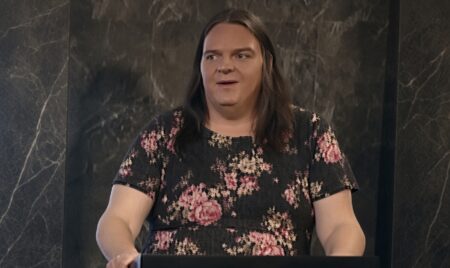


Sheena Bellows
ENEMY OF THE STATE .
Puppet of Soros
Bellows has publicity admitted there are “non citizens registered to vote” If State officials know of this, and refuse to address the issue, how can the CITIZENS trust the state government? Asking for a friend…..
Helping to hide the illegal voting scam by the Sec of State in charge of the Maine Fraud of Elections and Czarina Janet
Not surprising since Lance Walker also upheld Maine’s ranked-choice voting system in a case brought by former U.S. Representative Bruce Poliquin in 2020. He and Bellows as well as the Women’s League of Voters are all patsies for the ACLU-ME.