

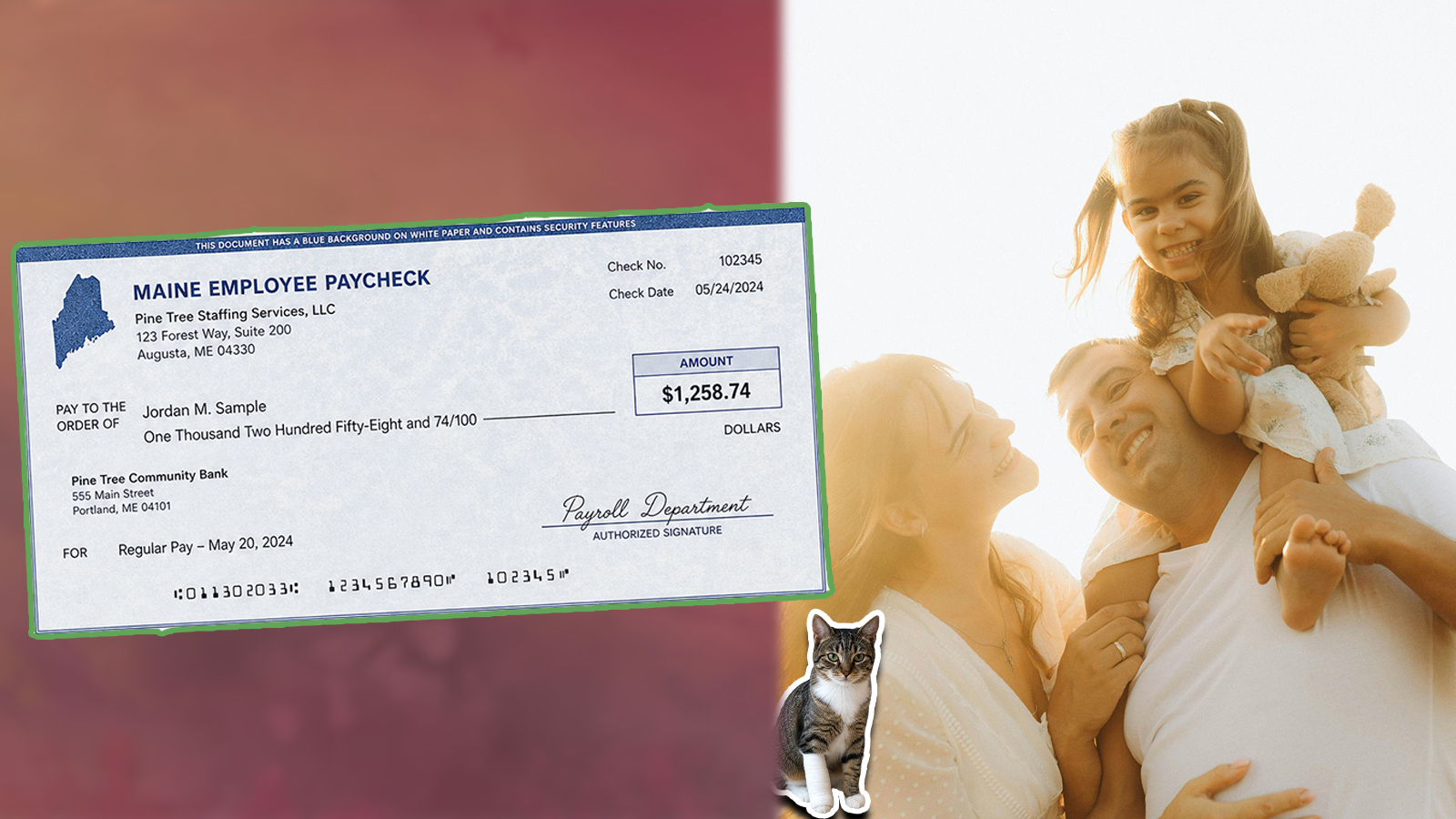
As of May 1, most employees in Maine are eligible to take up to twelve weeks of paid leave to care for a sick family member, as well as to bond with a newborn baby or newly adopted child.
Also eligible for leave under the program are those who are experiencing a serious health condition and are rendered unable to work for an extended period, and anyone serving as a caregiver for someone who meets the other conditions.
Mainers began paying into the program on January 1, 2025, more than a year in advance of the program becoming available.
Enacted last year as part of a spending bill, it has imposed a one percent payroll tax on most working Mainers and their employers, benefits not scheduled to begin until May 1, 2026.
Employers who choose not to participate in the state program are required to adopt a qualifying private plan in its place.
The one-percent premium in most cases split between the employer and employee, each contributing half to the cost of the program.
Click Here for More Information About the PFML Program
Although lawmakers considered a number of amendments to the program during their previous legislative session, including the possibility of a full repeal, the PFML program has largely remained the same since it was signed into law.
This past summer, however, Gov. Janet Mills (D) finalized a measure adding new penalties and enforcement measures to the program.
The bill also established a Bureau of Paid Family and Medical Leave within the Maine Department of Labor (MDOL) to administer the program.
Under the new law, employers who are out of compliance with a substitution agreement will be required to pay a fine equal to the amount of premiums that would have otherwise contributed, as well as a penalty worth one percent of the employer’s total payroll for the period in which their policy had lapsed.
The Commissioner of Labor will also be tasked with administering the program through the Bureau of Paid Family and Medical Leave, for which a list of enumerated fines, penalties and “other actions” could be taken if they are deemed “necessary or suitable.”
Additionally, this bill clarified that “intermittent leave” of less than one work day may not be taken unless both the employee and employer agree to it.
Lawmakers in the Senate voted along strict partisan lines in support of the measure. The House then followed suit shortly thereafter, sending the bill to the governor’s desk, where Gov. Mills signed it into law in June.


Thanks to Maine’s AFL-CIO and their Eintzengruppen/Maine People’s Alliance. More tax revenue and more tax payer funded dues paying positions. The classic Cosa Nostra solution for a manufactured problem.
Another reason not to hire any new employees. This is a very unfriendly state for small businesses.
Another TAX on the working man of whom the vast majority will never use, not to mention the 1% tax will soon be 2, 3 or 4%
According to The Maine is the third less friendly State for privately owned businesses. Our Commies in Augusta are determined to be less friendly than Illinois and New Jersey. numbers 49 and 50!
Just what we need-more gov’t control as we turn more and more socialist. The decline continues.
Lest we forget ~ we’re not only having to pay our .5%, we’re also having to foot the bill to the tune of 1% of Maine State employees who can use the “benefit” but are exempt from paying into it. As of 2024 (because – of course – there are no current numbers), the state wages were $832,000,000 which means $8,320,000 additional taxes become our burden because of this idiotic program. Whatever happened to banking your personal/sick/vacation time for your extended time off????
juju
Big Thumb Up! Most, not all, but most will use this as a paid vacation. Six weeks recovery from surgery. Didn’t lose on day of pay, No medical leave, No workers comp. Still had vacation time and sick leave after I went back to work.