

The atmosphere at a youth ball game is usually a soundtrack of summer: the crack of the bat, the enthusiastic chants of the players, and the calming hum of the crowd enjoying their day off as the warm breeze blows the black flies away just enough to bearably watch the children play. But, when you belong to a firefighting family, you hear the world a little bit differently. You notice who is there, and you acutely notice who is missing because their pager went off.
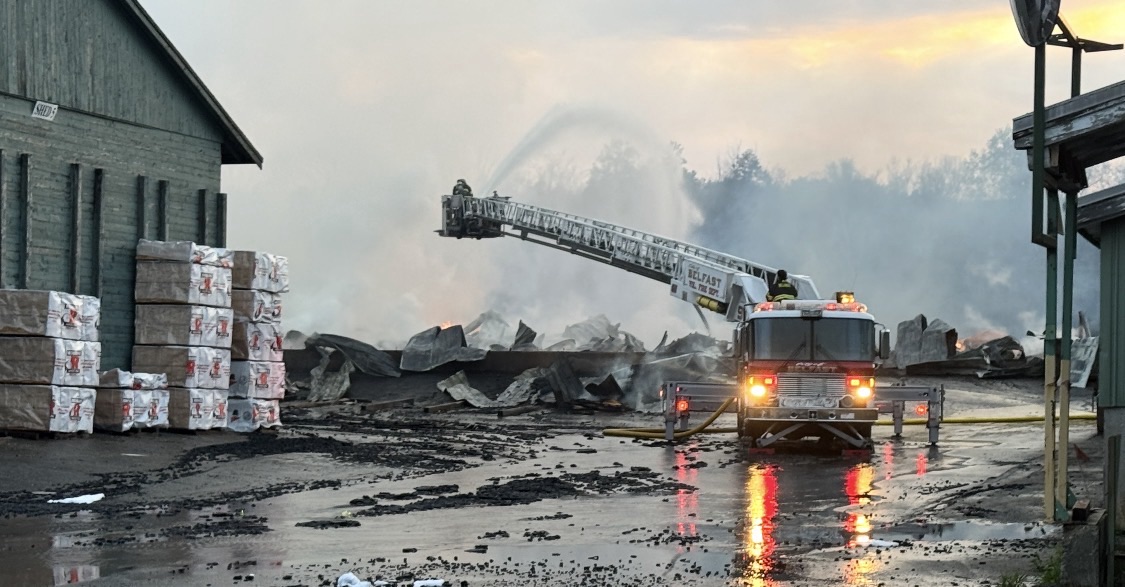
Last weekend, I attended a ball game with my young children while my husband, who is a volunteer firefighter here in Maine, was out servicing a local fire department. It should have been a carefree day watching the kids play. Instead, it felt heavy, shadowed by the horrific explosion at a mill in Searsmont and not knowing if everyone was ok, who might be injured or even worse, killed.
It was a mass casualty event. One firefighter lost his life. Ten others were injured or severely burned, some placed into medically induced comas just to survive the agonizing pain of their injuries. These aren’t corporate employees with massive hazard-pay stipends; these are literally volunteers. They are our neighbors, mechanics, laborers, and contractors. They are men and women who routinely abandon half-eaten dinners, leave their kids and spouses during family game night, are called out to save lives or put out fires on Christmas Eve, drop everything to rush to the scene of a motorcycle accident, climb mountains until after midnight carrying heavy equipment when they had originally planned all week long to be watching a family movie with their children on their day off from their regularly scheduled 40+ hour work week at their regular job, and they consistently jump out of warm beds right in the dead of winter sometimes having to plow themselves out to run toward chaos while the rest of the world runs away. They do it happily. They do it proudly!
While sitting in the stands, I overheard a conversation that perfectly encapsulates the staggering disconnect between the people who protect our communities and the people who live in them.
A woman nearby spent a significant amount of time passionately discussing Graham Platner, gushing over how charismatic and wonderful he is. The conversation shifted eventually to the Searsmont tragedy, her tone didn’t drop into solemn respect for the dead or injured. Instead, she fixated on a bizarre grievance, mentioning more than once her deep concern over how much water must have been used to fight that fire.
Not a word about the family planning a funeral. Not a breath of empathy for the firefighters fighting for their lives in a burn unit. Just bureaucratic anxiety over water usage.
It was jarring, a heartbreaking moment of how worthless a volunteer family sacrifices may seem to them, but it’s indicative of a larger cultural sickness. We have become a society so consumed by political talking points, climate agendas, and the lingering echoes of pandemic propaganda that we have lost our grip on basic human empathy. We are so busy tracking carbon footprints and debating ideological talking points that we fail to see the literal blood, sweat, and tears being poured onto the pavement to keep our towns safe.
While people get caught up in the trendy political outrage of the week, volunteer fire departments are facing a quiet crisis of their own. Recruitment is down nationwide, budgets are tighter than ever, and the demands on a volunteer’s time are at their highest. Yet, the expectation remains that when a mill explodes, a car flips, a tree is downed, a carbon monoxide detector goes off, a bomb threat possibility arises at the school, a house catches fire, a basement has flooded, a hiker is stuck on a mountain, an EMT needs a lift assist, someone fell off a ladder, a person wakes up dead, or heaven forbid a cat gets stuck in a tree (I always thought this was a myth but it actually has been a call, more than once), a fleet of trucks will miraculously appear to save the day.
We take them for granted because their sacrifice is quiet and humble. They don’t ask for a parade every time they extinguish a chimney fire or cut someone out of a crumpled vehicle. But when a tragedy like Searsmont happens, the absolute bare minimum we owe them is our collective grief, our respect, and our unfiltered gratitude.
If we have reached a point where a catastrophic loss of human life takes a backseat to environmental bean-counting or a political agenda at a baseball game, we have lost our way.
The next time you see a fire truck roll by, or notice a volunteer firefighter with his hazards on desperately trying to just get to the station to hop in a firetruck, remember what’s at stake. Stop worrying about the water, and start worrying about the souls of the people willing to pull you out of the fire, out of the chaos. They give everything for us. The least we can do is notice and appreciate.
Jennifer Perigo
Parkman, ME
I’m glad I didn’t hear such a conversation like that,I would definitely have a meltdown..not a clue about the real world!!It’s a terrible thing..my prayers to all..God bless 🙏
”Instead, she fixated on a bizarre grievance, mentioning more than once her deep concern over how much water must have been used to fight that fire.”
That’s the difference between old and new Maine — I was wondering where they were getting it from and if they would have enough. Any water system has a finite capacity and a finite ability to replace what is being used, and that’s if you are lucky enough to have hydrants. Otherwise you have to find and haul it.
But the question I would ask that woman is if she would prefer what happened back in 1947? That was the year they evacuated Bar Harbor by lobster boats running straight out to sea as there was nowhere else to go, and some of those boats almost didn’t make it.
It’s harder to tell now, but back in the ‘80s there were vast portions of Maine where there wasn’t a tree more than 35 years old because everything had burned flat.
Beautifully stated! I am the daughter of a volunteer fireman, and remember taking in families overnight in our house when theirs burned. Volunteer firemen (men meaning mankind of both genders for those ready to explode) are the most wonderful people in the world!! Gad Saad has a new book out …Suicidal Empathy….which could describe the person conversing that you overheard.
I’m a volunteer firefighter and you raise some thoughtful points but how dare you use the death of a young firefighter to score cheap, unsubstantiated points against the supporters of a political rival. Shame in you
Thank you for sharing your story. Your support is all the thanks they look for.
This is as well a written story as I have recently read .
Thank you Mrs. Perigo .
It is where we find ourselves today .
Hearing anyone “ gush “ over Graham Platner , will tell you ALL that you will EVER need to know about that person
Steer clear . Nothing they will ever have to say will be anything that you will ever need to hear .
These people are all around us . They can not be fixed . They can not be educated . They can not be healed .
Pay them no heed . Avoid them when possible .
Leave them to their misery . They deserve it .
Sooner or later after living their miserable , unhappy , unfulfilled little lives , they will eventually die and leave the world a better place .
We will be better off without them .
Outstanding letter.
To Iain: My intent was never to score political points, but rather to shed light on the underappreciated realities that often go
unnoticed. I decline to accept your shame, as that was not the heart of the piece.
At the end of the day, when my husband answers a call and when you answer a call, I know you both show up for anyone, regardless of politics. That is what truly matters! Thank you for your service and your dedication to your community.
To Iain: My intent was never to score political points, but rather to shed light on the underappreciated realities that often go
unnoticed. I decline to accept your shame, as that was not the heart of the piece.
At the end of the day, when my husband answers a call and when you answer a call, I know you both show up for anyone, regardless of politics. That is what truly matters! Thank you for your service and your dedication to your community.
Before Freon, ammonia was used for refrigeration. Ammonia gas is quite lethal.
Down in Washington County a few decades ago, memory is Millbridge, a blueberry processing plant had an ammonia leak. It also been there for a while and while this wouldn’t be allowed today, it’s floor drains went right into the river. There’s a class A river with fish.
One day there was an ammonia leak, and the volunteer fire department did what is appropriate, they set up a fog pattern, which caused the ammonia to react with the water forming, I believe, ammonium hydroxide, which is a liquid and fell to the ground. This saved human life, probably the life of birds and deer and everything else as well, but it saved human life.
Unfortunately, the ammoñium hydroxide in the river killed all the fish for about 5 miles downstream. The end result was that the blueberry place had to pay to restock the river.
I think the real question is, was it acceptable to kill the fish in that river in order to get the ammonia out of the air so it didn’t kill people?
What scares me is that I’m not sure everyone would say yes…..
After 40 years as a volunteer firefighter, I can tell you firsthand that the volunteer fire service has changed dramatically.
When I first joined, there was a waiting list to get onto the department. Today, that dynamic is long gone. Recruitment and retention have become extremely difficult challenges for volunteer departments across the country.
The reasons are not hard to understand. Society has changed. Families now often require two incomes. People are competing demands from travel, youth sports, work schedules, financial pressures, and countless other obligations. Free time has become one of the most valuable commodities people have.
For a volunteer fire department to survive today, it must become a living, breathing organization that is constantly nurtured and maintained.
In my opinion, there are four key sectors that must work together if a volunteer department is going to succeed.
First is the Recruitment Sector.
This cannot fall on one person alone. Several individuals should be assigned to recruitment and public outreach. These members must have the creativity and energy to actively manage social media, maintain a modern website, communicate with the public, and continuously recruit new members.
Recruitment is no longer passive.
It still amazes me how many people in town do not even realize they are protected by a volunteer fire department. Many simply assume that a fully staffed professional force will automatically arrive when they dial 911.
Departments must constantly educate the public on who they are, what they do, and why volunteers are desperately needed.
The second sector is Training.
Again, this cannot be an afterthought. A dedicated group should be responsible for building and executing a yearly training calendar that includes federal, state, and local mandates, along with drills requested both by the chief officers and the membership itself.
Training schedules must be posted well in advance — not the night before. People need time to plan around work, family, and life obligations.
But the most overlooked part of training is promotion.
Sending out a single text or email saying, “Ventilation training Wednesday at 1800 hours,” is not enough anymore. Departments are competing for people’s time. Training must be marketed internally just like recruitment is marketed externally.
That means phone calls, social media reminders, flyers, website announcements, and involving members in the actual development of training so they feel ownership and participation.
The third sector is Supply Chain and Member Support.
This group is responsible for making sure both new and existing members have the gear, tools, information, and support they need to succeed.
This may sound mundane, but it is critically important.
A new member who feels welcomed, equipped, and included is far more likely to stay. This sector must also work closely with the chief officers to ensure proper budgeting and long-term planning are in place so members have the resources they need.
The final sector is Leadership.
The fire chief and command staff must constantly oversee all three sectors and ensure they are functioning together as one team. If one sector begins to fail, eventually the others suffer as well.
This is not easy.
The reality is that if a department recruits ten new volunteers, historically only three or four may still remain after a year. Attrition is relentless. Chiefs are constantly trying to measure the return on investment of enormous amounts of time, energy, training, and budget dollars.
It is a difficult balancing act and an ongoing puzzle.
Lastly, departments need to take a hard look at their websites and public image.
Is the department website simply a generic municipal page? Or is it a modern tool designed for recruitment, retention, public education, and fundraising?
There is a massive difference.
If you compare fire department websites across the country, the successful organizations understand this. Departments that ignore their online presence risk becoming stagnant and disconnected from the communities they serve.
Volunteer fire departments remain one of the greatest examples of public service and community commitment in America. But today, success requires far more than just waiting for people to walk through the door.
It requires strategy, communication, leadership, and constant effort.
no matter how you paint it, Ms. Perigo used a tragedy to score political points.
Once upon a time I was a volunteer firefighter. When stationed stateside that was our way to meet the commumity we lived in. Physically I am unable to perform the duties now but I am always overcome with empaty. This past week losing a game warden, then a volunteer firefighter as we remember our fallen has been rough.
Jennifer, you have the patience and restraint of a saint. I’m not allowed to be in public unsupervised often because I do not have a filter. I have no fear sharing my humble opinion to some self absorbed thankless piece of a human being.
God bless your family, friends and allow our first responders
I’m like you Suthern .
The older I get the more vocal I get .
There is an old saying …… “ I have often regretted my silence but never my speech . “
Great letter, Jennifer Perigo. Truly sad how so much of humanity shows their ignorance and callused hearts. God help us.
The other problem many volunteer departments encounter is that people no longer work in a town they reside in. Hence this changes the employees attitude towards both the volunteer department and particularly in releasing employees to answer alarms.
It’s one thing to know that a couple of you guys are gonna disappear if their beepers go off because you know that’s the fire department that’s coming to respond to a fire at your workplace if there ever was one and hence it’s a form of insurance. However, if you’re in a city with a full-time paid department, your less inclined to support the concept of your employees, leaving work for the volunteer department.
This is where the state should step in, at least with advertising campaigns to encourage employers to support volunteer departments, and to encourage the public to support employers who do so. I hate to encourage anything more than that, but perhaps there should be a tax credit or something.
And one other thing, being employed by a paid department gives people a conservative break of their student loan, obligations, why does it being a member of a volunteer department give them a similar break — a significant as the loans are considered fully paid after 10 years regardless how much money is still owed.
Dr Ed: Maine finally did! SS 5217-F. Employer support for volunteer firefighters, volunteer municipal emergency medical services persons and volunteer municipal firefighters.
The more I read my Bible the more I realize how many people don’t. Morals and values, “never heard of her.”