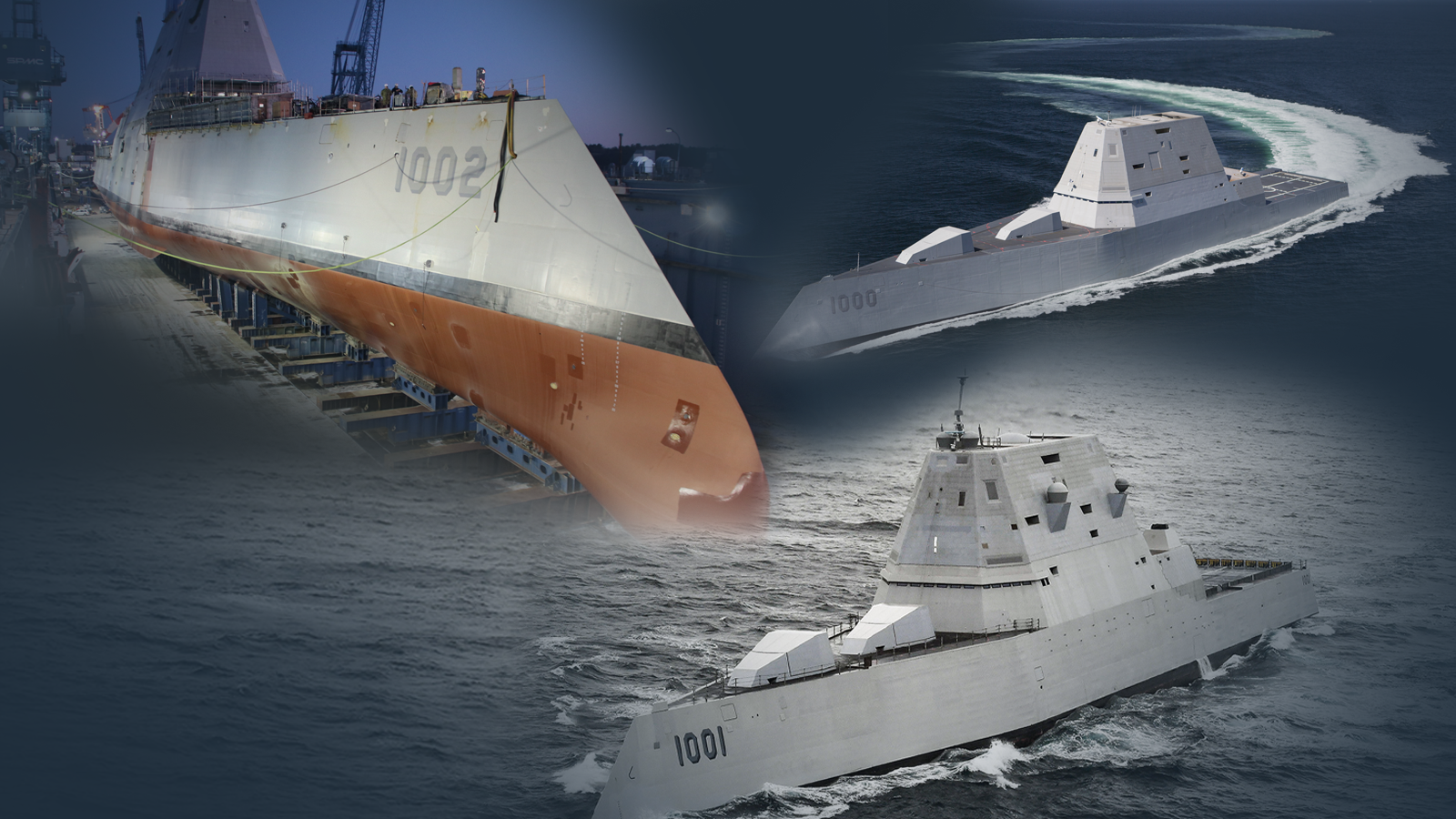
A trio of guided-missile destroyers built at Bath Iron Works is being given a new strategic thrust to help salvage original problems with the vessels.
They will now be designated as the nation’s front line of supersonic naval weaponry, defense officials announced.
“The U.S. Navy is repositioning its three Zumwalt-class guided-missile destroyers as the fleet’s first operational hypersonic strike warships, according to the May 2026 Shipbuilding Plan, transforming a once-controversial destroyer program into a central element of future American naval warfare,” ArmyRecognition.com reported Thursday.
The three Bath ships include the USS Zumwalt, USS Monsoor and USS Lyndon B. Johnson.
The 600-foot Zumwalt, launched from Bath Iron Works in 2013, is the lead ship of the Zumwalt class.
The Monsoor was launched from Bath in 2016 and the Johnson in 2018.
The U.S. Navy Shipbuilding Plan released earlier this month shows that the Zumwalt-class destroyers “are entering a new strategic phase that goes far beyond a standard modernization program,” Army Recognition said in its story.
“The document confirms that USS Zumwalt (DDG 1000), USS Michael Monsoor (DDG 1001), and USS Lyndon B. Johnson (DDG 1002) are now assigned the primary mission of Offensive Surface Strike and will undergo extensive modifications to integrate the Conventional Prompt Strike weapon system, giving the U.S. surface fleet its first long-range hypersonic strike capability,” the news outlet says.
“More importantly, the Navy now presents the Zumwalt class as the technological bridge between existing destroyers and the future nuclear-powered Battleship, designated BBGN in the plan, making these ships a key stepping stone in the evolution of American surface warfare,” it added.
The destroyers have been under fire from Congress for failed systems, according to a recent national security analysis.
The Zumwalt was the largest and most costly destroyer ever built in the U.S.
Before it even started to build the first of three Zumwalts, Bath Iron Works had to spend $40 million to make a special facility just to produce the ships.
“That gives you an idea of the magnitude of the program and its expenses,” Brent Eastwood of National Security Journal said late last year. “The entire program ballooned to 50 percent greater cost than expected.”
The Navy’s plan to salvage the troubled Zumwalt-class destroyers by arming them with Conventional Prompt Strike (CPS) hypersonic missiles by 2030 has now been solidified.
“Difficult as the path may be to get there, it could save a troubled, expensive program that has yet to live up to its potential,” Eastwood said.
The Mach +5 hypersonic glide missiles that are replacing the fleet’s failed 155mm advanced main gun systems would be the first-sea based hypersonic weapon.
The new plan for the ships “marks a doctrinal shift in the role of the Zumwalt class,” says Teoman S. Nicanci, defense analyst for Army Recognition.
“Originally designed around land attack and naval surface fire support, the class lost much of its original mission after the cancellation of the long-range ammunition intended for its Advanced Gun System,” Nicanci said. “The Navy now redefines the ships around Offensive Surface Strike, a mission set that places them in the high-end fight as low-observable strike combatants rather than experimental destroyers with uncertain purpose.”
The real significance of the newly announced plan “is not simply that the Zumwalt class will receive hypersonic strike weapons,” he added. “The deeper revelation is that the U.S. Navy now sees these three ships as the first operational bridge toward a new generation of American surface strike warships.”
The Zumwalt had an unusually dramatic kickoff during sea trials off the Maine coast in 2015, responding to a U.S. Coast Guard call for assistance when a fishing boat captain had a medical emergency 40 miles off Portland.
Due to deck conditions, the Coast Guard helicopter was unable to hoist the patient from the fishing boat, so Zumwalt’s crew used its rigid-hulled inflatable boat to transfer him to the destroyer.
From the Zumwalt he was transported to shore by the Coast Guard helicopter and then to a hospital.
Since its halcyon beginnings rescuing fishermen in crisis, the Zumwalt and its sisters have faced their own difficulties finding their sea legs.
But the latest sea-battle plan is seen as a way to salvage their future – as well as protecting billions in taxpayer dollars that originally went into the controversial Zumwalt class of destroyers.