

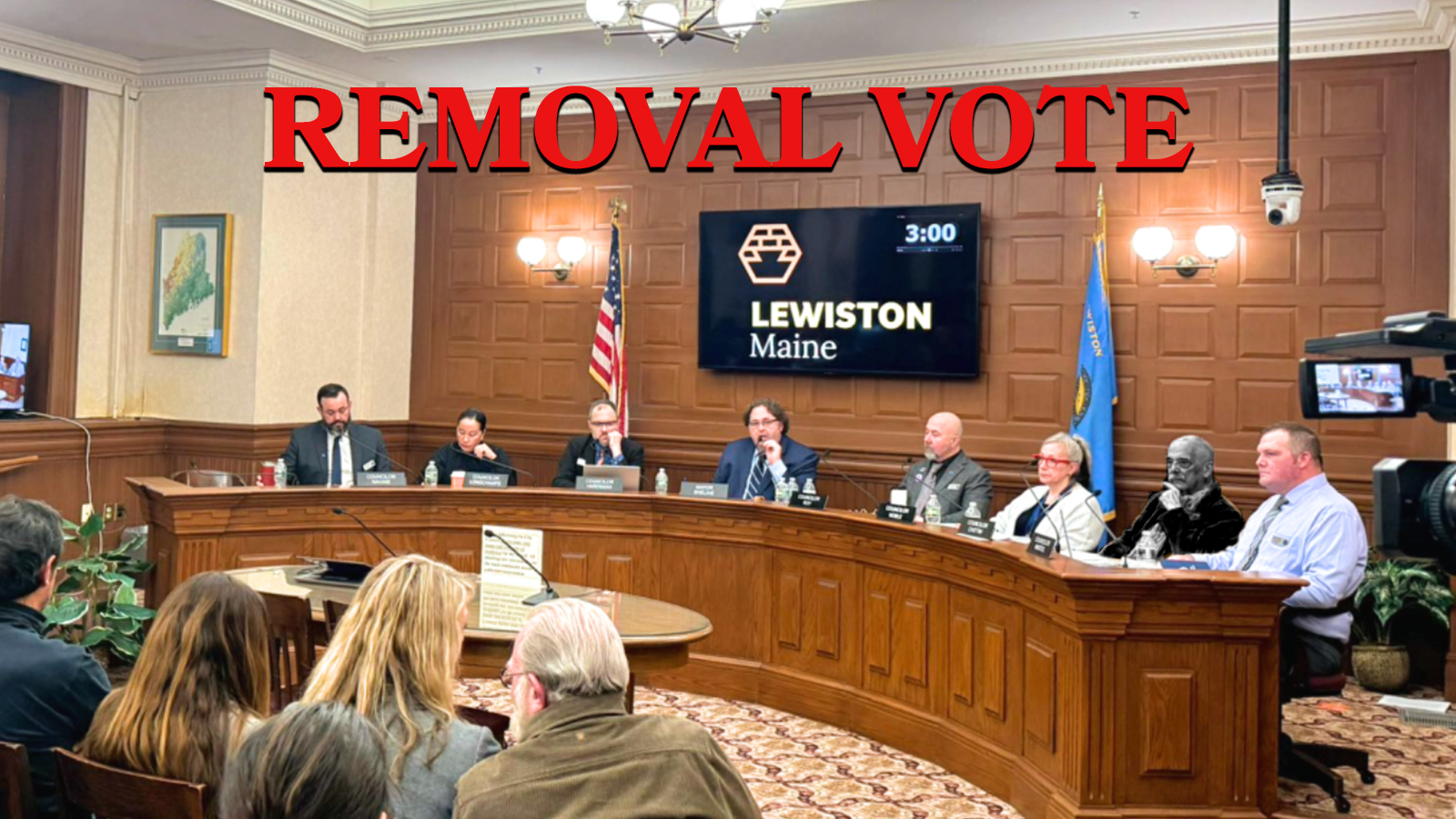
The Lewiston City Council could remove Council President David Chittim from his leadership position Tuesday following months of controversy over his attempts to reverse council decisions, his suggestion that the council could ignore the city charter, and his response to survivors of the 2023 mass shooting.
Two items on the council’s July 21 agenda could bring Chittim’s tenure as president to an early end.
The first asks councilors to rescind Vote 12-2026, the Jan. 5 vote that elected Chittim as council president for 2026. If that measure passes, the council would immediately accept nominations and elect a new president to serve through Jan. 4, 2027.
Councilor Bret Martel requested that both items be placed on the agenda.
City Administrator Bryan Kaenrath offered no formal recommendation on the proposals. The agenda information sheet states only that the leadership of the City Council is a policy decision for its elected members.
The unusual attempt to remove a sitting council president comes after an increasingly turbulent period at City Hall during which Chittim has repeatedly clashed with other councilors and drawn criticism for his handling of major issues confronting Lewiston.
Chittim, a retired professional engineer and land surveyor, represents Ward 6. He holds a master’s degree in environmental engineering from Purdue University and has served on several local boards and organizations, including the Historic Preservation Review Board and the Androscoggin Historical Society.
His background in city affairs helped elevate him to the council presidency, but several councilors now appear prepared to reconsider whether he should continue leading the body.
The most recent conflict erupted after Chittim acknowledged that he had been trying to restore an economic development position eliminated by the council during the municipal budget process.
The position had been removed through a supermajority vote, but Chittim continued looking for a way to fund it despite the council’s decision.
Chittim reportedly said he had been “moving heaven and earth” to find a way around restrictions contained in the Lewiston City Charter and council rules.
The remarks angered councilors who said Chittim was attempting to undermine a lawful vote and work around the will of the elected body he had been chosen to lead.
Councilor Chrissy Noble said the episode demonstrated why some residents distrust city government, while Councilor Joshua Nagine argued that Chittim’s actions undermined the council and placed city employees in an inappropriate position.
Chittim eventually agreed to stop pursuing funding for the position, although he continued to maintain that the council had made the wrong decision.
The dispute reinforced concerns that Chittim has used the presidency not simply to manage council business, but to revisit or circumvent decisions with which he personally disagrees.
It was not the first time Chittim faced criticism involving the city charter or the authority of fellow councilors.
Earlier in the year, Chittim was roundly criticized after suggesting the council could disregard or work around provisions of Lewiston’s charter while attempting to fill a vacant council seat.
The city charter is Lewiston’s governing document and establishes the powers, responsibilities and procedures that city officials are required to follow. Critics argued that the council president, more than nearly any other municipal official, should be expected to defend and follow those rules rather than openly discuss ignoring them.
The controversy arose during the council’s appointment of Noble to fill the vacant Ward 5 seat.
Martel criticized the appointment process and described the proceedings as a “kangaroo court.” He later said Chittim called him and warned that his public remarks could amount to conduct unbecoming a councilor or violate the council’s ethics policy.
Martel also criticized Chittim for discussing whether the council should ignore portions of the charter to achieve its preferred outcome.
Chittim’s comments drew widespread criticism from residents and council observers who argued that elected officials cannot selectively disregard the charter simply because its requirements are inconvenient or stand in the way of a desired result.
The episode also fueled accusations that Chittim was applying a double standard, warning another councilor about possible ethical violations while publicly considering whether the council itself should sidestep the city’s highest governing authority.
Chittim’s leadership has also been questioned over the city’s response to survivors and families affected by the Oct. 25, 2023, mass shooting.
Eighteen people were killed and 13 others were wounded when a gunman opened fire at Just-In-Time Recreation and Schemengees Bar and Grille.
More than two years after the massacre, survivors told city councilors that they were still struggling with medical expenses, lost income, permanent disabilities and lasting emotional trauma.
In February, Councilor Susan Longchamps proposed a voluntary city-led assessment to identify the remaining financial and personal needs of survivors and victims’ families.
The council unanimously voted to table the proposal after city officials raised concerns about privacy, legal authority and the potential overlap with existing victim-assistance programs.
The vote came during an emotional council meeting in which shooting survivor Ben Dyer described being shot five times at Schemengees and spending 19 days in the hospital.
Dyer said survivors were not seeking wealth but were asking city leaders for accountability, assistance and answers about the millions of dollars raised in the aftermath of the attack.
“We’re individuals just asking for accountability and support,” Dyer told the council. “And guess what? We don’t get it.”
During the meeting, Chittim appeared skeptical that the council could provide additional answers about the distribution of charitable donations.
He said questions concerning the money had been answered “over and over and over again” and suggested the council might never satisfy those who remained unhappy with the explanations they had received.
The comments drew criticism from survivors and their advocates, who argued that the issue was not merely whether officials had previously explained the distribution process, but whether city leaders had directly assessed what survivors still needed.
Amy Sussman, the aunt of shooting victim Max Hathaway, questioned why survivors and family members were limited to three-minute public comments rather than being invited to participate in a dedicated meeting or roundtable with city officials.
Families have demanded greater acknowledgment and accountability concerning the distribution of roughly $6.6 million collected through the Lewiston-Auburn Area Response Fund.
Approximately $4.7 million was distributed to 162 people directly affected by the shooting, while about $1.9 million went to nonprofit and community organizations.
The Maine Attorney General’s Office previously said it found no evidence that the Maine Community Foundation mishandled the donations.
Critics of Chittim argue that the legality of the foundation’s actions is separate from the city’s responsibility to determine whether survivors remain in need.
They say city officials could have used their positions to bring survivors together, identify unmet needs and connect families with state, federal or private assistance.
Instead, Lewiston did not seriously begin considering a formal assessment of those needs until early 2026, more than two years after the shooting. Even then, the initial proposal was tabled rather than immediately approved.
The council later invited representatives from the Maine Resiliency Center to discuss services available to victims and their families, but survivors continued to argue that the city’s response had been too slow and too limited.
Chittim has also faced criticism for remaining relatively quiet as Lewiston has experienced continued gun violence, much of it involving juveniles.
Police reported 19 shootings during the first half of 2026, matching the number recorded during the same period the previous year. Twelve of those incidents involved juveniles.
Lewiston police have repeatedly warned city officials about stolen firearms, repeat juvenile offenders, staffing shortages and the limited availability of secure detention and treatment programs.
Critics say the council president has not consistently used his leadership position to demand additional resources, stronger accountability or immediate action from state officials.
Chittim’s defenders could argue that the council president has limited independent authority and that responsibility for public safety and victim services is shared among the mayor, city administrator, police department and the full council.
The council president, however, is expected to manage meetings, maintain cooperation among councilors and serve as a liaison between the elected body and city administration.
The position depends heavily on the confidence of a majority of councilors.
Tuesday’s vote will determine whether Chittim still has that confidence.
If the council rescinds his January election, nominations for a replacement would be accepted immediately. The successful candidate would serve as council president for the remainder of the current term, which expires Jan. 4, 2027.


I just hope there is zero tolerance for Pork Bellying.One of the esteemed senate candidates brought this nationwide problem to light.Lewiston has enough issues to worry about we don’t need to have to deal with Pork Bellying also.