

The tiny St. John River Valley town of Allagash (population 240) has long been the butt of Maine jokes about its handful of last names and family trees that don’t so much branch as tangle.
Now Democratic U.S. Senate candidate Troy Dale Jackson, 58, and on his fifth pacemaker, finds his own ancestry under the same microscope that eventually ran his predecessor, oyster hobbyist Graham Platner, out of American politics and into hiding.
Jackson, a 26-year politician and lobbyist, has made a career of bragging that he’s a is a fifth-generation logger, but you don’t have to go far back the generational line to find where it crosses paths with the ancestors of his significant other Lana M. Pelletier


Allagash tipsters and genealogical records confirm that Jackson’s longtime significant other, Lana Pelletier — his high school sweetheart and the mother of his two adult sons, Chace and Camden — is, in fact, his second cousin by blood.
Jackson and Pelletier share the same great-grandparents: Thomas Pelletier and Edith Thibodeau. Thomas and Edith’s daughter Albertine was Troy’s grandmother; their son Louis Sr. was Lana’s grandfather. That makes Troy and Lana second cousins on the Pelletier line.
The pair has been together for Jackson’s entire political career, stretching from his early days as a pro-gun, pro-life, conservative working-class rabble-rouser in the late 1990s and early 2000s through his rise to become a pro-gun-control, pro-late-term-abortion socialist state Senate president.
Pelletier has eschewed the spotlight, slugging along at various state jobs while Jackson has pursued his political ambitions and lucrative side hustles as the political enforcer for Maine’s dwindling labor movement.
Now, his sudden elevation as the Democratic nominee to challenge Republican Sen. Susan Collins has brought renewed focus to both candidates, with left-wing muckrakers circulating conspiracy theories about Sen. Collins’ love life and the retirement investments of her husband. But the more curious significant-other story in the Senate race might just be the Aroostook romance that could have taken root at an Allagash family reunion.
Jackson has, at various points, referred to Pelletier as his wife in official bios and statements. Locals in the historically Catholic village of Allagash, however, are quick to set the record straight with the dry precision of people who have known both families — or just the one family, depending on your perspective — for generations: The couple is not, and has never been, legally married.
They simply live together, raise kids together and appear together on the occasional mortgage and lawsuit paperwork. In a place where everyone knows everyone’s business, the lack of a marriage certificate is less a scandal than local trivia.
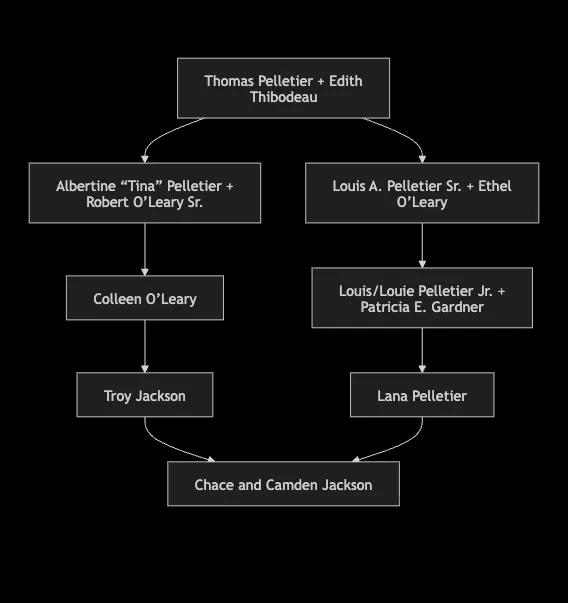
The Family Wreath: Jackson and Pelletier’s common great-grandparents were Thomas Pelletier and Edith Thibodeau Pelletier. Thomas and Edith had two children who matter here: Albertine Pelletier O’Leary and Louis A. Pelletier Sr. Albertine was the mother of Colleen McBreairty, and Colleen was the mother of Troy Jackson. Louis Sr. was the father of Louis A. “Louie” Pelletier Jr. Louie Jr. and his wife, Patricia “Patty” Gardner Pelletier, were Lana Pelletier’s parents. That means Colleen McBreairty and Louie Pelletier Jr. were first cousins. Their children, Troy Jackson and Lana Pelletier, are second cousins because they share the same great-grandparents: Thomas and Edith Pelletier.
Read “The Book of Troy” only at The Robinson Report

Second Cousins, Not First: The Critical Distinction
Before the pearl-clutching begins, let’s be precise — because the difference between first-cousin and second-cousin relationships is both legal and biological, and Maine law draws a bright line.
First cousins share a pair of grandparents. They inherit, on average, about 12.5 percent of their DNA from the same recent ancestors. That shared genetic material raises the risk of recessive genetic disorders in any children roughly twofold compared with the general population — from a baseline of about 2–3 percent for major birth defects to roughly 4–6 percent, according to reviews by the National Society of Genetic Counselors and studies published in the Journal of Genetic Counseling.
In short, Western man has, for millennia, tabooed first-cousin marriage because the progeny of such unions frequently exhibit physical deformities and severe cognitive impairment. That’s part of why Pakistani culture — both in Pakistan and in the British Isles, which Pakistani people have been colonizing for half a century — is notoriously maligned for astronomically high rates of consanguinity, a cultural fact that has materialized across the U.K. with obvious consequences.
Maine law reflects the concern that Pakistani-style incest should be prohibited. Bizarrely, the law was introduced only during the Reagan administration.
In 1985, the 112th Maine Legislature passed LD 873/H.P. 603, titled “An Act to Prohibit Marriage Between Certain Blood Relatives.” It was enacted as Public Law 1985, Chapter 181, and took effect on September 19, 1985. Under Title 19-A, §701 of the Maine Revised Statutes, marriage between first cousins is prohibited — but not completely.
First cousins who find their love destined in the stars can obtain a physician’s certificate of genetic counseling. That’s thanks to an amendment two years later that created a pathway for familial lovers who really wanted to test the genetic lottery. The counseling requirement has been on the books since the mid-1980s, with clarifying language added in the 1990s, making Maine one of the few states that permits first-cousin marriage if Dr. Deliverance signs the permission slip.
Second cousins, by contrast, share a pair of great-grandparents. Their coefficient of relationship is only about 3.125 percent — roughly a quarter of the first-cousin figure. Geneticists regard the elevated risk of recessive disorders as negligible compared with the risk for closer cousins.
Maine imposes no special restrictions on second-cousin marriage; it is treated like any other union between consenting adults. Jackson and Pelletier fall squarely into this second category — should they ever decide to formally get hitched.
Family records and local knowledge in Allagash identify them as the children of first cousins: Jackson’s mother, Colleen (O’Leary) McBreairty, and Pelletier’s father are first cousins through the Pelletier line that runs deep in the St. John Valley.
That makes the couple second cousins by blood — close enough for small-town knowing glances, distant enough that the law and biology shrug.
American Politics’ Long, Awkward History with Cousins
If the revelation feels awkward in 2026, American political history offers a robust, if slightly squirm-inducing, context. Cousin marriage — or at least cousin coupling — is practically a Founding-era tradition, practiced by figures far more exalted than a logger-lobbyist who now makes his home in Augusta.
John Adams, the second president, married Abigail Smith, his third cousin. Thomas Jefferson married Martha Wayles Skelton, also his third cousin. Martin Van Buren wed Hannah Hoes, his first cousin once removed. Franklin D. Roosevelt married Eleanor Roosevelt, his fifth cousin once removed — a degree of relatedness so remote that geneticists treat it as essentially unrelated, yet still close enough that the Roosevelt name stayed comfortably in the family.
John Adams’ grandson, John Adams II, married his first cousin, Mary Catherine Hellen, in a White House ceremony. Alabama Gov. Bibb Graves married his first cousin, Dixie Bibb. Even modern figures have gotten in on the act: Former New York City Mayor Rudy Giuliani’s first marriage was to Regina Peruggi, his second cousin once removed.
The practice was once common among the Anglo-American elite for the same reasons it persists in many traditional societies: keeping property, status and political alliances inside the extended family. It acquired its modern stigma only in the late 19th and early 20th centuries, as genetic science advanced and Progressive Era reformers began targeting “inbreeding” among the rural poor and certain immigrant groups.
By the time Maine adjusted its statutes in the 1980s, the cultural taboo had hardened, even as the actual genetic risk for second cousins remained trivial.
The Allagash Reality Check
In Allagash itself, the Jackson-Pelletier arrangement has been an open secret for decades. The couple’s two sons are grown. Pelletier works as a clinical care specialist with the Maine Department of Health and Human Services. Jackson has built a political brand on being the authentic working-class guy from the far north woods.
The fact that his domestic partner is also a blood relative of the second-cousin variety may strike outsiders as the punchline to a Deliverance joke. The comparisons between Appalachia and Allagash write themselves.
To locals who have watched the same surnames — Pelletier, McBreairty, Jackson and O’Leary — recycle through town records for generations, it is simply another data point in a place where the dating pool is shallower than the trout streams.
Jackson has never publicly addressed the cousin connection. His campaign materials continue to describe Pelletier as his “partner.” Older official bios occasionally slipped into “wife.”
In the grand tradition of American politics, where presidents married their cousins and the republic somehow survived, Troy Jackson and Lana Pelletier’s arrangement is less a scandal than a footnote written in the fine print of a very small town’s genealogy.
Where the relationship between Jackson and Pelletier may have real political consequences comes down to the rules of the secretary of the U.S. Senate, who handles the financial disclosures that candidates and elected members of Congress are required to submit.
Typically, pols must submit detailed accounts of their income, assets and liabilities, as well as the finances of their spouses. But because Pelletier and Jackson never wed, and because Maine does not recognize any form of common-law marriage, it’s not clear whether Jackson’s financial disclosures will cover the second-cousin couple’s full financial situation.
If Pelletier, as merely the mother of Jackson’s adult children, is exempt from inclusion in the financial disclosures in a way that Collins’ husband is not, then the knitted family tree could engage in all kinds of clever accounting tricks to artificially impoverish Jackson as a way of maintaining his working-class image.
As of this week, Jackson hasn’t filed the disclosures or a request for an extension, and the circumstances of his nomination are so unusual that the secretary of the Senate has yet to say when Jackson will be required to make his finances transparent — or whether those disclosures will include assets placed under the name of his second cousin.
Full Disclosure: This author endorsed Troy Jackson’s candidacy for governor.
The Book of Troy: Five Tales from the Maine politics archives…




When two sets of siblings marry each other, their children are double first cousins because they share 100% of the same grandparents.
If Robert O’Leary Sr. is a sibling of Ethel O’Leary, then:
This doubles their coefficient of relationship. While standard second cousins only share about 3.125% of their DNA, Troy Jackson and Lana Pelletier share roughly 6.25% of their DNA. Genetically, this makes them as closely related as standard first cousins. Ooph…