

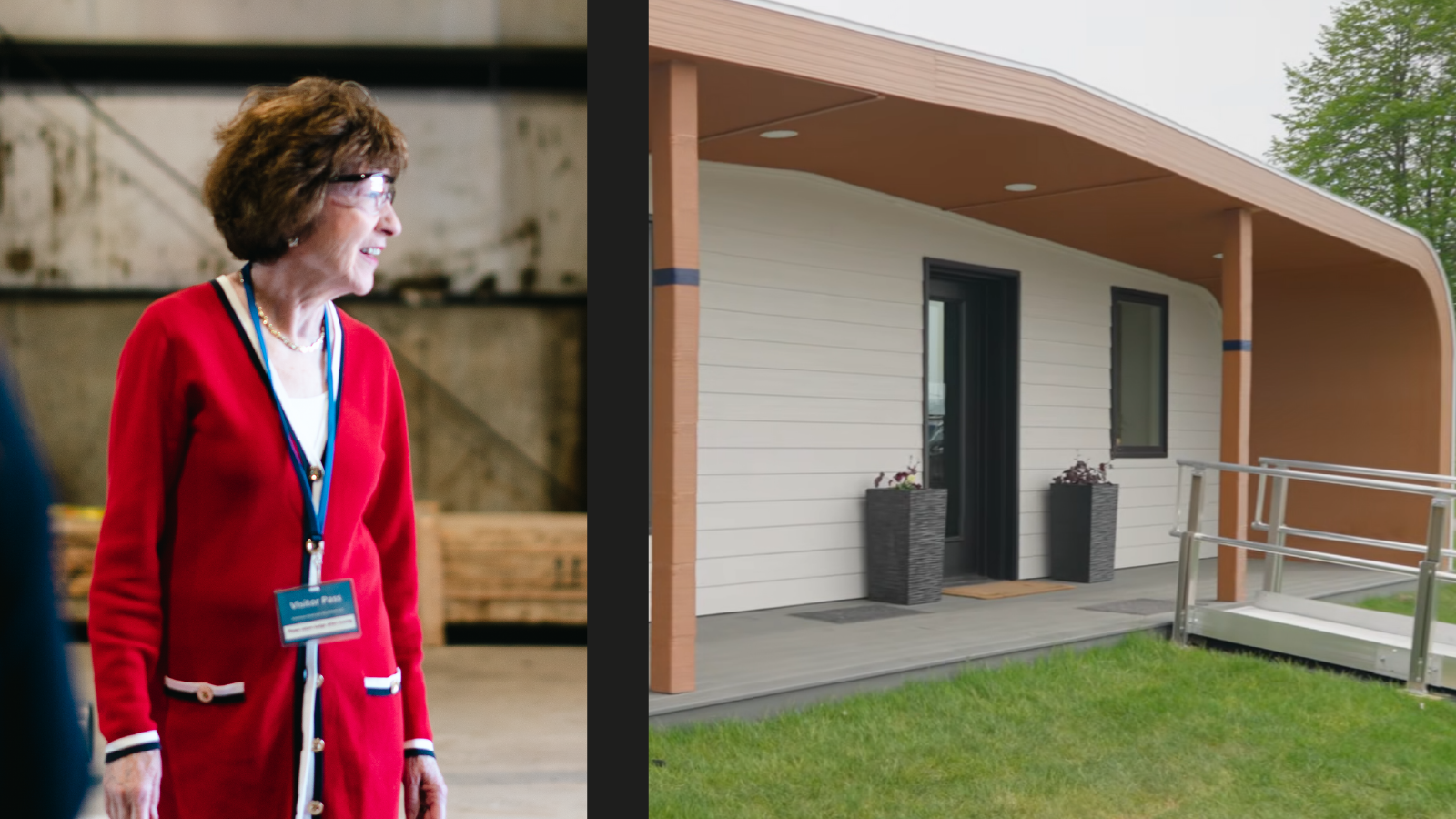
Sen. Susan Collins (R-Maine) announced on Wednesday that she has secured taxpayer funding to build 3D-printed houses for homeless people in the Bangor area amid overwhelming backlash against the similar Yellen Pines project in the city.
[RELATED: Bangor Council Approves 30-Year Tax Deal for Homeless Housing Despite Taxpayer Concerns…]
Sen. Collins bragged that she had secured a $4 million grant to build nine 600-square-foot houses in partnership with Penquis, a non-profit focused on a variety of services, including housing.
“I have long been proud to support the pioneering work of Dr. Habib Dagher and his team at the Advanced Structures and Composites Center, including by securing funding for its advanced manufacturing capabilities and for this project. By transforming recycled forest products into durable, energy-efficient homes, this innovative technology could help address our housing shortage, strengthen Maine’s forest products industry, and create new jobs across our state,” said Collins.
It is not clear how much of that $4 million grant will be directly spent on construction costs and how much is for a land purchase and technological advancement, however. If the funding is divided evenly between the houses, each would cost $444,444, at $740 per square foot.
Currently, only 22 properties in the entirety of Bangor are being sold for $450k or more.
Collins secured the funds through fiscal year 2024 appropriations.
The nine 3D-printed structures will house homeless people in the Bangor area. Though a specific address for the development has not yet been announced, Penquis was evaluating a potential site in Brewer.
It is not clear if any requirements will be imposed on homeless people seeking to live in one of these homes, or whether they will be “low-barrier” housing that allows residents to continue using drugs.
The Maine Wire reached out to Penquis, asking for that information and asking for more precise estimated construction costs.
They responded, saying that “those specifics have not been determined at this time.”
“Your questions are a bit ahead of where we are with the project. Those specifics have not been determined at this time, but we will be happy to share them with you when they are,” said Penquis Communications Manager Renae Muscatell.
“Significant planning work has already been completed, including the selection of an architectural and engineering partner. The project is now moving through the next stages of planning, including design considerations and identifying a potential location for the proposed neighborhood,” said Penquis Housing Development Director Lawrence Rodgers.
Though Penquis has apparently not decided whether the 3D-Printed project will be “low-barrier,” one of their other projects, Theresa’s Place in Bangor, is considered “low-barrier” and is explicitly available to homeless people with criminal histories.
The homes will be constructed using BioHome3D technology developed by UMaine with the help of $72 million in taxpayer funding secured by Collins, including the most recent $4 million.
The technology uses sawdust and residual wood from Maine sawmills as building material. A prototype of the homes was built on UMaine’s campus and unveiled in 2022.
Collins’ announcement comes as Bangor residents have repeatedly expressed outrage over the newly approved $11.2 million Yellen Pines homeless housing project.
That project is set to include 30 units, get 30 years of tax breaks from the city, and will cost approximately $373,000 for each roughly 400-square-foot unit.
The units will go to homeless people based on a need score that includes factors like drug use and criminality, with “needier” people taking precedence. The housing is “low-barrier.”


What a waste of money. 3D printed homes are only for academic studies, grants and PhD funding pet projects. It isn’t practical. More evidence that Suzie is tapped into the govt gravy train and not fiscally responsible like a real Republican.