

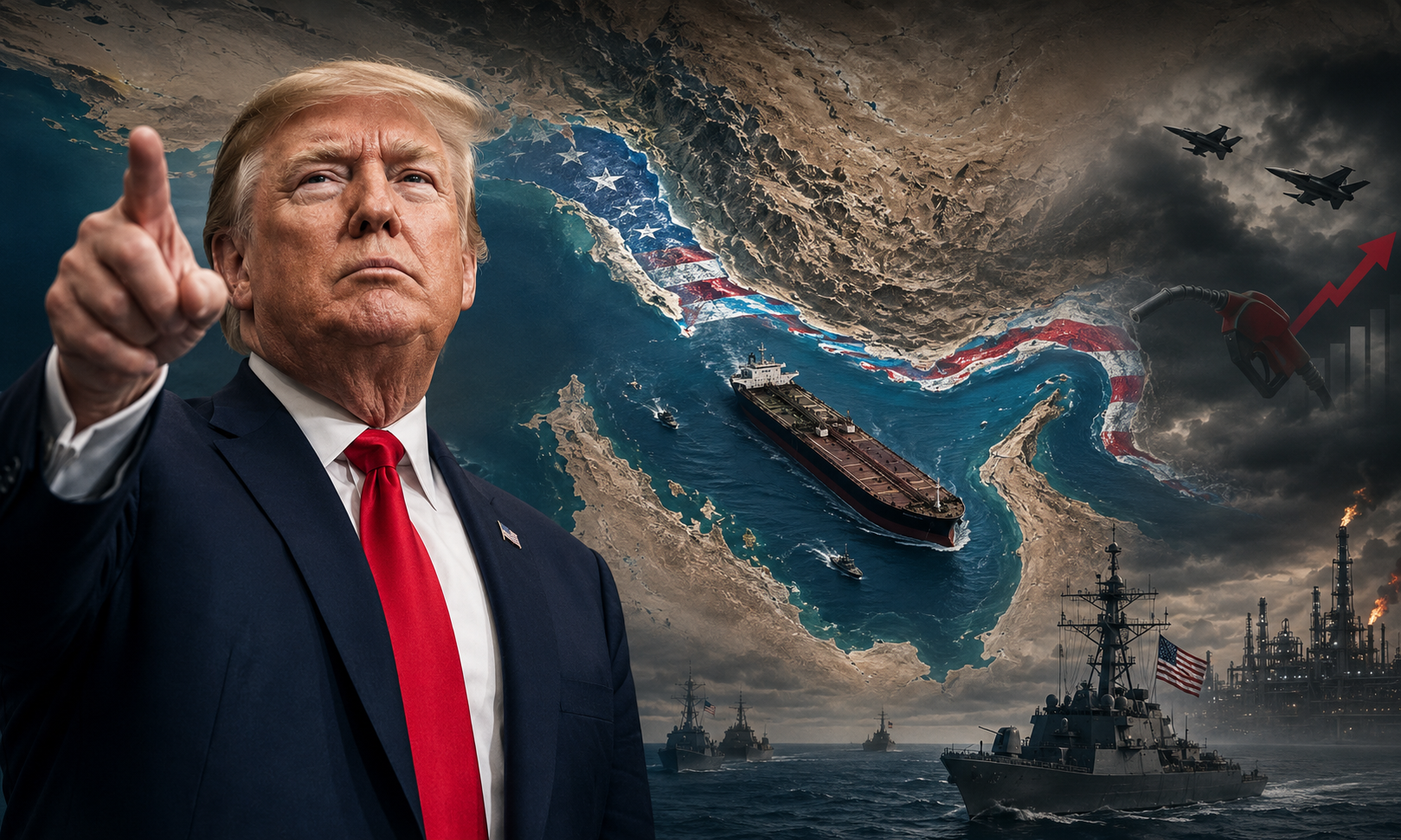
President Donald Trump dramatically escalated the war of words surrounding the Strait of Hormuz this week, posting an image portraying the strategically vital waterway as a “New US Territory” as hopes for a negotiated end to the nearly six-month conflict with Iran appeared to collapse.
Trump said Tuesday that there are no negotiations currently underway with Tehran and none scheduled, contradicting suggestions from other officials that diplomatic contacts could still be taking place behind the scenes.
“There are no talks or conversations going on, or scheduled, with the Islamic Republic of Iran,” Trump wrote on Truth Social, according to Reuters.
The statement came as a temporary agreement intended to provide a framework for ending the war expired without producing a lasting settlement.
Now, rather than diplomacy, Trump appears to be increasing pressure on Tehran — while simultaneously making the extraordinary suggestion that the United States should claim the Strait of Hormuz itself.
Trump posted a map depicting the strait as American territory after publicly entertaining the idea of placing the crucial shipping corridor under U.S. control.
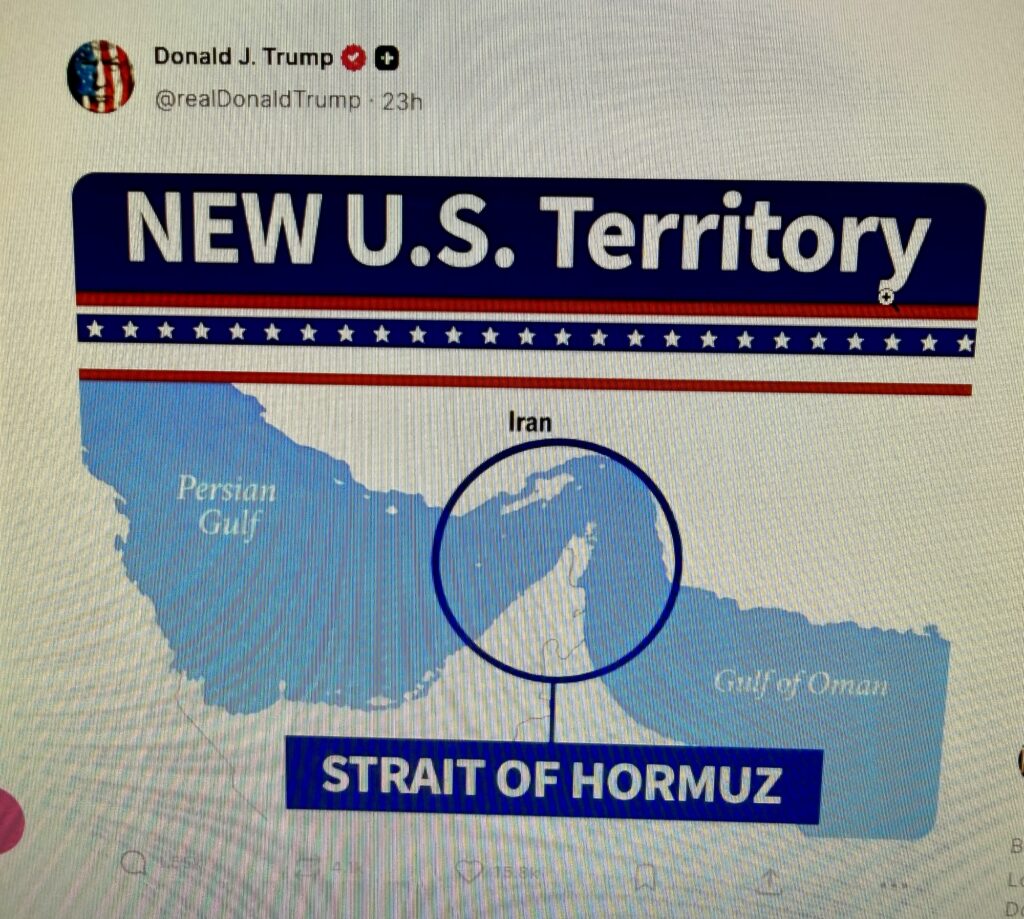
The Associated Press reported that Trump has suggested declaring the waterway American territory and posted a map advancing that position.
The Strait of Hormuz is one of the most strategically important waterways on earth, historically carrying roughly one-fifth of the world’s oil supplies and significant quantities of liquefied natural gas.
Any prolonged disruption has consequences far beyond the Middle East, including for drivers and businesses in Maine.
https://truthsocial.com/@realDonaldTrump/117116198386080523
Trump Says Strait Is Open; Iran Says It Isn’t
The increasingly heated rhetoric comes amid sharply conflicting accounts over who actually controls the Strait of Hormuz.
Trump maintains that the waterway is open and safe for commercial traffic.
Iran says the opposite.
Iranian officials insist the strait will remain effectively closed until Washington fulfills several demands, including lifting sanctions on Iranian oil, ending the U.S. blockade of Iranian ports, releasing frozen Iranian assets and stopping military threats and operations against Iran.
Shipping traffic remains severely constrained.
Reuters reported Tuesday that vessel movement through the strait remains minimal, despite Trump’s declaration that it is operating normally.
The disagreement underscores the central problem facing Washington: months of American military operations have not fully broken Iran’s ability to disrupt traffic through the waterway.
Reuters reported earlier this month that months of U.S. military action, including a two-week bombing campaign in July, had failed to eliminate Iran’s grip over passage through Hormuz.
Trump Threatens Oman
Trump has also turned his frustration toward Oman, traditionally one of America’s closest diplomatic intermediaries with Iran.
Oman has been attempting to negotiate its own arrangement with Tehran governing passage through the strait.
Those negotiations reportedly envision some degree of Iranian oversight of vessels entering the Persian Gulf, while Oman and other Gulf countries have proposed voluntary fees for ships using the waterway.
Washington has rejected the idea of Iranian tolls or fees, arguing that Hormuz is an international waterway that should remain open to unrestricted navigation.
Trump went considerably further.
The Associated Press reported that the president threatened to bomb Oman if the country interfered with American objectives surrounding the strait.
The comments were remarkable given Oman’s longstanding relationship with Washington and its traditional role as a diplomatic bridge between the United States and Iran.
Rather than abandoning its diplomatic push, however, Oman has continued negotiations with Tehran.
The proposed arrangement could ultimately become either a pathway back to negotiations or another point of confrontation between Washington and its Gulf allies.
Iran Hardens Its Position
Tehran, meanwhile, is showing few signs of backing down.
Iranian negotiator Mohammad Baqer Qalibaf has said the strait will remain closed until the United States complies with provisions Iran says were included in the June agreement.
That agreement, signed June 17, was supposed to create a 60-day framework for reaching a broader settlement involving the war, Iran’s nuclear program, sanctions and access to the Strait of Hormuz.
Instead, the framework unraveled.
Iran suspended participation after Washington declared the agreement effectively dead, while each side has accused the other of failing to honor its commitments.
A senior Iranian official told Reuters that Tehran is now moving toward what the official described as a “fully offensive” posture as diplomacy stalls.
So far, however, that declaration has not been followed by a major new wave of direct U.S.-Iran strikes.
The danger of escalation remains.
A commercial vessel passing through the Strait of Hormuz was recently damaged by a projectile, resulting in a crew casualty, while the United Arab Emirates reported detecting two ballistic missiles it said were launched from Iran toward maritime traffic. Tehran disputed responsibility.
The Price of the War Is Showing Up at the Pump
For Americans thousands of miles from the conflict, the most immediate consequence may be visible at the corner gas station.
Oil prices climbed again Tuesday as hopes for a U.S.-Iran peace agreement faded.
Brent crude settled at $91.02 per barrel, its highest closing level in more than three weeks, while West Texas Intermediate crude finished at $84.94 per barrel.
Gasoline prices have followed.
AAA reported Wednesday that the national average for regular gasoline had risen to roughly $4.09 per gallon.
Maine drivers are feeling the effects as well.
AAA data showed regular gasoline in Maine hovering at approximately $3.99 per gallon Tuesday, with Lewiston-Auburn averaging approximately $3.98.
That means a Middle East military confrontation taking place more than 6,000 miles away is increasingly hitting Maine families every time they fill their tanks.
The broader consequences could extend well beyond gasoline.
Higher oil prices increase transportation and shipping costs, which can eventually work their way into groceries, heating fuel, airline tickets and nearly every product transported by truck.
A War Without an Exit?
The conflict has now dragged on for nearly six months, despite repeated predictions earlier this year that a resolution could come quickly.
The United States and Iran reached what appeared to be a major diplomatic breakthrough in June, creating hopes that shipping through Hormuz would resume and the fighting would wind down.
Instead, the agreement collapsed.
Iran continues to demand sanctions relief and an end to military pressure before fully reopening the strait.
Trump has refused to remove the naval blockade and now says there aren’t even negotiations underway.
And the president’s suggestion that America should simply claim one of the world’s most important international waterways has injected a new and unpredictable issue into an already combustible confrontation.
For now, Trump insists the United States controls the situation and the Strait of Hormuz is open.
Iran insists it does not.
Commercial shipping remains severely disrupted.
Oil is back above $90 a barrel.
And American motorists, including Maine drivers now paying roughly $4 for a gallon of gasoline, are increasingly paying the price for a war that once appeared headed toward a negotiated conclusion but now appears to have no clear diplomatic off-ramp.


I for one am sick of listening to Trump talk about this .
He needs to get it done and if destroying Iran some more we need to do it .
These crazy Muslims can’t be trusted to do anything but cheat , lie , and steal .
47 years and counting they’ve been Fu*@king with us .
They’ll just BUY a yard sale Nuke from North Korea if they want one .
Level that Kargh Island once and for all ……PUT THE IRANIANS OUT OF THE OIL BUSINESS .
Once and for all . GET IT DONE .
STOP talking about it .
Declare a national energy emergency so no American oil can be sold for non American use. OR make a law stating any oil taken out of America belongs to the people. Pay the oil co to extract and deliver it only.
Once again, the United Nations has shown just how useless it is.
“If you’re losing a war, just war harder” – Sun Tzu
Normal not high class elite cannot afford high oil and gas prices. This includes 95% of all Mainers. Either make Iran one big sandbox or get out of OPEC so only American oil is our sole supplier which would drastically cut the price of 2 oil. Winter is only a few mos away, who can afford 600 bucks for a 100 gals of oil? Not me, not anyone I know. This President talked a great talk, but refuses to follow up on any of his talk with appropriate actions, and dont even get me started on the promise he made of major arrests of politicians that again, was all blowhard talk, no action.
Israel first! Calm down goyim
Great now do the same for maine
Plot twist, MiG29Pilot and Hohn White ……same person. I know shocking.