

Maine has suddenly become a regular stop for some of the most powerful figures in President Donald Trump’s administration and Republican leadership in Washington.
Vice President JD Vance came to Bangor in May. Centers for Medicare and Medicaid Services Administrator Dr. Mehmet Oz traveled to Portland earlier this month. House Speaker Mike Johnson appeared alongside former Gov. Paul LePage in Auburn earlier this week.
On Wednesday, it was U.S. Energy Secretary Chris Wright’s turn.
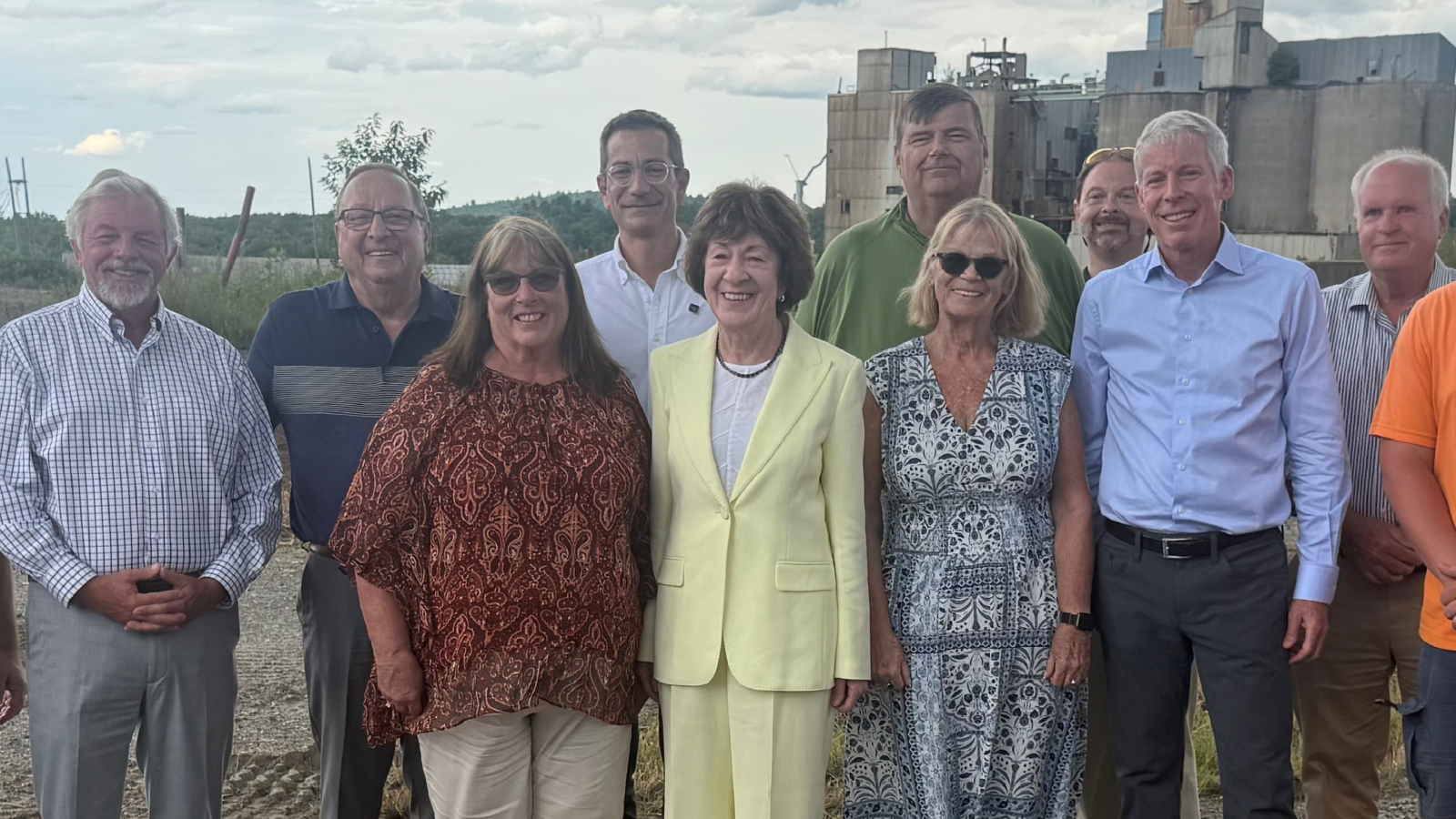
Wright traveled to Lincoln, where he toured the former Lincoln Paper and Tissue mill property that is being redeveloped into a sprawling technology park — including a planned energy storage facility that supporters say could fundamentally change how Maine and the broader New England power grid handle periods of extreme electricity demand.
The visit brought Wright together with Republican U.S. Sen. Susan Collins and LePage, the Republican nominee for Maine’s 2nd Congressional District, at a time when electricity costs, grid reliability and energy policy have become increasingly important political issues in Maine.
The planned Form Energy project will occupy roughly 50 acres of the former mill property and use a relatively new iron-air battery technology designed to store electricity not simply for a few hours, but for days.
According to Form Energy and local officials, the Lincoln system could store and discharge enough electricity to supply at least 65,000 households and continue operating for more than four days, potentially providing power during prolonged cold snaps, storms or other periods when electricity demand spikes.
Wright used Wednesday’s visit to make the case that long-duration storage could address a weakness in conventional battery systems.
“How long do those high pressure systems and peak demands last? They last a few days,” Wright said, contrasting the proposed Form Energy system with batteries capable of providing power for only several hours.
“What Form Energy is going to build here is a battery that will run for more than four days,” Wright said. “It’s energy storage that’s matched with the problem.”
From a shuttered mill to an energy hub
The project carries particular significance for Lincoln.
The site once housed the Lincoln Paper and Tissue mill, an economic anchor for the region before the facility shut down in 2015. The property is now being redeveloped as the Lincoln Technology Park under a long-term town strategy aimed at attracting advanced manufacturing, energy and technology companies.
Form Energy describes its batteries as relying primarily on iron, water and air rather than some of the materials traditionally associated with lithium-ion batteries. The technology essentially uses a reversible rusting process to charge and discharge electricity.
The Lincoln installation is expected to become one of the largest multi-day battery storage facilities of its kind in the world.
The project received approximately $147 million in federal support through a grant announced in 2024. If remaining regulatory approvals are secured, construction is currently expected to begin in 2028.
That timeline means Wednesday’s event was less a groundbreaking than a preview of what supporters hope the former mill property can eventually become.
But Wright’s presence also brought national attention to a project that sits directly in the middle of one of Maine’s biggest policy debates: how to provide reliable electricity without continuing to drive up costs for ratepayers.
Maine’s electricity debate takes center stage
Maine residents have endured repeated increases in electricity costs in recent years while the state continues pursuing aggressive renewable energy and electrification policies.
At the same time, the aging New England grid faces growing pressure from electrification, winter demand, proposed data centers and the retirement of older generating resources.
The Lincoln project is intended to act almost like an enormous energy reserve.
Electricity could be stored when supply is plentiful and then released for days when weather, demand or other conditions strain the grid.
For Wright, that distinction is important.
Rather than relying on shorter-duration batteries that can provide electricity for only two or four hours, the Lincoln system is designed around the reality that New England’s most serious grid challenges can last for days.
“We’re going to have additional grid capacity that’s going to run through that storm from this energy system,” Wright said Wednesday.
Collins has been closely connected to the project since its inception. She was part of the congressional delegation that announced the federal funding in 2024, and the grant originated from the Grid Resilience and Innovation Partnerships program created through the bipartisan infrastructure law she helped negotiate.
Another heavyweight visit to Maine
Wright’s appearance is also noteworthy for another reason.
It continues a remarkable stretch in which Maine, particularly the state’s more politically competitive 2nd Congressional District, has attracted attention from senior members of the Trump administration and national Republican leadership.
Vice President Vance visited Bangor on May 14 for a White House event focused on combating fraud in taxpayer-funded programs. The Bangor event was the first White House event in Maine since Trump began his second term. Vance was joined on the trip by administration officials and was greeted in Maine by LePage.
Then came Dr. Oz.
The CMS administrator traveled to Portland on Aug. 4 as part of his examination of alleged Medicaid fraud and questionable health care billing in Maine.
During that visit, Oz spoke directly with this reporter about concerns involving MaineCare billing and services for people with autism, including questions about whether taxpayer-funded services were being properly documented and legitimately delivered.
Oz said federal officials were seeing cases in Maine where services had been billed and paid for without sufficient supporting documentation, and he raised broader concerns about potential fraud involving programs serving adults with autism and intellectual disabilities.
The issue has gained particular attention after federal officials began scrutinizing rapidly growing Medicaid spending and billing patterns in several states.
Earlier this week, House Speaker Mike Johnson also came to Maine, appearing with LePage at Auburn Concrete as the former two-term governor campaigns for the open 2nd Congressional District seat.
Now Wright has arrived in Lincoln, once again with LePage present.
The series of visits is difficult to ignore in an election year.
Maine’s 2nd Congressional District is expected to be one of the most closely watched House races in the country following Democratic Rep. Jared Golden’s decision not to seek another term.
LePage is attempting to return to elected office against Democrat Matt Dunlap, Maine’s former secretary of state and current state auditor.
Meanwhile, Collins is seeking another term in what is expected to be one of the country’s marquee U.S. Senate contests.
The repeated appearances by nationally prominent Republicans give Maine GOP candidates something campaigns often struggle to generate on their own: national attention.
But the officials traveling to Maine have also focused on issues with direct relevance to voters here.
Vance talked about fraud.
Oz discussed MaineCare, autism services and potential fraud directly with this reporter.
Johnson spoke about the economy and LePage’s congressional campaign.
And Wright came to talk about one of the subjects Mainers encounter every month when they open their utility bills: energy.
Maine increasingly on Washington’s radar
For a state with just 1.4 million residents and four electoral votes, Maine has received an unusual level of attention from Washington in recent months.
Part of the explanation is political.
The 2nd District remains one of the relatively few congressional districts where voters have repeatedly supported Trump while also electing Democrats to Congress. Control of the House could once again hinge on a small number of competitive districts like Maine’s.
Collins’ Senate race adds another national contest to the equation.
But Wednesday’s visit to Lincoln demonstrated that politics is only part of the story.
The former mill site represents a challenge familiar to communities throughout rural Maine: what comes after a major employer disappears?
If the Form Energy project succeeds, an industrial property that once produced paper could eventually become home to one of the world’s largest long-duration battery installations, storing electricity for tens of thousands of New England homes.
There are still permits to obtain, construction to complete and years to go before the batteries begin operating.
For one day, however, a former paper mill in Lincoln became the latest place in Maine to draw the attention of Washington.
And judging by the parade of national figures who have traveled north in recent months, it may not be the last.


I thought Angus King was all about this fancy new battery farm …..he was too busy to attend ?
Isn’t he an “ Independent “ ….if he’s truly a-political ….he could attend …..couldn’t he . ?
Mark My Words ……This thing is going to be a giant financial boondoggle ….
Spend the money on “ the grid “ instead ….replace fifty thousand old bent rotten power poles that line the state .
Clear the tens of thousands of trees overhanging the lines that break in the snow every year .
The minimal amount of power that the thing actually stores will probably get sent to Massachusetts anyway .
So WHERE WAS ANGUS ?
Angus?? He is too busy packaging bathmats.
You’re right !
Angus liked those bath mats so much he bought the company !
Private investors, right? No deficit dollars right?