

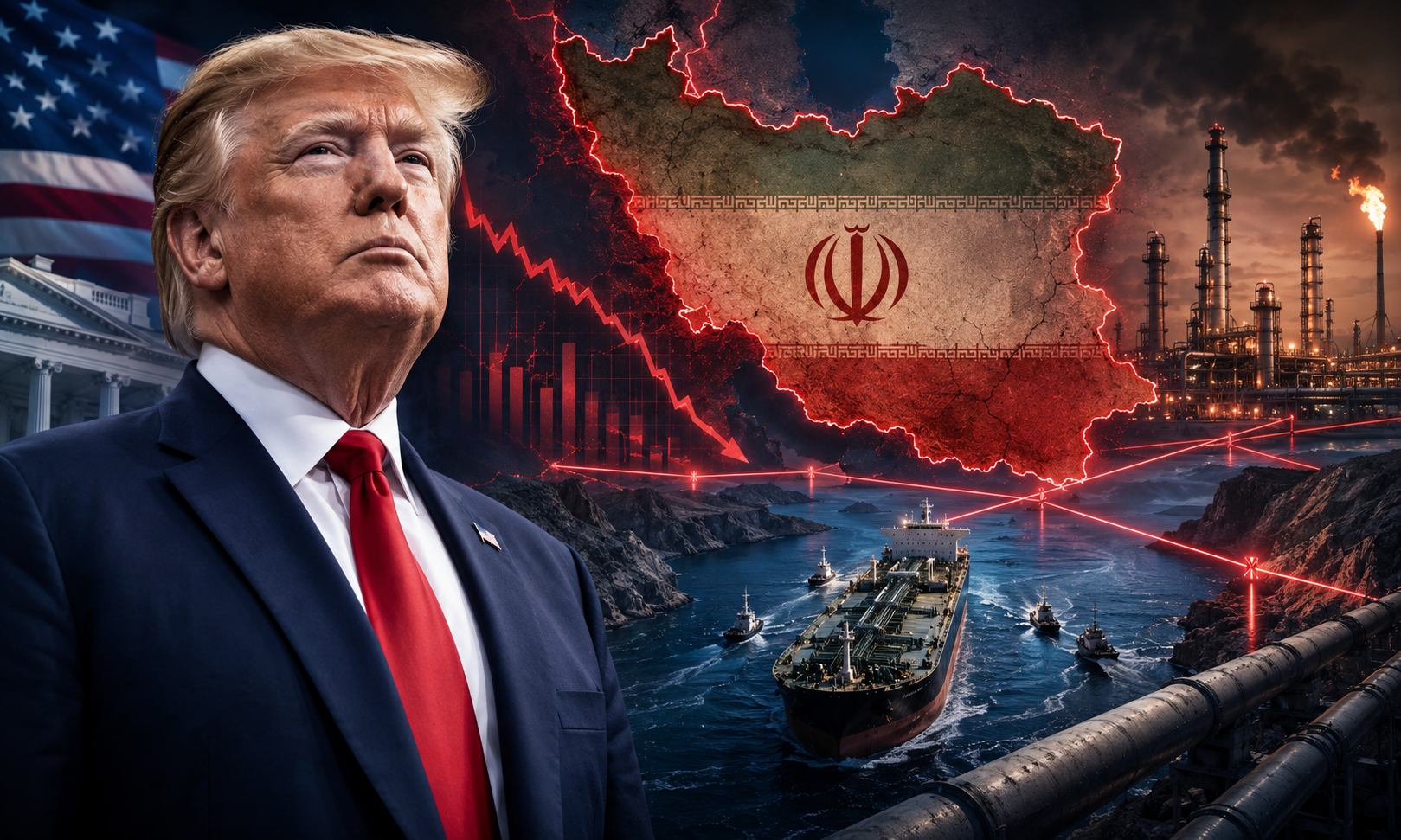
President Donald Trump is dramatically escalating economic pressure on Iran, threatening severe consequences for countries, banks and businesses that continue helping Tehran as nearly six months of war show few signs of ending.
Trump announced Wednesday what he described as the “most crushing economic operation ever taken against any country,” declaring that the United States would pursue “Economic Warfare and Isolation on an unprecedented scale” after diplomatic efforts to end the conflict again stalled.
“ANY country that allows its financial institutions, businesses, airports, or government entities to provide any type of lifeline to Iran will itself face TREMENDOUS Economic Consequences,” Trump wrote in a Truth Social post, according to multiple reports.
The president specifically targeted Iran’s oil-smuggling networks, financial transfers, exchange houses, ship registrations, front companies and other mechanisms Tehran has used to work around years of international sanctions.
The latest move represents a significant shift toward economic pressure after months of military operations, failed ceasefires and unsuccessful attempts to negotiate a lasting agreement with Tehran.
Trump said Tuesday that no negotiations with Iran were currently underway, despite intermittent attempts by regional governments to reopen diplomatic channels. Iranian officials, meanwhile, maintain that they remain willing to negotiate but will not accept what they characterize as demands for surrender.
Iranian Foreign Minister Abbas Araghchi dismissed Trump’s newest threats Thursday, accusing Washington of continuing what he called failed policies and “economic terrorism.”
UAE Cuts Economic Ties With Iran
Trump’s economic campaign is already receiving support from at least one major regional player.
The United Arab Emirates announced Wednesday that it was suspending trade and financial transactions with Iran following renewed missile attacks that triggered nationwide warnings for UAE residents.
The decision is particularly significant because the UAE has historically been one of Iran’s most important commercial links to the outside world.
Trump’s broader warning, however, could create far more complicated diplomatic problems if Washington attempts to punish major economies that continue trading with Tehran.
China remains Iran’s largest oil customer and one of its most important economic partners. Reuters reported that aggressive American efforts to restrict Chinese purchases of Iranian oil could provoke retaliation from Beijing at a time when the United States and China remain locked in broader economic and strategic competition.
Trump previously announced a 25 percent tariff in January on countries conducting business with Iran. His latest declaration appears broader, threatening economic consequences against institutions, businesses and governments providing nearly any form of assistance to Tehran.
Strait of Hormuz Remains at Center of Conflict
At the center of the confrontation remains the Strait of Hormuz, the narrow waterway connecting the Persian Gulf to international shipping lanes and one of the most important energy corridors in the world.
Trump has repeatedly insisted that the waterway is open.
Iran says otherwise.
Actual shipping data suggests the reality falls somewhere between those competing claims.
Commodity vessel traffic through the strait remained extremely limited this week, with tracking firm Kpler recording just nine commodity vessels traveling through the waterway Tuesday and another nine Wednesday.
Some ships may be operating without their electronic tracking systems activated, meaning the actual number could be somewhat higher, but traffic remains far below normal pre-war levels.
Earlier negotiations reportedly considered allowing Iran significant authority over vessels entering the Persian Gulf through Hormuz as part of a broader agreement to end the conflict. Those negotiations ultimately failed to produce a permanent settlement.
Trump said Tuesday that there were no talks currently taking place.
Oil Prices Climb as Standoff Continues
The continuing confrontation is also beginning to hit global energy markets again.
Brent crude climbed above $94 per barrel Thursday, reaching its highest level in roughly three weeks, while West Texas Intermediate crude approached $88 per barrel.
Both benchmarks had risen for five consecutive trading sessions as investors increasingly concluded that the conflict was unlikely to end quickly.
The reduced flow of oil through Hormuz has disrupted supplies to refineries and contributed to tighter inventories of refined fuels.
That could eventually translate into higher gasoline, diesel and heating costs for American consumers if the standoff continues.
Iran’s Economy Already Under Severe Pressure
Trump’s strategy appears aimed at attacking an increasingly vulnerable point for Tehran: its economy.
Iran entered the war already burdened by decades of international sanctions, inflation and currency depreciation.
The conflict has significantly worsened those problems.
Iran’s inflation rate reportedly reached approximately 66 percent in July, while food prices increased by roughly 128 percent. The rial has continued losing value, industries have been disrupted and Iranian leaders are reportedly concerned that deteriorating living conditions could spark renewed protests against the government.
Trump appears to be betting that tightening that economic pressure, while simultaneously targeting the foreign governments and businesses helping Iran survive, could accomplish what months of military operations have not: force Tehran back to the negotiating table on American terms.
Iran’s leadership is publicly signaling the opposite.
A senior Iranian official warned this week that Tehran could move into a “fully offensive” military posture after negotiations toward a permanent settlement stalled.
That leaves Washington and Tehran in an increasingly dangerous standoff.
The United States is attempting to economically isolate Iran. Tehran is refusing to concede. Shipping through one of the world’s most important energy corridors remains severely disrupted, and oil prices are once again moving higher.
Trump has made clear that he believes Iran is running out of options.
Whether the president’s promised “economic D-Day” forces Tehran back to the negotiating table or triggers another round of military escalation, may now determine the next phase of a conflict approaching its six-month mark.



Mr President PLEASE.
STOP talking about this and just DO IT .
We are sick and tired of hearing about Iran .
Here’s a News Flash : Iran isn’t our friend . They never were . They never will be .
The only thing these Crazy Radical Muslims live for , and the only thing they understand……. is death .
Let’s get this done before they come do it to us .
Stop talking about it .