

Hawes, Fish and Mallar oppose Yellen Pines deal as residents question costs, drug use and long-term financial risk
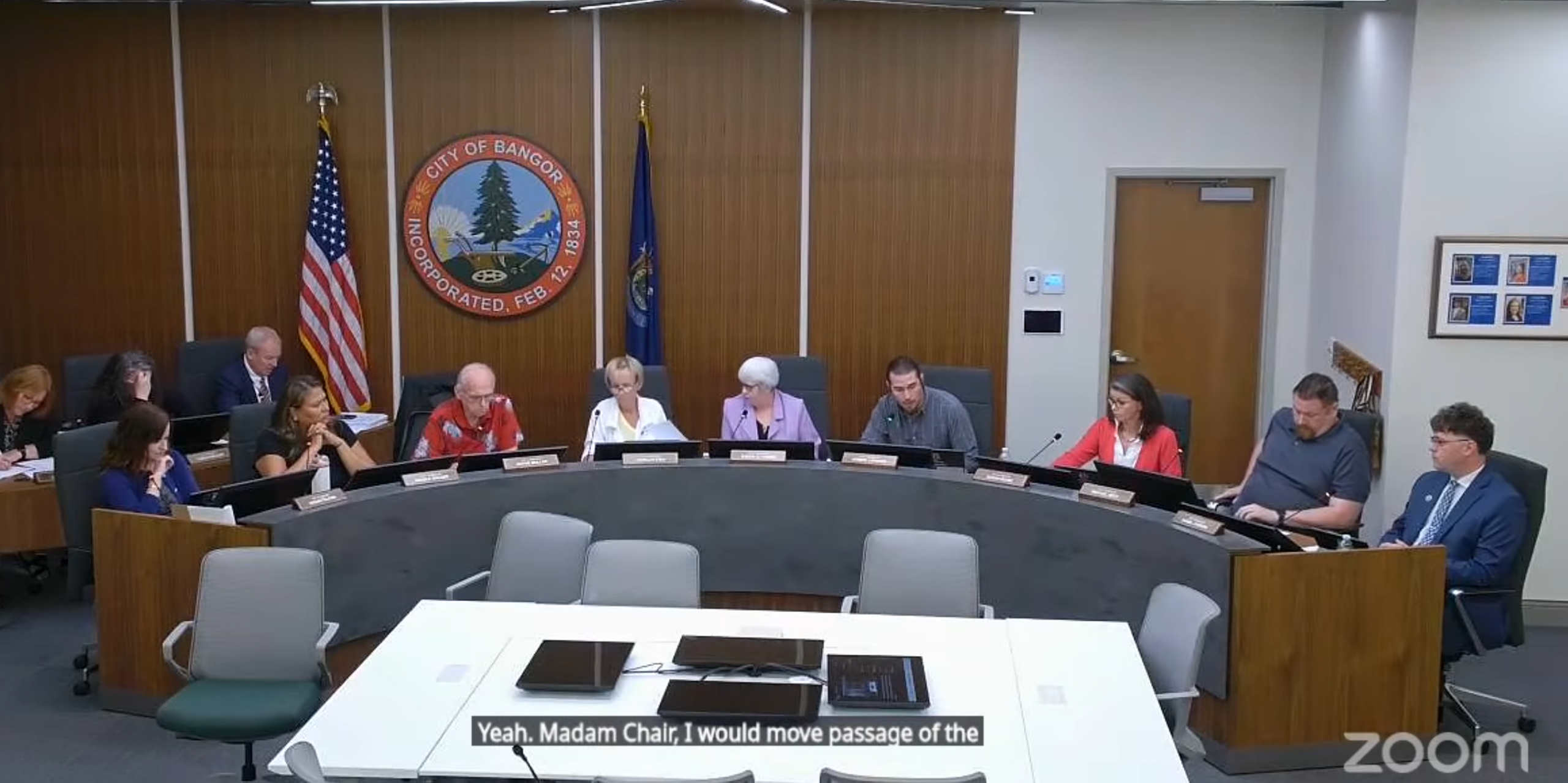
BANGOR, Maine — The Bangor City Council voted 6-3 Monday night to approve a controversial 30-year tax arrangement for a permanent supportive housing development intended for some of the city’s chronically homeless population, despite warnings from residents and three councilors that Bangor taxpayers could be assuming a costly long-term obligation without enough financial certainty.
Council Chair Susan Hawes and Councilors Carolyn Fish and Wayne Mallar voted against both the credit enhancement agreement and creation of the tax increment financing district for Yellen Pines, a proposed 30-unit permanent supportive housing development at 205 Corporate Drive.
Councilors Michael Beck, Daniel Carson, Susan Deane, Susan Faloon, Joseph Leonard and Angela Walker voted in favor.
The Bangor Housing Development Corporation project is intended to house 30 people experiencing chronic homelessness, with Preble Street expected to provide around-the-clock supportive services.
Under the agreement approved Monday, 75 percent of the property tax increment generated by the development would be returned through the credit enhancement agreement for 30 years.
That three-decade commitment became the centerpiece of a lengthy and at times contentious public debate over how far Bangor should go financially to address homelessness, and whether city taxpayers are being asked to shoulder responsibilities that should fall more heavily on state government, surrounding municipalities and private organizations.
Bangor resident Hillary Simmons urged councilors to delay the agreement until taxpayers receive a more complete accounting of its potential costs.
“This is not about opposing affordable housing or helping people experiencing homelessness,” Simmons said. “This is about fiscal responsibility and whether Bangor should make a 30-year financial commitment without first providing taxpayers with a complete financial picture.”
Simmons pointed specifically to Logan Place, a permanent supportive housing development in Portland that supporters have cited as evidence that the model can reduce police, ambulance, jail and emergency health care usage.
According to Simmons, Logan Place received $435,000 in federal HOME funding but received no TIF assistance.
“If Logan Place is being represented as an example of why Bangor should support Yellen Pines, then someone should explain why the success of Logan Place demonstrates that Bangor needs to return 75 percent of the tax increments for 30 years,” Simmons said.
She asked councilors to table the proposal until taxpayers could see the estimated annual cost, estimated 30-year value of the agreement, complete financing package, remaining funding gaps and justification for providing the 75-percent benefit for three decades.
“Supporting housing and protecting Bangor taxpayers is not mutually exclusive,” Simmons said. “Thirty years is a long time.”
Residents Question $11 Million Price Tag
The overall cost of Yellen Pines also came under scrutiny.
Bangor Realtor Emily Ellis told councilors that 175 residential homes had sold in Bangor during the previous six months, with an average sale price just under $318,000 and a median price of approximately $289,000.
She contrasted those figures with Yellen Pines, which she said works out to approximately $373,000 for each roughly 400-square-foot unit, or about $932 per square foot.
“There is a difference between affordable housing and subsidized housing,” Ellis said.
Her husband, Mike Ellis, said he reviewed the project’s plans and compared its projected cost with supportive housing developments elsewhere, including projects in Canada.
He questioned how Yellen Pines reached an approximately $11.2 million price tag for 30 units.
Other speakers questioned whether Bangor could eventually face additional financial exposure if state funding supporting the development changes.
Jackie Small told councilors that ongoing services at Yellen Pines are expected to be financed through Maine’s Housing First program, which is supported through the state’s real estate transfer tax.
Small argued that while Bangor would be making a 30-year commitment, future legislatures and governors could change the state funding formula supporting the services.
“The city’s obligation is locked in for three decades,” Small said. “The state’s is not.”
Small urged councilors to slow the process and reconsider the proposal after the November election.
“Bangor has to stop making rash decisions because the implication that this proposal could have on Bangor for the next 30 years are very real,” she said.
Drug and Alcohol Use Becomes Issue Before Vote
One of the sharpest exchanges came immediately before the council voted on establishing the TIF district.
Hawes questioned Bangor Housing representative Mike Myatt about whether drug and alcohol use would be permitted at Yellen Pines.
Myatt stressed that Yellen Pines would be permanent supportive housing rather than a homeless shelter.
“If someone’s using in their unit, they could be doing that,” Myatt said.
He said the purpose of having Preble Street’s wraparound services on site would be to encourage residents to address substance use and other problems.
Hawes pressed further.
“But you allow drugs and alcohol to be consumed on the premises. Is that correct?” she asked.
“If someone’s using in their unit, they could be doing that,” Myatt responded.
“To encourage, but not to prevent,” Hawes replied. “So I have issues. I will be voting against the TIF.”
Hawes ultimately joined Fish and Mallar in opposing the measure.
Fish: Bangor Cannot Have ‘Endless Monies’
Fish delivered one of the strongest arguments from the council against the project.
She said Bangor has already worked with Bangor Housing, MaineHousing and private developers to add housing but still has not adequately answered a fundamental question: Who is Bangor financially responsible for helping?
“To me, I am tired of passing and voting yes on taxpayers’ backs for projects like this when we do not have a system of filtering,” Fish said.
Fish said Bangor’s homeless residents need assistance and described life on the street as inhumane but questioned whether city taxpayers should assume long-term financial obligations for people arriving from other communities.
“We do not have endless monies to take care of everybody else’s,” Fish said.
She also questioned the cumulative impact if Yellen Pines eventually expands beyond its initial 30 units.
Fish said she wanted more information about the financial consequences of the project and greater participation from the state, surrounding communities and service providers before committing Bangor taxpayers.
“I want to know the financial data,” Fish said. “I want to know what the future circumstances and the ripple effect on the city are going to be.”
Supporters Say Doing Nothing Also Costs Bangor
Supporters countered that Yellen Pines should not be viewed simply as a benefit for 30 individuals.
Councilor Susan Faloon called the development an investment in the entire Bangor community.
“This is not just an investment in 30 people,” Faloon said. “This is an investment in our entire community.”
Supporters argued that chronically homeless individuals already generate substantial public costs through police interactions, ambulance calls, emergency medical care, shelters and incarceration.
Jennifer Lohler, who works in homeless services in Bangor, told the council that chronically homeless individuals who were housed in June had spent an average of 1,819 days homeless.
That is nearly five years.
“Having an apartment doesn’t automatically resolve the barriers someone faced before they were housed,” Lohler said.
She argued that supportive housing is particularly important for individuals who may return to homelessness without continued assistance.
“Home for Good pairs permanent housing with ongoing support that can give someone the foundation to build from,” Lohler said.
Preble Street Points to Portland Results
Chris Saunders, vice president of operations at Preble Street, joined the meeting remotely and urged councilors to approve the project.
Saunders pointed to Logan Place in Portland, another 30-unit supportive housing development, as evidence that housing chronically homeless individuals can reduce costs elsewhere in government.
According to Saunders, Logan Place residents experienced an 88-percent reduction in jail nights during the project’s first year.
Ambulance and emergency calls dropped by 66 percent, while police contacts fell by 80 percent, he said.
Saunders also said the system of care spent $23,328 less on residents during Logan Place’s first year than it had during the previous year.
He argued that the savings would be more than $40,000 in today’s dollars.
“Moving people from chronic homelessness to stable permanent housing benefits both the individual and the Bangor community,” Saunders said.
Myatt similarly argued that the TIF should be considered an investment capable of reducing other municipal costs.
“We’re not asking for capital dollars,” Myatt said. “We are asking for very precious taxpayer dollars, but we feel that that investment from the city in Yellen Pines will come back in savings for the municipality.”
Myatt said those savings could include fewer police calls, first responder interactions, unpaid medical bills and jail stays.
He also made the stakes of Monday’s vote clear.
“If we don’t get the TIF, our project cannot move forward,” Myatt said.
Council Gives City Manager Authority to Add Conditions
Before approving the credit enhancement agreement, the council voted to amend the order to give the city manager authority to place conditions on the final agreement.
That amendment passed 8-1.
The council then approved the amended credit enhancement agreement 6-3, with Hawes, Fish and Mallar opposed.
The separate order creating the affordable housing TIF district at 205 Corporate Drive also passed 6-3, with Hawes, Fish and Mallar again voting no.
Project HOPE Could Bring Another $126,000 Bangor Commitment
The Yellen Pines debate came as Bangor is simultaneously considering another homelessness initiative.
Councilors referred a separate proposal for Project HOPE to the Government Operations Committee.
The proposal would authorize Bangor to accept and appropriate up to $300,000 from MaineHousing while providing a $126,000 match from the city’s unspent opioid settlement funds.
Project HOPE is modeled on a Portland initiative designed to move people directly from homelessness into permanent housing while providing ongoing case management and support.
Residents questioned what happens after the initial funding period ends and whether Bangor taxpayers could eventually be asked to cover future expenses.
One speaker warned councilors that homelessness-related proposals increasingly arrive as urgent requests requiring immediate action.
“It’s always an emergency,” she said. “It’s always all hands-on and all resources on deck for the same 1% of Bangor’s population.”
“Slow down, Bangor,” she added.
The Project HOPE proposal is scheduled for further consideration rather than receiving final approval Monday night.
Eric Pelletier Unanimously Approved as Bangor Fire Chief
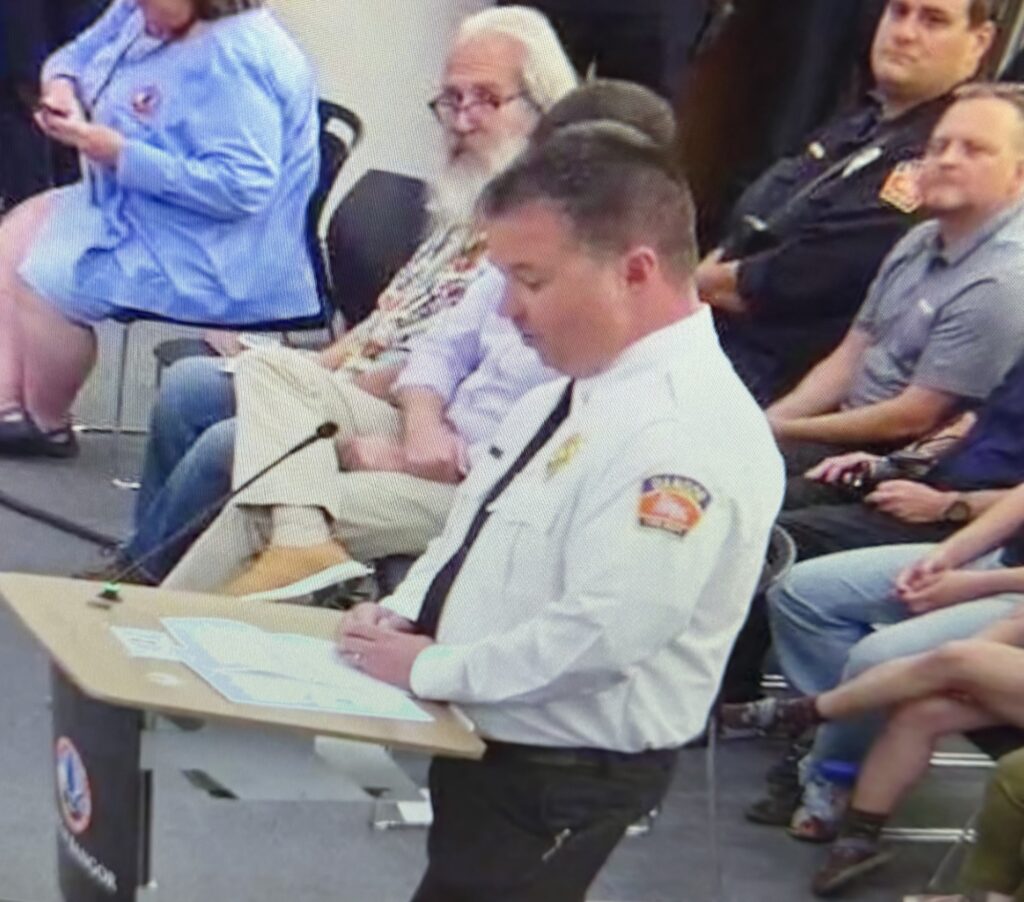
The council found considerably more agreement later in the meeting, unanimously approving Eric Pelletier as Bangor’s next fire chief.
Pelletier joined the Bangor Fire Department as a lieutenant in 2015, was promoted to captain in 2018 and has served as deputy fire chief for eight years.
Before joining Bangor, Pelletier served as both a captain and assistant chief in Hermon.
He has more than 26 years of fire service experience and holds an associate degree in fire science and a bachelor’s degree in fire science administration.
Councilors approved his appointment 9-0.
“I am humbled and honored to accept this position and the responsibility that comes with it,” Pelletier told the council.
Pelletier thanked former chiefs, city employees, members of the department and his family before outlining priorities including public and firefighter safety, emergency preparedness, community relationships and professional development.
“Safety for the public and our personnel will always be a top priority,” Pelletier said.
Mansfield Stadium Field Named for Ron St. Pierre
Councilors also voted 9-0 to officially name the baseball field at Mansfield Stadium in honor of Ronald “Ron” St. Pierre.
St. Pierre and David Mansfield voluntarily managed operations at Mansfield Stadium for more than 30 years, until the city’s management agreement with Bangor Westside Little League ended in 2023.
St. Pierre also devoted countless volunteer hours to coaching generations of Bangor youth and supporting baseball tournaments at the local, state, regional and national levels.
Bangor Parks and Recreation Director Tracey Ouellette told councilors that St. Pierre and Mansfield were instrumental in shepherding the stadium and preserving it as an important community asset.
By placing St. Pierre’s name permanently on the field, Ouellette said, future generations will have an opportunity to learn about his decades of service to Bangor.
The measure passed unanimously.




That’ll be a great addition to the neighborhood.
It would be more effective, economical, and humane for every state to have asylums for all of the junkies and the mentally ill .
more B.S. from the tax and spend demoKKKrats that run Bangor. I’m old enough to remember when Bangor was a very nice city, not the crap hole it has become.
How can anyone justify paying 373,000 per 400 sqft unit.The cost is insane but the idea itself is worthwhile.The members of the Bangor City Council might be the most inept and under qualified group anywhere in America.They prove time and time again how much of an embarrassment they are,it never seems to end.
Penal Colony? Darwin / isolation / experimentation ? That’s scraching the surface. Additional cost incurr with the mental/health “services” that with be imparative with such. Locking doors i.e. autism children who “sneak out”
Oh, it’s not prison / jail or a penal colony?
You can not hang this albatross around the neck of the taxpayer and expect to sail away into the night.
There are consequences.
The “lawmakers” are the problem here folks. As a side note, who are the two sitting behind the old dude the women and whoever? Nice touch with the purple jacketed set in the middle.
Aye Vay people, have you no shame? I will answer that, NO!
Bellies prove it!
It’s best that I see this knot yet again, for The Word of The Almighty will spew you out of His mouth.
In less than 2 years it will look like LBJ’s “Great Society” housing projects from the 60’s.
These so called “Leaders” are certainly not looking out for the taxpayers of Bangor.
They are out of their flipping minds!!!!