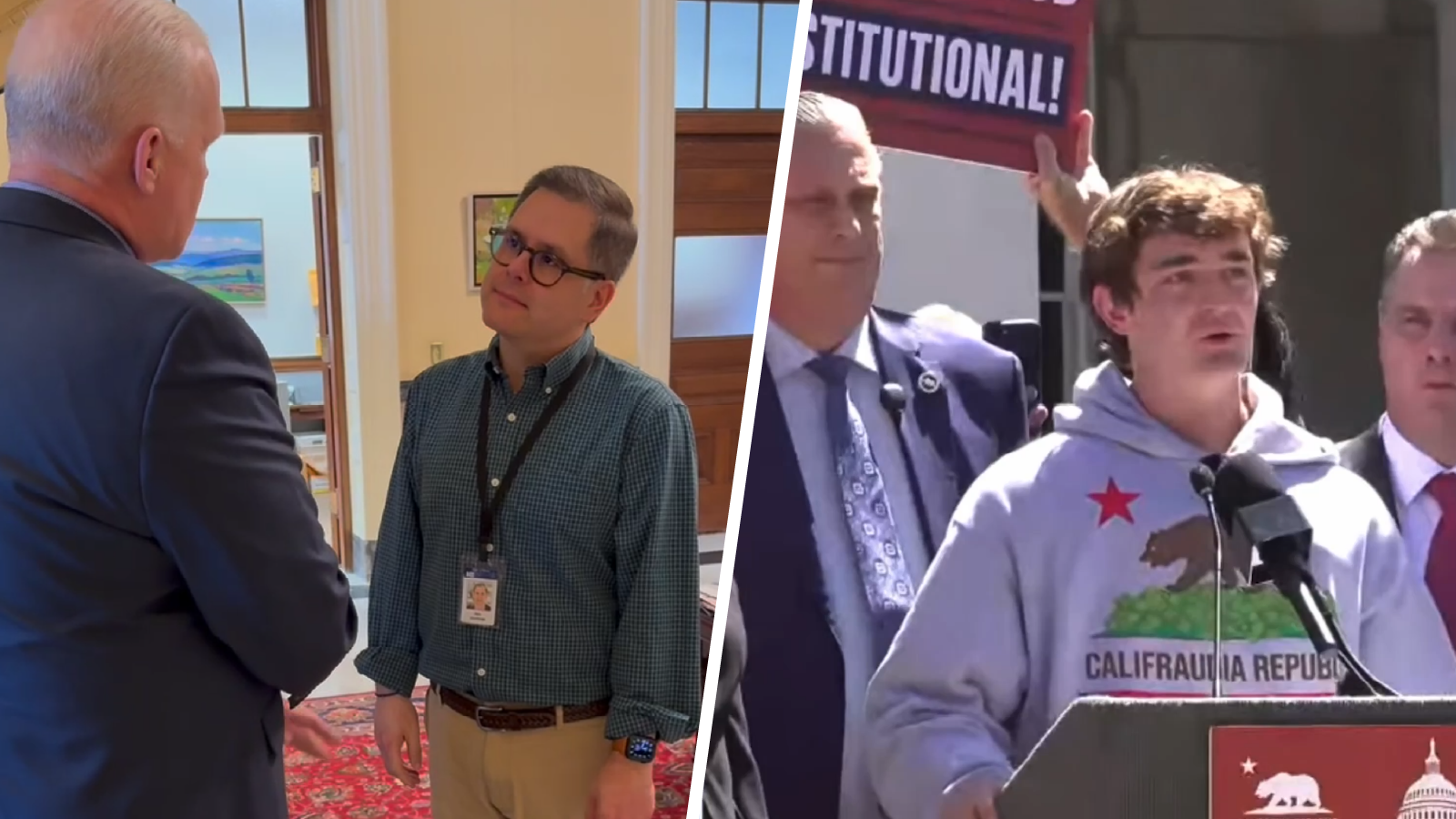
California Gov. Gavin Newsom has signed controversial legislation critics have dubbed the “Stop Nick Shirley Act,” escalating a national fight over investigative journalism, taxpayer-funded organizations and whether laws designed to protect workers from harassment could ultimately discourage reporters from exposing fraud.
The controversy may soon find its way to Maine.
There are plans under discussion for independent journalist Nick Shirley to travel to Maine, where The Maine Wire has spent months investigating alleged fraud and questionable billing involving taxpayer-funded service providers.
Nothing has been finalized, and no date has been set.
But if Shirley comes, he will arrive in a state where questions surrounding Medicaid spending have already drawn the attention of federal officials, congressional leaders and national media, while reporters asking those questions have often received a colder reception in Augusta.
Newsom signed Assembly Bill 2624 on Aug. 22. The legislation, officially concerning privacy protections for immigration-support service providers, became known as the “Stop Nick Shirley Act” after Republican California Assemblyman Carl DeMaio used Shirley’s name while campaigning against it.
Shirley has become one of the country’s most recognizable independent journalists investigating suspected fraud in taxpayer-funded programs, particularly after his viral reporting on Minnesota daycare facilities receiving millions of government dollars.
His method is straightforward.
He shows up.
Shirley visits addresses, turns on a camera, knocks on doors and asks where taxpayer money is going and whether the services being billed are actually being provided.
It is an approach familiar to The Maine Wire.
On April 18, Shirley and this reporter appeared together on Fox News’ “Saturday in America,” discussing fraud allegations in Maine and California, the role of independent journalists in exposing misuse of taxpayer dollars, and concerns that the proposed California legislation could make that work more difficult.
https://www.foxnews.com/video/6393373493112
At the time, the debate was still largely theoretical.
Now it is not.
Newsom has signed the measure into law, Shirley has become the face of the national opposition to it, and the same questions discussed on Fox News this spring, how aggressively journalists should be allowed to investigate publicly funded organizations, and whether government can protect vulnerable workers without chilling legitimate reporting, are now at the center of a much broader First Amendment fight.
What California’s Law Actually Does
AB 2624 expands California’s Safe at Home address-confidentiality program to qualifying workers, volunteers and providers affiliated with organizations offering immigration-support services.
Supporters say the measure protects workers from threats, harassment and doxxing.
The law also creates civil and criminal provisions involving publication of personal information or images. Importantly, the final language includes intent requirements.
Criminal liability is tied to publishing information with the specific intent that another person imminently commit a violent crime or make a threat of violence.
That distinction matters.
The law does not simply prohibit journalists from photographing an immigration-service provider or identifying a taxpayer-funded organization.
Assemblywoman Mia Bonta, the Oakland Democrat who authored AB 2624, has rejected claims that the measure criminalizes legitimate investigative reporting.
Critics, however, argue the danger is not limited to whether a reporter is ultimately convicted.
Independent journalists often operate without large legal departments. The possibility of litigation, legal bills or government scrutiny may itself discourage publication of photographs, names, locations or information involving taxpayer-supported organizations.
That chilling effect is at the heart of the opposition.
Shirley brought that argument to Sacramento last week during a “Stop Nick Shirley Act Rally” at the California State Capitol, where Republican lawmakers joined him in warning that the law could undermine transparency.
Maine Has Its Own Fraud Questions
For Maine taxpayers, the issue is not theoretical.
Maine Wire reporters Steve Robinson, Seamus Othot and Jon Fetherston have spent months examining billing data, visiting businesses, photographing locations, knocking on doors and comparing what exists at those addresses against millions of dollars in taxpayer-funded MaineCare payments.
In multiple cases, providers examined by The Maine Wire later faced payment suspensions, credible allegations of fraud or other government scrutiny.
Federal officials have noticed.
Centers for Medicare and Medicaid Services Administrator Dr. Mehmet Oz traveled to Maine earlier this month and met with former Gov. Paul LePage and this reporter to discuss concerns involving MaineCare-funded home-care and autism services.
Oz raised serious concerns about documentation supporting services billed to MaineCare and said federal reviewers had found major deficiencies in records examined.
During that meeting, Oz also indicated that he plans to return to Maine for additional follow-up.
No date has been announced.
That expected return is significant because it suggests Washington’s interest in Maine’s fraud problem is not fading.
Vice President JD Vance has publicly discussed fraud in Maine. House Speaker Mike Johnson has weighed in. Federal prosecutors are also facing an expanding workload involving suspected fraud.
Shirley himself testified in July before the U.S. Senate Homeland Security and Governmental Affairs Committee during its “Exposing Fraud in America” hearing.
The issue has clearly moved beyond Augusta.
Ten Trips Looking for Answers
While federal officials have increasingly engaged with The Maine Wire’s reporting, getting similar engagement from Gov. Janet Mills’ administration has proven considerably more difficult.
This reporter has made multiple trips to Mills’ office seeking answers and offering to provide information The Maine Wire has uncovered concerning potential fraud involving publicly funded programs.
Those visits have now reached double digits.
Ten trips.
The efforts have not resulted in a substantive conversation with Mills about the issue. On multiple occasions, outreach has been ignored or rebuffed.
The Maine Wire has not asked the governor to accept its conclusions as fact.
It has asked the administration to examine the evidence, answer questions and explain to taxpayers what is happening to their money.
Investigative journalists do not prosecute fraud.
They do not suspend providers or issue subpoenas.
They ask questions.
Often those questions begin with information government already possesses — incorporation records, provider addresses, licensing data and payment records.
Then somebody has to go there.
Is the business operating?
Who works there?
Are services being provided?
Who owns it?
Why did it receive millions of dollars?
And where did the money go?
Could a ‘Stop Nick Shirley Act’ Come to Maine?
California’s law raises another question Maine journalists and taxpayers should consider now:
Could Maine enact something similar?
The answer is yes.
A Maine legislator could introduce a bill modeled on portions of AB 2624, creating new confidentiality or privacy protections for certain nonprofit employees, immigrant-service providers, health-care workers or other groups.
Such a measure would move through the normal legislative process — committee review, House and Senate votes and ultimately the governor’s desk.
Maine voters could also pursue comparable statutory protections through the citizen-initiative process.
Gov. Mills could not simply impose California’s law in Maine by executive order. Comparable civil or criminal restrictions would require statutory authority.
Any proposal would also face First Amendment scrutiny.
Maine already has anti-doxing protections in certain circumstances, including protections involving minors, but state law expressly preserves constitutionally protected speech and press activity involving matters of public concern.
That balance would become critical if lawmakers ever considered extending special privacy protections to people working for organizations receiving taxpayer money.
There is currently no indication that Maine lawmakers are preparing an AB 2624-style proposal.
But California has demonstrated that lawmakers can create special statutory protections around people working in politically sensitive, publicly supported organizations.
For journalists investigating MaineCare spending, that development is worth watching.
What Happens When Journalists Show Up?
Nobody is claiming California’s law applies in Maine.
It does not.
Nor does the enacted law simply make journalism illegal.
But the broader debate matters because independent reporting increasingly depends on journalists willing to go where regulators and larger institutions sometimes have not.
Shirley did that in Minnesota.
He did it in California.
The Maine Wire has been doing it here.
Providers have faced suspensions.
Federal officials have arrived.
Congress has taken notice.
Oz has already traveled to Maine once and, according to his conversation with this reporter, intends to return.
And Shirley is considering bringing his own camera to Maine.
If he does, it will not be the first time Shirley and this reporter have crossed paths in the national fraud debate.
The larger question is what happens if those investigations continue producing results.
Will Maine officials embrace the scrutiny?
Or will someone eventually ask Augusta to give the subjects of that scrutiny new legal protections?
Taxpayers should never be asked to accept on faith that billions of dollars are being properly spent.
Sometimes an audit catches the problem.
Sometimes a whistleblower speaks.
And sometimes a reporter has to walk to the address, turn on the camera and knock on the door.
The question remains the same:
Where did the money go?