

The White House on Wednesday posted four packages of declassified and formerly internal government records, a document dump that runs from CIA China reporting to an FBI box of fake voter forms in western Michigan.
The documents show unequivocally that the intelligence community, during President Trump’s first term but especially under President Joe Biden, actively concealed information about the extent to which China was engaged in pro-Biden clandestine activities.
Trump, in a prime time address last night, laid out what the documents reveal, stopping short of suggesting that the 2020 election was stolen or rigged. He also never alleged that actual votes were changed. But his remarks, in concert with the document release, expose the soft center of American elections, i.e. the registration database and the identity checks around it.
Here are ten items we’re tracking from the Election Integrity documents…
1. DHS says more than 250,000 noncitizens are illegally registered in four states — California, Pennsylvania, New Jersey and Nevada
The Department of Homeland Security says a review of public voter files from four states that do not use the federal SAVE citizenship-verification system turned up more than a quarter-million ineligible registrants.
“OVER 250,000 NON-CITIZENS ARE ILLEGALLY REGISTERED TO VOTE IN JUST THE FOUR STATES FOR WHICH PUBLIC DATA FILES HAVE BEEN REVIEWED,” DHS states, in all capital letters, in a one-page summary titled “Preventing Alien Voting.”
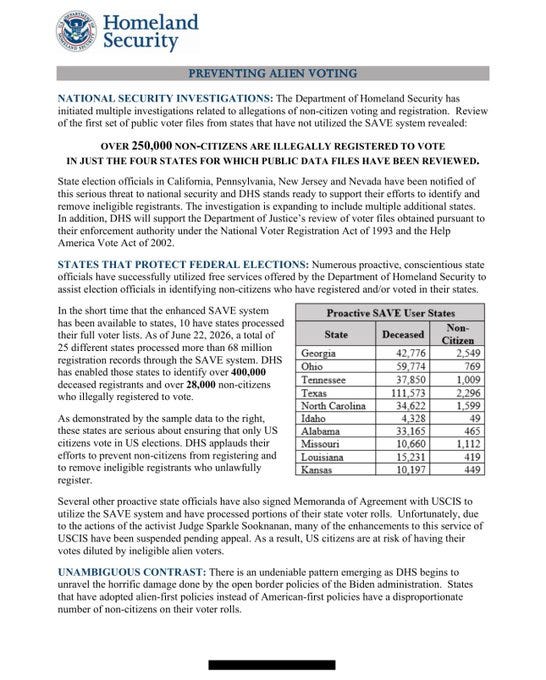
The states notified are California, Pennsylvania, New Jersey and Nevada, according to the document. DHS says it “stands ready to support their efforts to identify and remove ineligible registrants” and that the review is expanding to additional states.
Notably, Maine Secretary of State Shenna Bellows has admitted that non-citizens are registered to vote in Maine, but she has refused to turn over Maine’s Central Voter Registration file to DOJ.
2. In Michigan, the FBI ran 107 seized voter forms and found 91 phantoms
In a box of voter-registration applications seized from a 2020 paid canvassing operation in Michigan, FBI database checks came back empty for the overwhelming majority.
“Database searches were conducted on the 107 voter registration applications from item 1B1 … in an attempt to identify voter registration applications with potentially fraudulent signatures or listing non-existent individuals,” the FBI electronic communication says. “Ninety-one individuals returned no results in database checks.”
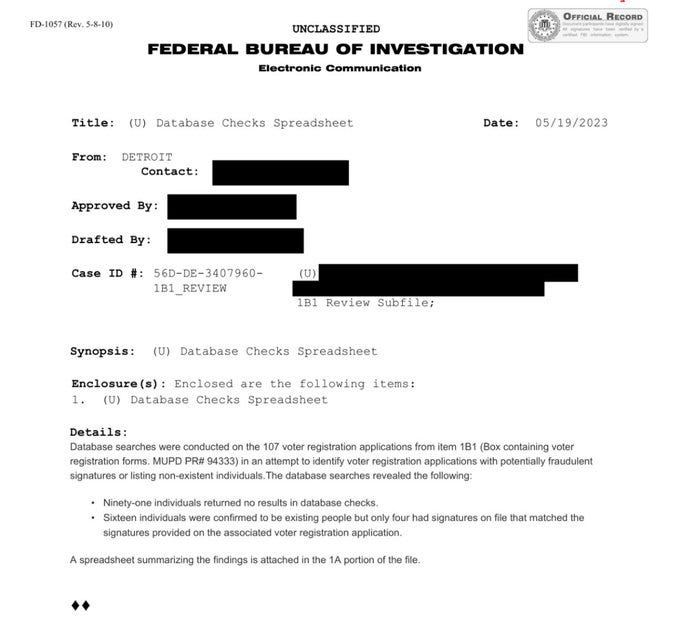
Sixteen of the 107 named people existed at all. Only four had a signature on file that matched the application. The context of the intelligence document is difficult to discern, so it’s not entirely clear how large the false registration scheme was.
Regardless, the document shows the FBI was aware of a large-scale effort to falsify voter registrations in a swing state but appears to have done nothing further to expose the individuals behind it.
3. An unevaluated FBI report from Albany claimed China made fake U.S. driver’s licenses to cast mail-in votes for Biden
The most explosive single page in the China package is also the one the FBI wrapped in the most warnings.
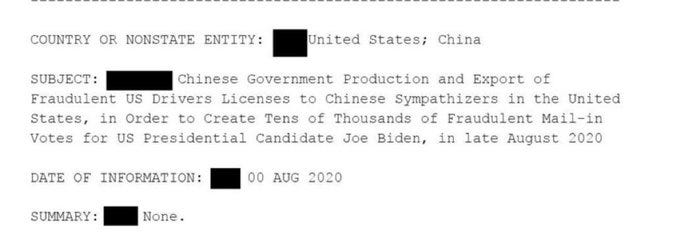
The FBI Intelligence Information Report, dated September 2020 and later provided to Senate Judiciary Chairman Chuck Grassley, carries this banner on its face: “INFORMATION REPORT, NOT FINALLY EVALUATED INTELLIGENCE.”
The subject line alleges Chinese government production and export of fraudulent U.S. driver’s licenses to CCP sympathizers in the United States “in order to create tens of thousands of fraudulent mail-in votes” for Joe Biden in late August 2020. The report says China pulled real names, ID numbers and addresses from millions of TikTok accounts to make the fakes hard to detect.
If China is pulling address information from TikTok accounts, that would suggest that ByteDance was turning on GPS services to track users — which is another good reason to never download TikTok. The FBI’s own comment on the same page points out the questions raised by the intel: “A person’s address information was not a valid field when creating a TikTok account. It was unspecified how China would attain US address data from the application.”
4. A CIA note says China’s goal was to stop Trump’s reelection — and other records show analysts complaining the reporting was “massaged”
The intelligence community lied to President Trump about China’s efforts to interfere in the 2018 and 2020 elections. The memos consistently say that intelligence was “massaged,” but when you review all of the memos about the handling of China-related intelligence, it’s clear that the intent was to deceive Trump.
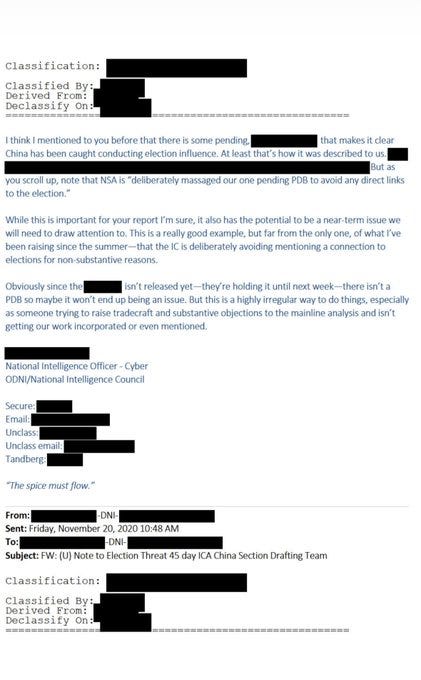
Internal email traffic shows analysts fighting over how China-and-elections link was packaged. One message in the file complains that the National Security Agency (NSA)“deliberately massaged our one pending PDB to avoid any direct links to the election.”
The National Intelligence Officer for Cyber went further, writing that the intelligence community was “deliberately avoiding mentioning a connection to elections for non-substantive reasons” and that tradecraft objections “isn’t getting our work incorporated or even mentioned.”
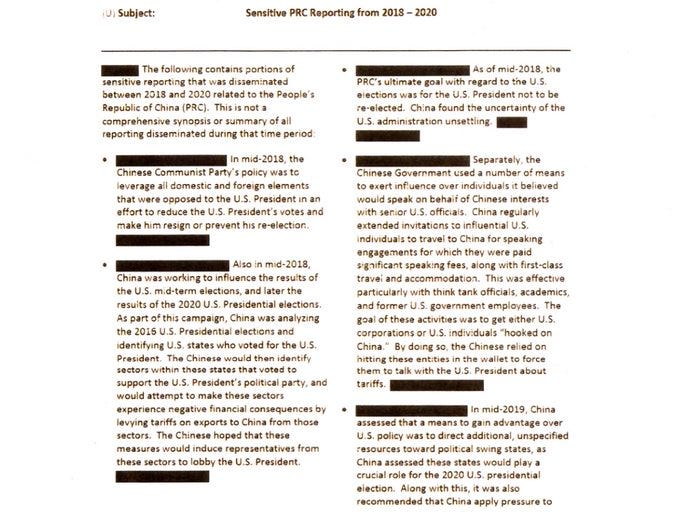
A CIA note on sensitive PRC reporting from 2018 to 2020 describes a mid-2018 Chinese Communist Party (CCP) policy to leverage domestic and foreign actors opposed to the president to reduce his votes, force his resignation or prevent his reelection. Later reporting summarized in the package describes Beijing steering resources toward swing states, pressuring Trump’s financial backers and flagging journalists for negative coverage.
Ties to Maine: China’s state-run media Xinhua reported in Jan. 2019 that then-Secretary of State Matt Dunlap was among the U.S. officials who accepted a PRC-backed trip to China. The article describes how Ping Huang, then the New Chinese Consular General in New York, visited Maine for the inauguration of Gov. Janet Mills.
Per Xinhua, Huang also visited with Dunlap and Senate President Troy Jackson.
Jackson is now among the front-runners to receive the Democratic U.S. Senate nomination, while Dunlap is the Democratic nominee for U.S. Representative in Maine’s Second Congressional District.
5. Declassified tables catalog roughly 204 million U.S. voter records in datasets attributed to Chinese actors — usable, one paper warns, to request absentee ballots for low-propensity voters
A declassified inventory of U.S. data attributed to PRC possession leads with a single staggering line item: unspecified U.S. voter data totaling 204,822,241 records — 45 gigabytes, dated 2016, including names, ages, phone numbers and addresses.
The White House Government Transparency Task Force frames the wider claim this way: “The declassified intelligence reveals that voter registration rolls from at least 18 states (not all identified by name) have been compromised by the People’s Republic of China,” and “more than 200 million voter records were also compromised by the PRC, without state-specific affiliations.”
The companion DHS threat paper spells out how those voter files could be used. The registration file often carries the exact fields needed to request a mail ballot, and that package “can support bulk absentee requests for low-propensity voters” — the registered citizens least likely to show up and notice a ballot was pulled in their name.
Maine’s Absentee Ballot request platform runs on pre-2016 antiquated software. Until recently, the site lacked even a basic “Captcha” to prevent mass, automated ballot requests.
In theory, Maine would have been ripe for the kind of mass exploitation the DHS threat paper lays out. Indeed, current large-language models would make mass requests for absentee ballots a trivial task for even a moderately skilled computer user.
6. CISA testers took full control of election-office networks “within hours or days”
The least conspiratorial document in the dump is also the hardest to wave away. From roughly 2019 to 2024, the Cybersecurity and Infrastructure Security Agency (CISA) broke into state and local election-office networks on purpose and wrote down what it found.
“In multiple cases, CISA assessors gained full network control within hours or days,” the agency’s 2026 Election Report says, “demonstrating that many SLTT partners remain soft targets incapable of stopping even moderately skilled adversaries.”
CISA described flat networks, shared credentials, weak multifactor authentication, outdated operating systems and legacy remote access left reachable from places that should have been sealed off. And it said the certification rules make it worse: “Some government election systems certification regimes require that no patches be applied for months before an election,” leaving known holes open on machines about to count real votes. The result, in CISA’s words: “known, documented vulnerabilities persist for months or years on production election systems.”
The report doesn’t say whether it was able to access Maine offices under Secretary of State Shenna Bellows.
7. A Michigan witness told the FBI canvassers were paid on debit cards to register phony voters — and thought the point was to suppress Trump’s vote
An FBI document, recorded in 2023, records how one witness in Michigan described a paid canvassing operation of more than 100 people, quotas tied to completed registrations, and pay of roughly $800 loaded onto company debit cards to compensate workers.
According to the witness, supervisors told a meeting of more than 100 workers that if they could not gather enough applications, they should “just fill them in.” When someone asked what that meant, the witness said, a supervisor picked up a blank form, filled it with made-up information and said, “this is what I mean.”
The instructions, subject who was interviewed, were to invent Social Security numbers, invent names, sign cursive for people who could not. The witness estimated personally submitting about 100 fake applications.
A separate July 2025 interview describes gift-card and bonus incentives, and the witness offered a personal opinion that the operation may have been trying to suppress votes for President Trump.
8. The case ran about four years, stalled repeatedly at DOJ, and ended with no charges — a slow-walk the file lays bare
The Michigan investigation began with a city clerk’s referral in October 2020 and did not close until federal prosecutors declined the case years later, after handwriting lab work stretched into 2024. Along the way, the Justice Department’s Public Integrity Section used the department’s election non-interference policy to control the clock.
Put together, the documents show that an investigation into well-financed large-scale voter fraud operations in a swing state was effectively killed by the Biden Administration.
“Accordingly, PIN concurs in the proposed interviews of the canvassers only after the November 7, 2023, election is concluded, certified, and uncontested,” the Election Crimes Branch director wrote — pushing roughly 100 canvasser interviews past yet another election.
It’s worth pointing out that, had former Vice President Kamala Harris won the 2024 election, none of this would be public knowledge.
At least one FBI agent did not want to let go of the Michigan case.
“I’m not really comfortable closing the case at this point without raising these issues,” the agent wrote, then quoted DOJ’s own manual back at headquarters: even when no fraudulent votes result, “the fraudulent registrations that arise from this conduct are not victimless offenses.”
9. A federal threat paper says China breached state voter systems — and warns stolen data “does not get stale”
The second DHS document, an 11-page unclassified paper dated July 2026, highlights the threat posed by China’s possession of stolen voter information.
“Recently declassified records revealed that China breached multiple state voter registration systems prior to the 2020 election,” the paper says. “Unfortunately, this is not a new phenomenon.”
Hackers have tried to breach registration systems in all 50 states, with confirmed successes in at least 20, according to DHS.
“Data obtained in a breach from 2021, for example, could be used to request a ballot for an election in 2028 because the data does not get stale,” the paper says. An adversary can use stolen fields to request absentee ballots, or to alter and delete registrants — change addresses, change parties, wipe records — slowly enough to evade detection.
“The real threat is what can be done with the stolen data,” the paper says.
Paging Shenna Bellows… Paging Shenna Bellows…
10. What the documents do not prove
None of the four packages, on its face, establishes that certified U.S. vote tallies were altered at scale or that any presidential result was flipped. CISA’s report is about fragile systems, not a stolen count. The 250,000 noncitizen figure is a headcount limited to four states. The Albany driver’s-license report is stamped “not finally evaluated” and carries the FBI’s own technical caveat. The Michigan file proves fake registrations and a federal non-prosecution — not that manufactured forms became counted ballots.
However, the documents prove indisputably that actors within the federal intelligence community tried to conceal information about China’s actions concerning national elections from President Donald Trump.


Anyone who thinks the current election process is secure and legitimate is a fool .
Democrats can cry all they want , but they are the ones who have benefited from the corruption of the process and THEY KNOW IT ….
They sure as hell don’t want to change the rules and safeguard the process now ….
Any Legislators who are opposed to the SAVE ACT should be impeached and thrown out of office .
I don’t want to hear another word about “ democracy “ from these Democrat and RINO assholes .
Pass The SAVE Act ……DO IT NOW !
Well that certainly explains why Mills won’t touch those Chinese grow houses in Maine she would lose out on her cut.
The Feds need to come to Maine and kick a$$ use steel toed boots so you don’t get bit.
We need a huge ICE STORM.
Outstanding reporting.
If China is pulling address information from TikTok accounts, that would suggest that ByteDance was turning on GPS services to track users
No need of that — in order for TikTok to actually work, it has to know the IP address of the machine the person is using. Unless someone is hiding behind a VPN, this will be the actual IP address, which is registered to someone — and most people playing with TikTok are not going to have their own IP address registered.
Or in English, most people purchase Internet access from a company, either hardwired to the home, or as part of a cell phone service. If you know what you’re doing, it’s very easy to take one of these numbers and come up with a physical location within probably 20 or 30 miles of where you actually are. Maybe 50 miles in really rural areas, but all of these companies connect to the real Internet at a physical location and the IP address will give you that location.
So unless you’re doing something funky, something way, beyond the abilities of a TikTok user, they’re gonna know who’s in Maine, who’s in New Hampshire, and who’s in Texas. They’re gonna have a pretty good guess which county in Maine you’re in.
GPS is more accurate, but if you have ever noticed how websites have a pretty good idea where you’re located — and sometimes think you’re in a town you’re not in — this is how.
Come on folks. The United States has been running these razor thin wins for years. When will “we” get over the us against them and get down to being a functioning country again? Or was I dreaming….Oh, yeah. Did we ever function as a United States ever? Fill your answer below: