President Donald Trump returned to the White House Correspondents’ Association dinner Friday night, delivering an hour-long address that mixed tributes to the law enforcement officers who stopped an attempted assassin with sharp attacks on journalists, Democratic politicians and some of the president’s longtime critics.
The July 24 dinner was held exactly three months after the association’s original April 25 gathering was disrupted by gunfire and abruptly evacuated. Federal prosecutors have charged 31-year-old Cole Tomas Allen of California with attempting to assassinate Trump after he allegedly opened fire near the security checkpoint outside the Washington Hilton.
Friday’s make-up event was moved from the Hilton to the Waldorf Astoria in downtown Washington and featured a substantially smaller crowd, increased police protection and stricter screening procedures. The traditional red carpet and separate cocktail receptions were eliminated, while guests were directed through a single secured entrance with multiple identification checks.
Trump opened his remarks on a serious note, praising the courage shown by Secret Service agents, law enforcement officers, hotel employees and attendees during the April attack.
“The show must go on,” Trump told the crowd, framing the rescheduled dinner as a rejection of political violence and an affirmation that Americans would not be intimidated.
The measured tone did not last long.
Trump quickly shifted into a largely unscripted, campaign-style performance that targeted members of the press and several prominent political opponents. He described the gathering as “the largest group of Trump Derangement Syndrome people ever put together at one time,” drawing a mixture of laughter, groans and silence from the ballroom.
The president mocked journalists and political figures over their appearances, intelligence and past criticism of his administration. At other points, however, Trump praised reporters for remaining calm during the April shooting and acknowledged the professional work of journalists whose coverage has been critical of him.
Trump also poked fun at the prepared material written for him.
After one joke received a stronger reaction than others, Trump said it was “the only thing I thought was good in this whole fricking stupid speech they wrote.”
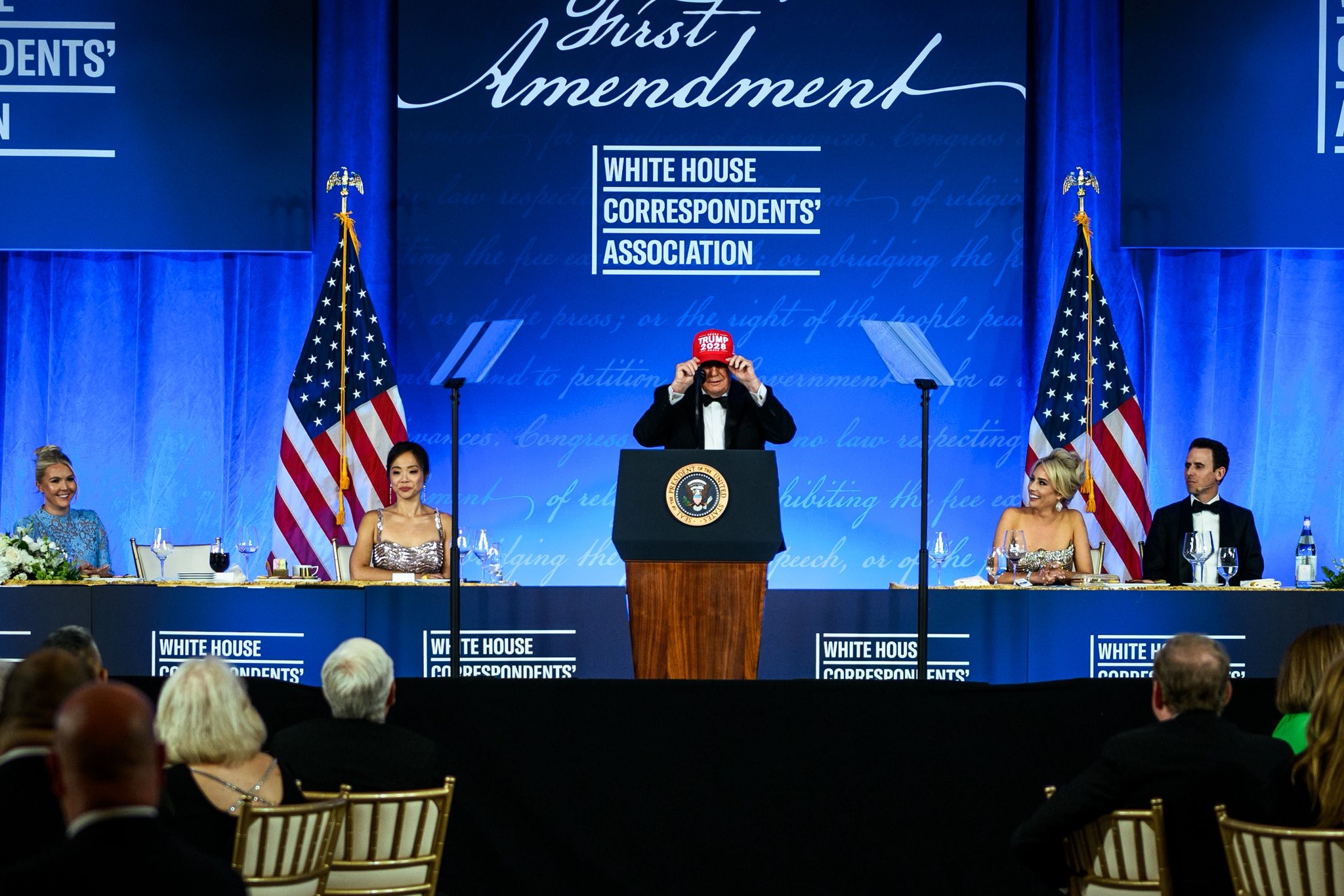
The most politically provocative moment came when Trump produced a red “Trump 2028” hat and placed it on his head, teasing the possibility of seeking another term in office.
Trump did not make a formal campaign announcement, despite some initial descriptions of the moment suggesting otherwise. His appearance in the hat was delivered as a joke about a third — and potentially even fourth — presidential term. The 22nd Amendment to the U.S. Constitution prohibits a person from being elected president more than twice.
The gesture nevertheless produced a noticeably subdued response inside a room filled largely with journalists who have spent much of Trump’s second term covering his battles with major news organizations.
The evening’s most solemn moment came when Trump joined outgoing WHCA President Weijia Jiang to honor Secret Service officer Victor Gonzales, who was struck by gunfire during the April attack but survived because of his protective vest.
Gonzales was credited with confronting and helping stop the alleged gunman before he could reach the ballroom, where Trump, Vice President JD Vance, Cabinet officials and thousands of guests had gathered.
The WHCA presented Gonzales with its President’s Award for Exceptional Service. Employees of the Washington Hilton were also recognized for helping keep guests calm and directing them to safety while gunfire erupted near the event.
The dinner unfolded against the backdrop of an increasingly hostile relationship between the Trump administration and the national press.
Just one day earlier, the Justice Department withdrew subpoenas issued to New York Times journalists as part of an investigation into confidential sources behind reporting about security concerns involving a Qatari-provided aircraft intended for presidential use.
Among the subpoenaed reporters was Tyler Pager, who attended Friday’s dinner to receive a WHCA award recognizing fair and objective White House reporting.
The Trump administration has said its legal actions against news organizations are intended to protect national security, stop unauthorized disclosures and hold media companies accountable for false reporting. Press-freedom advocates have argued the subpoenas, lawsuits and access restrictions are designed to intimidate journalists and discourage aggressive reporting.
Trump largely dismissed those concerns Friday, portraying himself as one of the most accessible presidents in American history while accusing many of the reporters in attendance of treating him unfairly.
Despite the barbs, Trump ended the night on a more conciliatory note, praising the press corps and highlighting the shared resolve shown during the April attack.
The evening was smaller, more heavily guarded and far less glamorous than the association’s traditional Washington gathering. But three months after gunfire brought the original dinner to an abrupt end, Trump and the journalists who cover him returned to the same room trading jokes, grievances and political blows under the watch of a significantly expanded security presence.