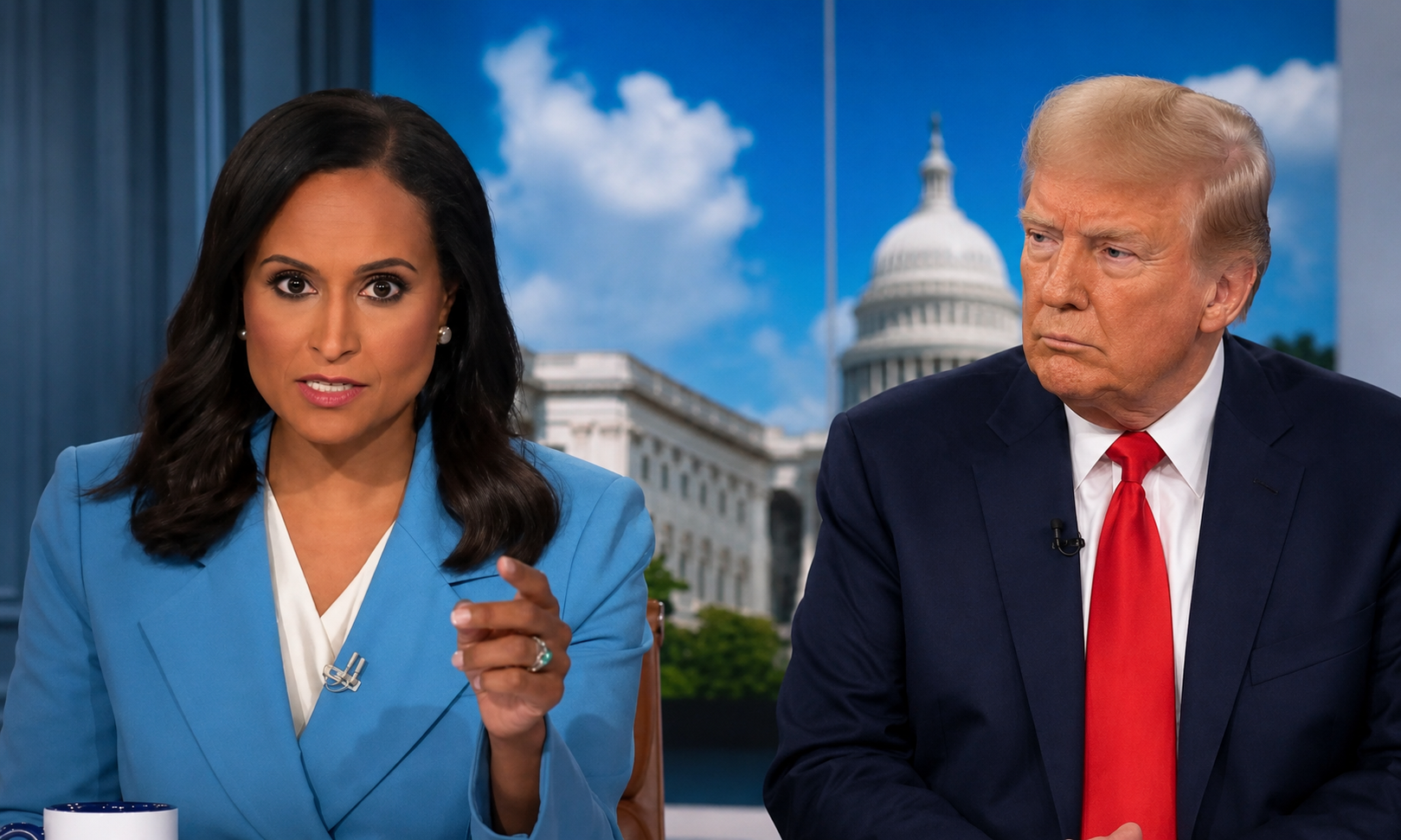
President Donald Trump is once again taking his long-running battle with the national media directly to the federal agency overseeing America’s broadcast airwaves.
Trump said Sunday that NBC News’ Meet the Press moderator Kristen Welker should be reported to the Federal Communications Commission for “rebuke or punishment” after she characterized the president’s record of endorsements in this year’s Republican primaries as producing “some mixed results.”
The dispute represents the latest escalation in Trump’s increasingly aggressive campaign against major television networks he accuses of misleading viewers, treating Republicans unfairly and using publicly regulated broadcast airwaves to advance politically biased coverage.
Welker made the disputed remark while appearing on Washington, D.C., NBC affiliate WRC-TV ahead of Sunday’s broadcast of Meet the Press. Discussing Trump’s role in the upcoming midterm elections, Welker said the president would “loom large” after endorsing numerous candidates during Republican primaries, with what she described as “some mixed results.”
Trump quickly fired back on Truth Social.
https://truthsocial.com/@realDonaldTrump/posts/117184581053116309
The president called Welker’s assessment a “purposeful inaccuracy” and argued that his endorsement record has been overwhelmingly successful. He said Welker should be reported to the FCC and specifically called on FCC Chairman Brendan Carr to take the issue seriously.
Trump has pointed to victories by several of his preferred candidates while claiming extraordinarily high success rates for his congressional endorsements.
There have, however, been losses.
The Washington Post reported that four Trump-endorsed House candidates and six candidates he supported in statewide Republican primary races had lost as of Sunday. Among those were gubernatorial candidates in Georgia and Iowa and Florida Congressman Cory Mills, who was seeking reelection. Trump-backed candidates also scored major victories in Republican Senate primaries in Texas, Louisiana and South Carolina.
NBC News stood behind its moderator.
“Kristen is one of the best in the business and we stand by her,” the network said in a statement reported by multiple outlets.
Trump’s Fight Goes Beyond Welker
The confrontation is considerably bigger than one Sunday morning television host.
Trump has repeatedly argued that broadcasters enjoying access to federally regulated airwaves should face consequences when their news operations engage in what he considers intentionally dishonest or politically discriminatory reporting.
Last month, Trump called for action against ABC and NBC after the networks did not interrupt regularly scheduled programming to broadcast one of his speeches live. He has previously suggested that broadcast licenses associated with networks producing what he calls “fake news” should be challenged or revoked.
Carr, whom Trump elevated to lead the FCC, has also demonstrated a willingness to scrutinize major broadcasters.
Reuters reported that the FCC is examining NBC parent company Comcast’s relationship with its local broadcast affiliates. The commission has also subjected eight ABC-owned stations to unusually early license-renewal reviews following months of conflict involving Trump, ABC and late-night host Jimmy Kimmel.
ABC and parent company Disney responded by suing the FCC, arguing that the commission’s actions amount to unconstitutional retaliation and violate First Amendment protections.
That legal fight could ultimately become far more important than the political rhetoric surrounding Welker.
What Can the FCC Actually Do?
Trump’s criticism raises an important distinction that can become lost in the political fireworks: NBC itself does not possess one single national broadcast license that the president or FCC chairman can simply revoke.
The FCC licenses individual television stations that use the public airwaves.
Cable channels, streaming platforms and national news organizations operate under different regulatory structures, meaning any effort to punish NBC through licensing would largely involve individual NBC-owned or affiliated broadcast stations.
The FCC does have authority under federal communications law to determine whether licensed broadcasters continue serving the “public interest,” but that authority is restrained by the First Amendment. The agency generally does not police whether individual news reports are politically biased or factually inaccurate.
That distinction creates a potentially enormous constitutional hurdle for any effort to punish a station simply because government officials object to its political coverage.
The FCC has not revoked a broadcast station’s license in more than four decades, according to the Washington Post, and media-law experts have argued that removing a license because of an editorial viewpoint would face an immediate First Amendment challenge.
Still, that does not mean the FCC is powerless.
License renewals, ownership transactions, affiliate relationships and other regulatory matters provide the agency with significant leverage over companies operating broadcast stations, making Carr’s willingness to use greater regulatory scrutiny potentially consequential even if the commission never attempts to directly punish Welker.
A Larger Fight Over Media Power
The latest confrontation also highlights a debate that has followed Trump through both of his presidencies.
Trump and his supporters argue that major national news organizations have spent years presenting politically slanted reporting as objective journalism while enjoying extraordinary influence over elections and public opinion.
His critics counter that allowing presidents or federal regulators to punish broadcasters over unfavorable coverage would give government officials precisely the kind of power over the press that the First Amendment was written to prevent.
For now, Trump is making clear that he has no intention of backing away from the fight.
Welker’s description of his endorsement record lasted only a few seconds.
The resulting battle over who controls America’s public airwaves and how far a presidential administration can go in challenging the broadcasters using them could last considerably longer.