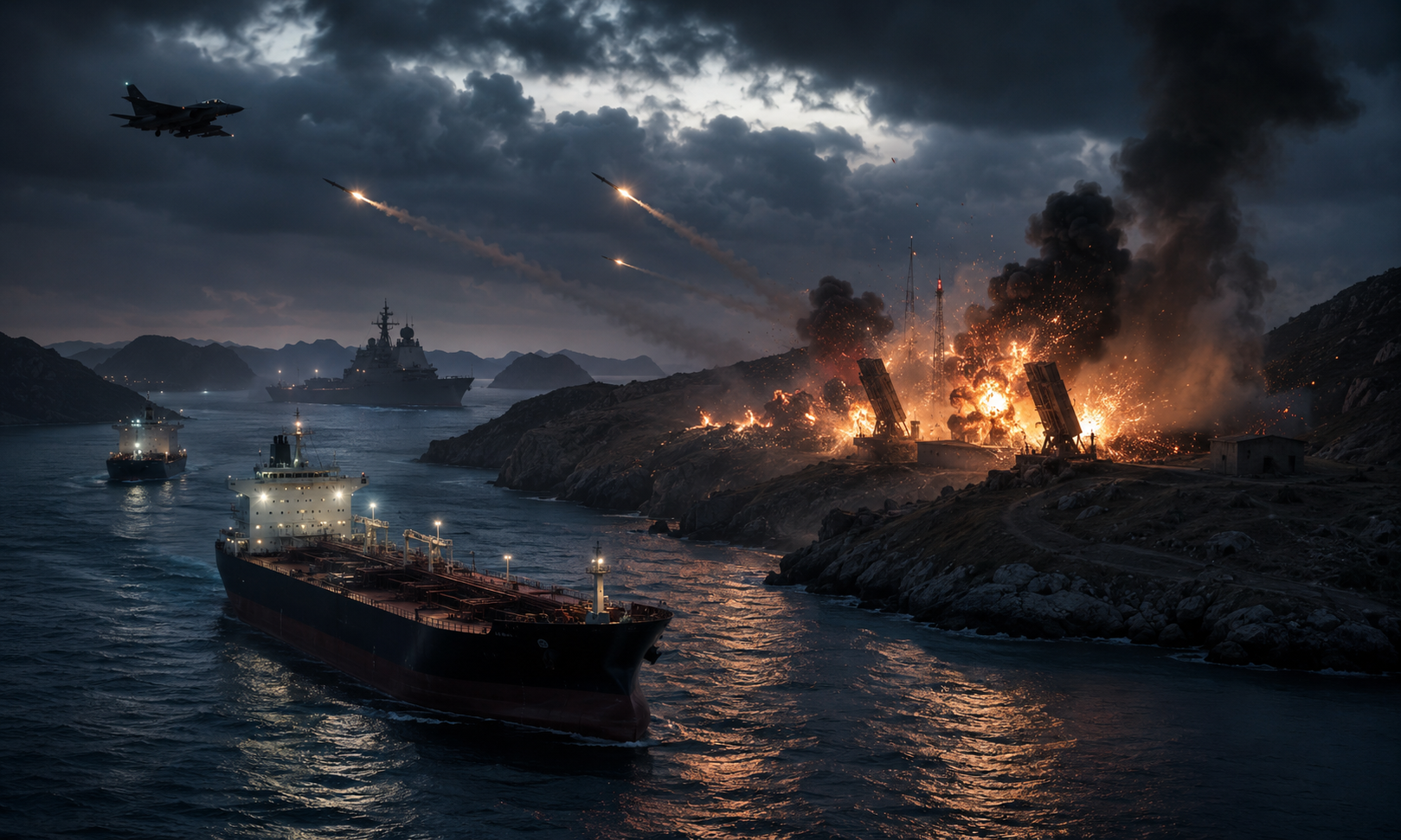
The uneasy standoff between the United States and Iran took a dangerous turn Sunday when American forces struck two Iranian rocket launchers on Larak Island, marking the first known U.S. attack on Iran since late July and raising the prospect of another round of retaliation.
The Aug. 30 strike came after Islamic Revolutionary Guard Corps forces were observed preparing to launch rockets carrying sea mines into the Strait of Hormuz, according to U.S. officials. Iran’s Revolutionary Guards quickly vowed retaliation, saying the American attack killed and wounded Iranian military personnel and civilians, although Tehran did not immediately provide a precise casualty count.
The attack interrupts a month-long lull in major American military action against Iran and comes as President Donald Trump has increasingly shifted his strategy from sustained military strikes toward an aggressive campaign designed to economically isolate Tehran.
For several weeks, the conflict appeared to be transitioning into a tense but somewhat quieter standoff.
Sunday’s strike was a reminder that the war is far from over.
U.S. Hits Iranian Launchers Near Critical Shipping Lane
Larak Island sits in one of the most strategically sensitive locations in the world, near the Strait of Hormuz, the narrow waterway connecting the Persian Gulf with the Gulf of Oman.
U.S. Central Command spokesman Tim Hawkins said IRGC forces were preparing rockets capable of carrying sea mines into the strait when American forces acted, according to the Associated Press.
The U.S. military had completed clearing sea mines from international shipping routes in the strait last week. Trump subsequently warned Iran that attempts to place new mines in international waters would not be tolerated.
The administration has made reopening and protecting commercial shipping through Hormuz a major priority.
Before the conflict, roughly one-fifth of the world’s oil consumption moved through the strait. Commercial traffic remains sharply reduced as Iran continues attempting to exert control over the critical waterway.
That gives even a relatively small military confrontation around Larak Island implications extending far beyond Iran and the United States.
A sustained disruption in Hormuz can affect oil prices, transportation costs and global supply chains consequences that eventually reach American consumers thousands of miles away.
Iran Promises Retaliation
Iran’s Revolutionary Guards wasted little time responding to Sunday’s attack.
The IRGC said several fighters and civilians were killed or wounded and promised what Iranian state media described as a “response and punishment” against those responsible.
Iran did not immediately release a confirmed casualty count.
That threat now becomes the immediate question facing the Trump administration.
The last known American strikes against Iran occurred in late July. Iran subsequently claimed responsibility for attacks against U.S. military assets in Kuwait following those operations.
Sunday’s strike could once again begin the familiar cycle: Iranian military activity, an American response, followed by Tehran promising retaliation.
What happens next may determine whether the conflict returns to sustained military exchanges or remains primarily an economic and maritime confrontation.
Trump Opens a New Economic Front
Even before Sunday’s strike, Trump was dramatically increasing the financial pressure on Tehran.
On Aug. 24, the administration formally launched Operation Economic Outcast, a Treasury Department campaign intended to sever Iran’s remaining access to international financing, trade and revenue.
Treasury Secretary Scott Bessent said the objective is to cut what the administration considers Iran’s remaining economic lifelines and force Tehran to choose between international isolation and returning to negotiations. Treasury simultaneously sanctioned more than 60 entities, individuals and vessels accused of helping Iran generate oil revenue, obtain nuclear and missile technology or conduct cyber operations.
The campaign goes considerably further than simply sanctioning Iranian companies.
Treasury is targeting financial institutions, businesses and intermediaries outside Iran that continue facilitating Iranian transactions. New sanctions measures target five areas the administration says Tehran depends upon digital assets, technology, gold, aviation and shipping.
The administration has also threatened to remove entities facilitating Iranian money laundering from access to the U.S. dollar system.
Treasury demonstrated that approach again Friday when it moved against Banque Misr UAE, alleging the bank processed billions of dollars in transactions benefiting the Iranian regime.
The department proposed cutting the bank’s correspondent access to American financial institutions while announcing additional sanctions against individuals and entities accused of helping Iran move money through the United Arab Emirates.
In other words, Washington’s message is no longer directed solely at Tehran.
Countries, banks and businesses continuing to provide Iran an economic lifeline could increasingly find themselves forced to choose between doing business with Iran and maintaining access to the American financial system.
A War Entering a Different Phase
The strategy represents an important shift for Trump.
After months of U.S. and Israeli military operations, the administration has increasingly portrayed economic pressure as the next phase of the confrontation.
Vice President JD Vance said last week that the war had entered a “new phase” focused on economic pressure, while Trump has indicated he is in no hurry to restart negotiations.
That does not mean American military power has been removed from the equation.
Sunday proved precisely the opposite.
Instead, the emerging strategy appears to combine overwhelming military deterrence with a sustained attempt to financially isolate Tehran.
Iran faces growing pressure but has shown little public willingness to capitulate. Iranian officials have rejected Washington’s economic campaign and threatened consequences for countries participating in American sanctions.
That creates a potentially volatile equation.
The United States is attempting to choke off Iran’s economy while maintaining military forces capable of striking Iranian targets. Tehran continues threatening shipping, American interests and nations it believes are helping Washington.
Between them sits the Strait of Hormuz.
What Comes Next
For Trump, the central question may no longer be whether American military power can damage Iran.
It clearly can.
The larger question is whether military force combined with unprecedented economic pressure can compel Tehran to negotiate without pulling the United States into another prolonged cycle of strikes and retaliation.
Diplomatic channels have not completely disappeared. Oman and other regional governments continue attempting to create pathways toward de-escalation, while Washington maintains that Iran ultimately has a route back toward economic normalization if it accepts an agreement.
But Sunday’s strike makes that diplomatic path considerably more uncertain.
American forces have attacked Iranian territory for the first time in roughly a month. Iranian soldiers and civilians were reportedly killed or wounded. Tehran has publicly promised retaliation.
The Trump administration may have entered a new economic phase of its confrontation with Iran.
The missiles, however, have not gone away