

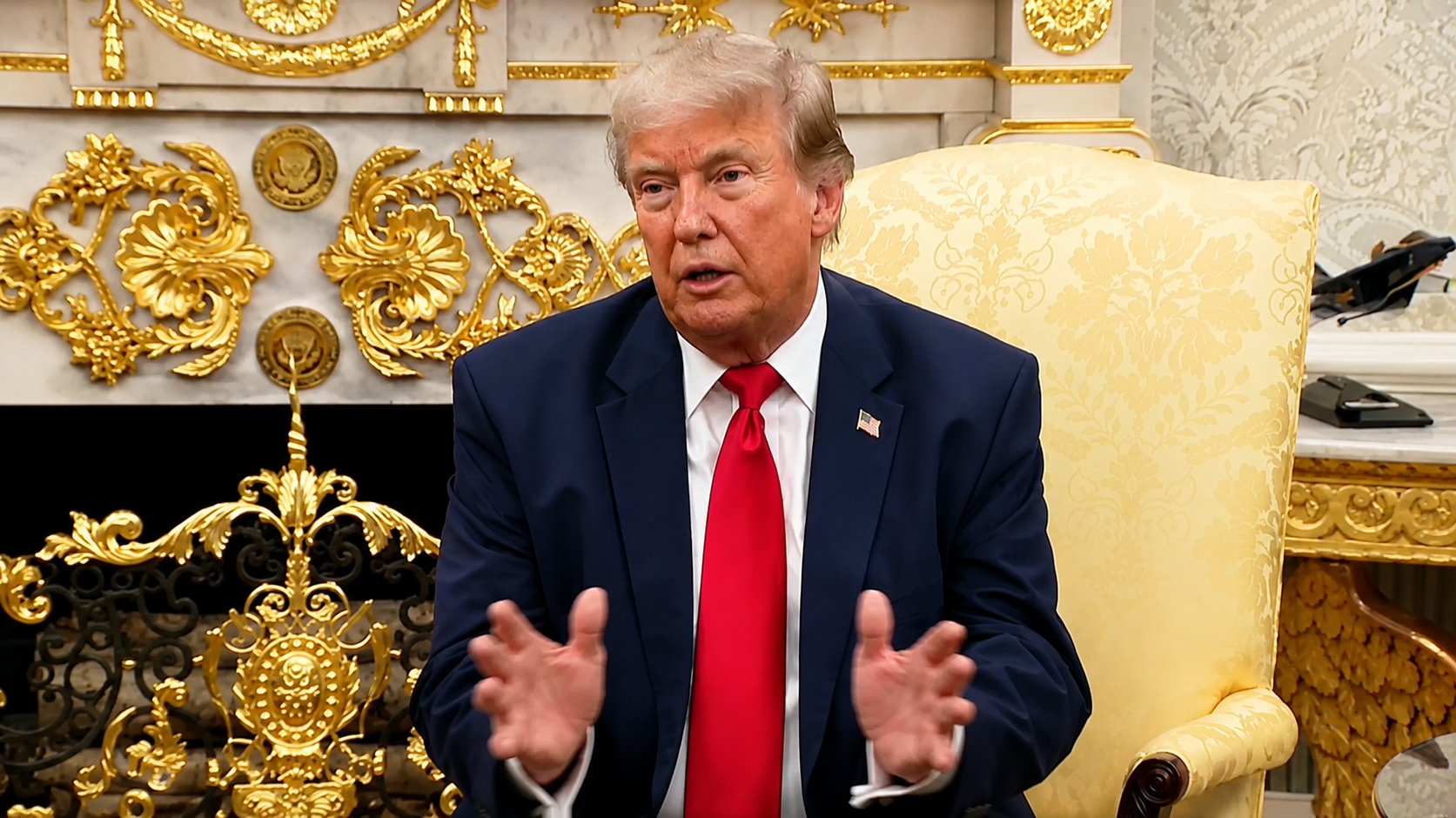
President Donald Trump announced Tuesday morning that the U.S. Navy has cleared the international waters of the Strait of Hormuz of naval mines, while issuing a stark warning to Iran that any vessel attempting to place new mines in the strategically vital waterway will be destroyed.
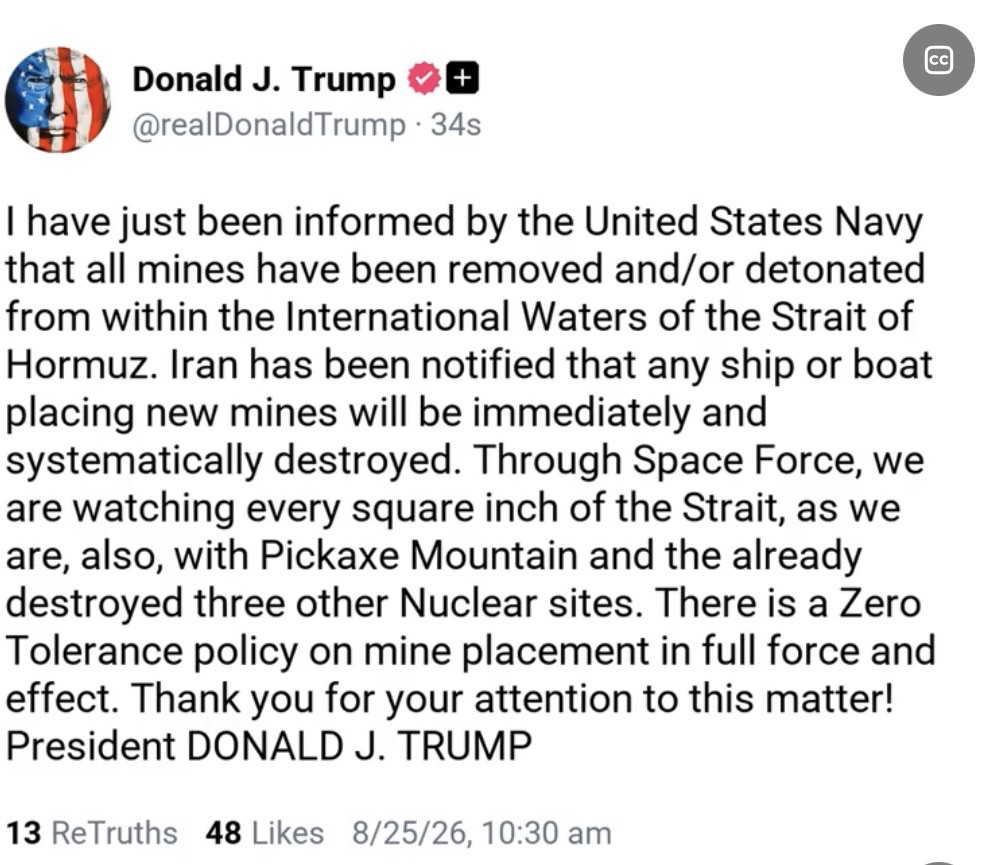
“I have just been informed by the United States Navy that all mines have been removed and/or detonated from within the International Waters of the Strait of Hormuz,” Trump wrote in a Truth Social post at approximately 10:30 a.m. Tuesday.
“Iran has been notified that any ship or boat placing new mines will be immediately and systematically destroyed,” the president added.
The announcement represents the latest development in the months-long confrontation between the United States and Iran over control and freedom of navigation through one of the most economically important waterways in the world.
Reuters independently reported Trump’s announcement Tuesday, although the president’s assertion that the waterway has been completely cleared was attributed to information he said he received from the Navy.
‘Zero Tolerance’ in the Strait
Trump said the administration is also using U.S. Space Force capabilities to maintain surveillance over the Strait of Hormuz and sensitive Iranian nuclear facilities.
“Through Space Force, we are watching every square inch of the Strait,” Trump wrote, adding that the United States is also monitoring Pickaxe Mountain and three previously destroyed Iranian nuclear sites.
“There is a Zero Tolerance policy on mine placement in full force and effect,” Trump said.
The president’s statement goes beyond announcing the removal of existing mines. It effectively establishes a public warning to Tehran that Washington intends to prevent Iran from again using naval mines to threaten or restrict international shipping.
Trump made a similar declaration on Aug. 18, when he said the Strait of Hormuz was open and operating and that mines in the waterway had been removed or detonated. His Tuesday statement renewed that claim while adding an explicit threat against vessels attempting to deploy additional mines.
Why Hormuz Matters
The Strait of Hormuz is a narrow maritime passage connecting the Persian Gulf with the Gulf of Oman and Arabian Sea. Its importance extends far beyond the military confrontation between Washington and Tehran.
Before the current conflict, more than 20 million barrels of oil per day moved through the strait — roughly one out of every five barrels consumed worldwide.
That traffic has fallen dramatically.
Provisional shipping data from Vortexa showed oil movements through Hormuz at approximately 5 million barrels per day Monday, according to Reuters.
That makes restoring reliable commercial traffic through the waterway consequential not only for military operations but also for energy prices, shipping costs and consumers thousands of miles away — including in Maine.
Despite the reported mine-clearing operation, the security situation surrounding Hormuz remains volatile. The United States and Iran have not conducted airstrikes against each other’s forces in recent weeks, but attacks involving commercial vessels have continued. An oil tanker was disabled Tuesday after being struck by a projectile near Oman, according to the Associated Press. The crew was reported safe.
Pressure on Tehran Continues
Trump’s announcement comes as his administration continues applying economic and military pressure on Iran while diplomatic efforts struggle to produce a broader settlement.
The administration has expanded sanctions targeting Iranian oil, weapons and other revenue-producing networks, while Iran has continued threatening shipping and attempting to exert control over transit through Hormuz.
At the same time, Pakistan has been working to mediate between Washington and Tehran. Pakistani officials said Tuesday that significant progress had been made during talks in Tehran, though no comprehensive agreement ending the confrontation has been announced.
The White House has previously described U.S. strategy as maintaining maximum pressure on Tehran while leaving open the possibility of a negotiated agreement. Trump said in July that the United States maintained naval control of Hormuz and was closely monitoring Iranian activity, including at Pickaxe Mountain.
Tuesday’s message made clear, however, that Washington intends to draw a hard line around renewed attempts to mine the waterway.
For Maine residents, a military confrontation nearly 6,000 miles away can seem distant. The Strait of Hormuz is one of the places where that distance disappears quickly.
A prolonged disruption of oil and liquefied natural gas shipments through the strait can ripple through global energy markets, transportation costs and ultimately the price Mainers pay to heat their homes, fill their vehicles and move goods across the state.
For now, Trump says one of the greatest physical threats to navigation through the strait — naval mines — has been eliminated.
His message to Iran about what happens next was considerably less ambiguous: Don’t put them back.



Another brain fart.