It’s no secret that the fees and requirements necessary to obtain an occupational license are barriers to entry that bar many professionals from working in their desired field. In 1950, only five percent of the country’s workforce required a license to perform their work. Nearly 70 years later, that figure has grown and now consumes an estimated 25 percent of America’s workforce. Put simply, licensing regimes created by state legislatures and enforced by government bureaucrats have expanded exponentially since their inception.
Advocates and individuals who practice in licensed fields claim licensure is necessary to preserve the health and safety of the general public. While this might be accurate for some fields, licensing has grown to encompass professions that are not a danger to public safety. Instead, these unnecessary requirements and fees place a burden on workers trying to enter regulated professions and make services more expensive for consumers.
The Pioneer Institute, a non-partisan research organization based in Boston, released a new report this week that measures the impact of occupational licensing on government finances in the United States. According to the report, the “misallocation of resources” caused by occupational licensing results in lost revenue at the state and local level that exceeds the amount currently collected through licensing fees in most states.
This misallocation of resources measurement includes “the inappropriate allocation of the human capital of people who cannot, because of licensing, work in the occupation for which they are best suited, the resources wasted fulfilling licensing requirements that do not raise quality, the resources lost to rent-seeking when occupational practitioners and their industry associations push for licensure, and the resources wasted providing services of unnecessarily high quality.”
According to Pioneer Institute, Maine currently collects approximately $109 million from occupational licensing fees. The Institute found that Maine could increase tax revenue from licensing to $135.9 million if it eliminated the misallocation of resources within its current licensing rules and regulations. While some licenses would be eliminated entirely, reducing fee collections, the gains made by new income, sales and other tax revenues would exceed current revenue collections.
Put differently, net state and local revenue would increase by an estimated $26.9 million if occupational licensing reforms are implemented in Maine. In addition, the study found 28 other states would realize a net increase in revenue if they reformed their licensing laws. Most notably, the State of New York could collect an additional $1.5 billion in new tax revenue.
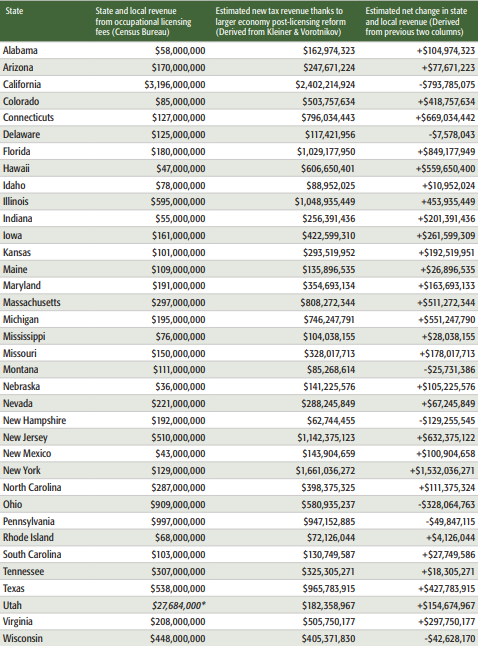
The author notes that the model is relatively extreme because the $26.9 million increase would only occur if all licensing regulations that misallocate resources are repealed. However, the model used in the Pioneer Institute’s report illustrates how occupational licensing reform would typically increase revenue instead of decreasing it.
This is an important finding for lawmakers who worry licensing reform will put a dent in state’s pocketbook. Making it easier to obtain a license, or streamlining the licensing process by honoring licenses issued by other states, can boost economic activity and more than make up for lost fees. Pioneer Institute’s report allows lawmakers to perform a more holistic cost-benefit analysis of licensing reform, instead of simply looking at how much revenue would be lost from a reduction in fees.
Nonetheless, the Maine Legislature should seriously consider implementing licensing reforms — including Rep. John Andrews’ LR 2864 — to boost government revenues, unleash the potential of our workforce and attract more workers to the state.
Maine not only has the oldest median age in the nation, but our working population is projected to decrease by six percent by 2026. Making Maine a more attractive state through licensing reform would certainly help to reverse that trend.