On August 18, the federal Bureau of Ocean Energy Management (BOEM), part of the Department of the Interior (DOI), announced next steps to develop offshore wind energy in the Gulf of Maine.
On August 19, the BOEM published a Request for Interest (RFI) and Request for Competitive Interest (RFCI) in the Federal Register to solicit public comment. The initiative is part of the Biden administration’s goal of deploying 30 gigawatts of offshore wind energy capacity by 2030.
“The RFI is the first step in BOEM’s commercial planning and leasing process to identify the offshore locations that appear most suitable for development, taking into consideration potential impacts to other resources and ocean users. The purpose of the RFI is to gauge interest in the development of commercial wind energy leases within the RFI Area, which consists of about 13,713,800 acres in the Gulf of Maine,” the DOI said in a press release.
As part of public comment, the BOEM is seeking feedback from “stakeholders, industry, Tribes, ocean users, and others regarding the location and size of specific areas they wish to be included in (or excluded from) a future offshore wind energy lease sale, along with planning considerations.”
Feedback will be used to narrow the area under consideration for offshore wind development.
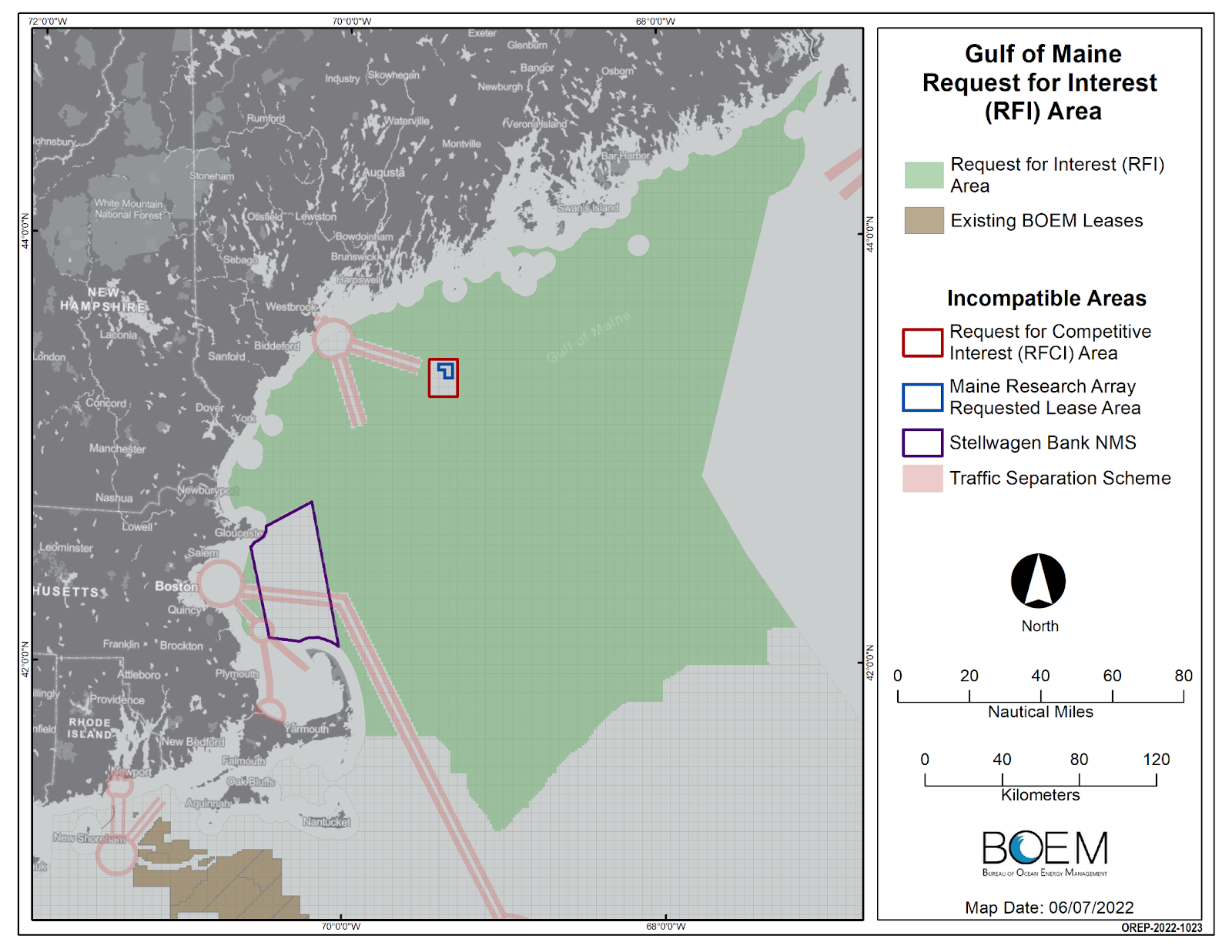
The RFCI is the agency’s next step in processing a research lease which the state of Maine applied for in October 2021. The application requested 8,700 acres on the Outer Continental Shelf more than 20 nautical miles from the coast and in the Gulf of Maine, to allow an array of floating offshore wind turbines to conduct research that the state said would “foster better coexistence between floating offshore wind projects and Maine’s heritage industries and the marine environment.”
“If developed, the research array would comprise up to 12 floating offshore wind turbines capable of generating up to 144 megawatts of renewable energy,” the BOEM wrote in its August 18 news release about the RCFI.
The BOEM also added that if it does not receive any indications of competitive interest, the agency will still move forward with the research application. If one or more qualified entities file indications of competitive interest, the BOEM may “decide to move forward with the lease issuance process using competitive leasing procedures.”
According to the BOEM, the RFCI area, which is 68,320 acres, expands upon the area Maine requested for its research lease “to allow future siting flexibility to avoid or minimize conflict with existing ocean users should a lease (research or commercial) be issued.”
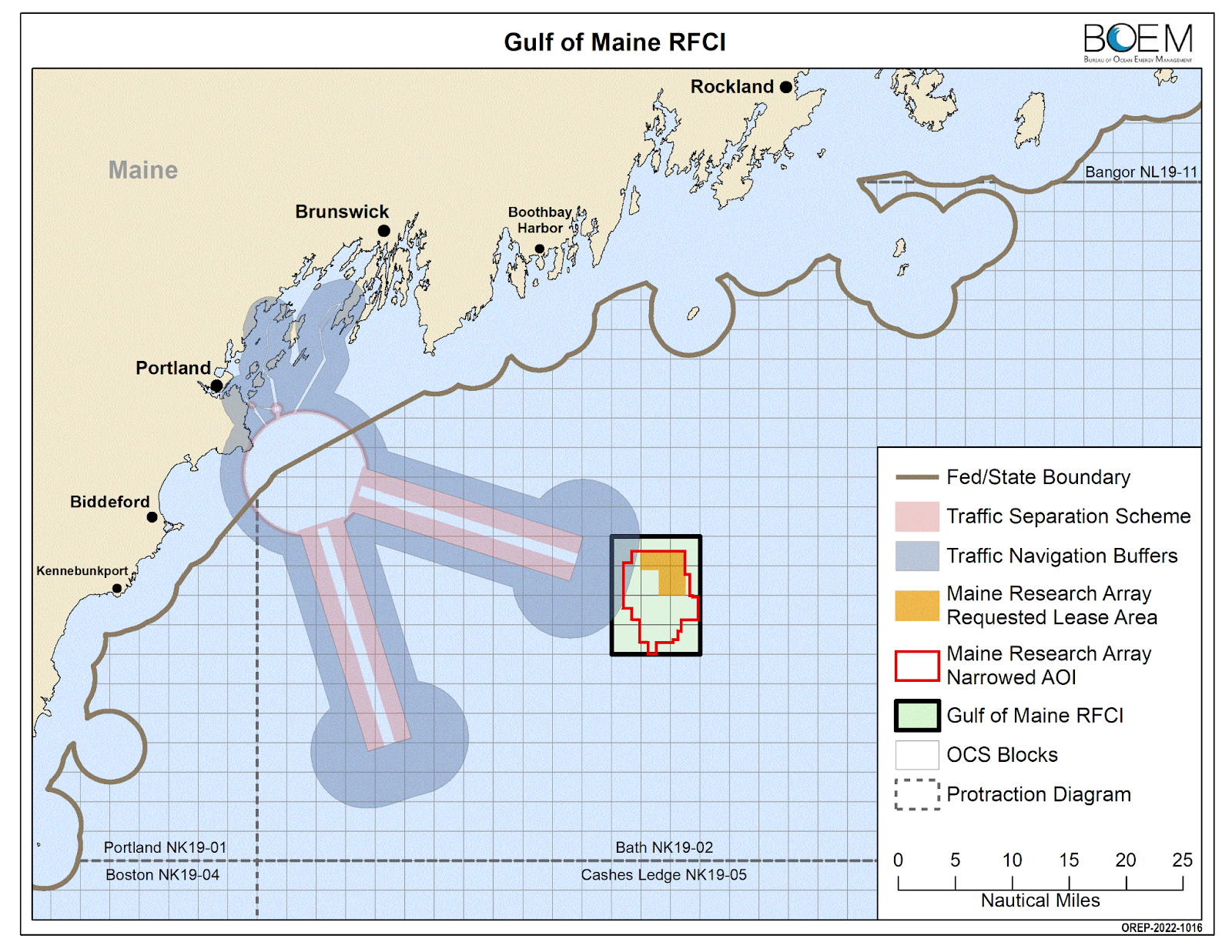
“Only a project that is approximately the size of Maine’s research lease proposal (i.e., no more than 10,000 acres and no more than 12 floating turbines) and provides a conceptual framework for addressing the research priorities identified in the RFCI will have the potential to move forward,” the agency added.
Gov. Janet Mills signed LD 1619, which created a 10-year moratorium on the development of new offshore wind projects in state waters, into effect in July 2021.
According to a press release from Mills’ office at the time she signed LD 1619 into law, the ban “preserves State waters for recreation and fishing–where up to 75 percent of Maine’s commercial lobster harvesting occurs–and cements into law Maine’s priority of locating offshore wind projects in federal waters in the Gulf of Maine.”
LD 1619 was signed a month after LD 336, which authorized the state’s application to develop the research array in state waters.
Asked about the governor’s support of the development of offshore wind in federal but not state waters, a representative from the Governor’s Energy Office offered the following statement:
“Offshore wind has the potential to create thousands of jobs in Maine, deliver a clean, renewable source of energy to Maine people and businesses, and strengthen our economy. As part of the Mills Administration’s responsible approach to offshore wind, the Administration has prioritized locating offshore wind in federal waters to preserve the State’s territorial waters for important uses like fishing – where up to 75 percent of Maine’s commercial lobster harvesting occurs – and recreation. Governor Mills proposed the moratorium in response to concerns raised by the fishing industry and it was enacted with bipartisan support of the Legislature. The State is continuing to develop its strategic plan for offshore wind, which is expected early next year, and engagement with neighboring states and the Federal government through the Bureau of Ocean Energy Management.
“As these Federal processes move ahead, we strongly urge BOEM to follow Maine’s lead by taking a responsible, regional, and research-driven approach to offshore wind in the Gulf of Maine, and ensure broad engagement with important stakeholders, particularly Maine’s valuable fishing industry and coastal communities. This approach is crucial to ensuring that offshore wind is advanced in a manner that fits with the interests of Maine people. The Governor’s Energy Office looks forward to continuing to engage with BOEM to that end and particularly about the State’s application for a floating offshore wind research array using patented technology from the University of Maine.”
Patrice McCarron, executive director of the Maine Lobstermen’s Association, said the organization is “disappointed” with the development.
“The Maine Lobstermen’s Association is disappointed that the administration is moving forward with a request for interest for commercial wind planning and leasing even before announcing a decision on a planned research array in the Gulf of Maine,” said McCarron. “The Gulf of Maine is one of the most biologically productive marine regions in the world and Maine’s fishing industry opposes industrialization of this important ecosystem. We simply do not know either the impact or the irreparable harm that a massive offshore wind project would cause to both the fishing and lobstering industry and our coastal communities.”