

Maine’s unemployment rate for July came in at 3.2 percent, roughly one percentage below the regional average for New England.
The national unemployment rate for last month was very similar to the regional rate, coming in at 4.2 percent, identical to this same time last year.
This represents a slight drop in comparison to June, where unemployment was calculated to be 3.3 percent.
Since this same time last year, however, unemployment has risen by about this same amount. In July of 2024, Maine’s unemployment rate was found to be 3.1 percent.
[RELATED: Maine’s Unemployment Rate Held Steady in June as Labor Force Participation Dropped Slightly]
Maine’s labor force participation last month came in at 59.9 percent, well below the national average of 62.2 percent.
Labor force participation rates are representative of the proportion of working-age individuals who are either employed or actively searching for work.
Although there are a number of different ways to calculate the labor force participation rate, the MDOL arrives at its statistics by considering all individuals over the age of 16. Consequently, retirees and other elderly individuals are included in these numbers.
As a result, it can be more complicated to parse these statistics, particularly given Maine’s aging population.
The MDOL cautions in their press release that these figures represent “preliminary” estimates and “should be considered in the context of whether they are below, near, or above historical averages, rather than if they are up or down a few tenths of a point from some other month.”
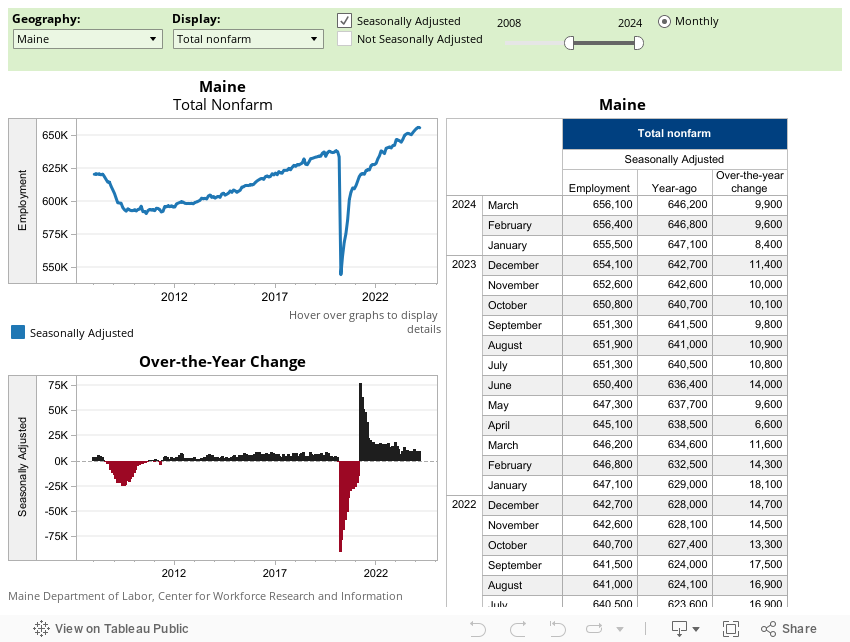
The total number of non-farm jobs available in Maine has dropped by 1,100 since this same time last year and 500 since the month prior. This drop was reportedly to have primarily occurred in the leisure and hospitality sector.
In June, the state only added 400 jobs after seeing a 200 job decrease in May. Prior to this, the state was gaining between 1,200 and 3,600 jobs per month.
These are the first decreases that the state has seen since March 2021.
After many months of strong, double digit job growth post-pandemic, the rate at which non-farm jobs were added to the state began to slow around April of 2024, about a year after the total number of non-farm jobs returned to pre-pandemic levels.
On average, Mainers worked 33.2 hours per week last month and earned an average of $32.45 an hour.
Much like last month, Mainers employed in construction saw the longest work weeks, while those in the leisure and hospitality industry had the shortest. Workers in this industry also earned the least money per hour on average.
Employees in the professional and business services industry had the highest average hourly wages in July. That said, this was the only industry to see a drop in average hourly earnings since this time last year, decreasing by 19 cents.
Construction workers saw the greatest increase in their average hourly earnings since last year, rising by $1.67 per hour.