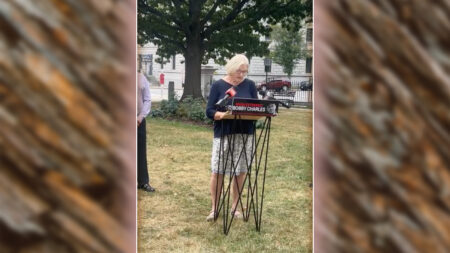
Portland Public Schools Superintendent Ryan Scallon issued a forceful statement Wednesday denouncing President Donald Trump’s recent comments about Somali immigrants, comments that the White House has tied to Trump’s broader agenda on immigration enforcement, national security, and cultural assimilation. Scallon’s message comes as he continues to face mounting criticism over his own administration following a contentious Portland School Committee meeting on November 2.
Trump’s remarks, made during a December 2 cabinet meeting, targeted Somali immigrants directly. He said he does not want Somalis in the United States, referred to the immigrants from Somalia as “garbage,” declared that their home country “stinks,” and urged them to “go back to where they came from and fix it.”
Those comments immediately drew national attention, especially in states like Maine and Minnesota where federal authorities are preparing targeted immigration enforcement operations focused on Somali nationals with outstanding removal orders.
Scallon quickly released a districtwide statement saying he “fully disagrees” with Trump’s characterization of Somali immigrants and accused the president of dividing communities. He reiterated the district’s stance against “hateful rhetoric” and reminded families that harassment and discriminatory speech will not be tolerated in Portland schools.
Social workers and counselors, Scallon said, are available for students seeking support.
Scallon highlighted the diversity of Portland Public Schools, the most diverse district in Maine, and insisted that immigrant and multilingual families remain “a valued and integral part” of the community.
But Scallon’s political response lands at a time when the superintendent is already under increased scrutiny. At a November 25 School Committee meeting, Scallon faced pointed questions about transparency, communication failures, and administrative handling of staff restructuring. Several board members expressed frustration over what they described as repeated lapses in timely and clear communication. Community members also raised concerns about trust in district leadership.
The tense meeting underscored growing dissatisfaction with Scallon’s management, frustrations that predate his latest public comments on national politics.
Trump’s criticism of Somali communities is not new but is now intensifying as part of his 2025–2026 policy push. His advisers frame his recent comments as aligned with a broader immigration agenda that emphasizes strict enforcement, national security, and cultural assimilation, all pillars of his “Make America Great Again” platform.
For years, Trump has cited federal cases involving Somali-American youths recruited by al-Shabab, along with isolated terror incidents, as justification for tighter immigration screening. These cases formed part of the legal rationale behind his travel restrictions during his first term.
Trump argues that some refugee groups struggle to assimilate, pointing to language barriers, employment challenges, and social service demands in cities like Minneapolis and Lewiston. The White House sees Somali communities as emblematic of what Trump calls “failed integration policies.”
Federal authorities are preparing new targeted enforcement operations in Minnesota aimed at Somali nationals with removal orders. ICE has already increased its activity in the Twin Cities and other regions with large Somali populations.
Trump narrowly lost Minnesota in 2016 and has repeatedly used Somali immigration as a political flashpoint to energize supporters. His advisers believe the issue highlights contrasts with Democratic policies in the state.
Trump’s stance ties directly into his core message: strict borders, law-and-order enforcement, and a reaffirmation of what he calls traditional American culture.
The administration’s recent push for stricter commercial driver’s license (CDL) enforcement, citing safety risks from non-English-speaking drivers, is also connected to Somali and East African immigrant communities in several states, adding another layer to the political debate.
Scallon’s decision to publicly condemn Trump while the district grapples with significant internal challenges has drawn mixed reactions. Supporters say he is standing up for vulnerable students. Critics argue that he is inserting Portland schools into national political fights instead of addressing leadership issues raised at the November 25 meeting.
The district remains under pressure to resolve questions about communication breakdowns, staffing decisions, and administrative accountability, concerns that remain unresolved as Scallon pivots to respond to national political developments.
As federal enforcement plans intensify and Trump continues sharpening his rhetoric, Maine, with growing Somali communities in Portland and Lewiston, is poised to become part of the national spotlight.