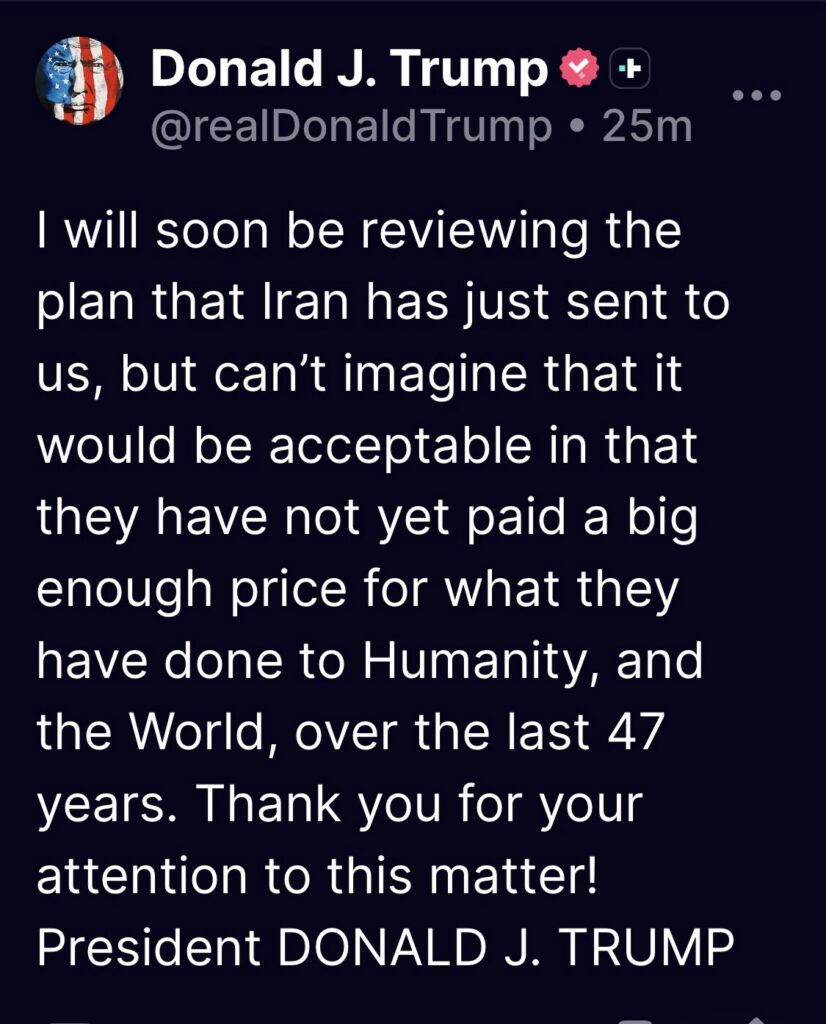
President Donald J. Trump said he will soon review a plan submitted by Iran, signaling skepticism that the proposal will meet U.S. expectations as the conflict enters a critical stage.
“I will soon be reviewing the plan that Iran has just sent to us, but can’t imagine that it would be acceptable in that they have not yet paid a big enough price for what they have done to Humanity, and the World, over the last 47 years,”
The statement concluded with his now signature close: “Thank you for your attention to this matter! President DONALD J. TRUMP.”
A War That Has Reshaped Global Markets
The ongoing conflict between the United States and Iran began escalating earlier this year following military strikes and retaliatory actions that quickly spread across the region. A central flashpoint has been the Strait of Hormuz, a narrow shipping lane through which roughly one-fifth of the world’s oil supply typically passes.
Iran’s disruption of shipping traffic through the strait has driven oil prices sharply higher and strained global supply chains, turning the military conflict into an economic issue felt far beyond the Middle East.
“Art of the Deal” Diplomacy in Focus
Trump’s statement suggests a renewed diplomatic push, one that reflects his long-standing emphasis on negotiation and leverage as tools of foreign policy.
Recent reports indicate that Iran has submitted proposals tied to reopening shipping routes and reducing tensions, though the president has made clear he is not yet satisfied with the terms offered.
Trump has also indicated that he prefers a negotiated resolution but has warned that military options remain available if diplomacy fails or if Iran does not meet U.S. conditions.
That combination of negotiation pressure and continued military readiness has been widely viewed as an effort to force concessions while avoiding a prolonged war.
Rising Gas Prices Felt at Home
The war’s impact is not limited to the battlefield. Americans have already begun to feel the consequences at the gas pump.
Gasoline prices have climbed to wartime highs, with averages reported around $4.39 per gallon, driven largely by disruptions to global oil supply tied to the conflict.
Analysts widely agree that reopening the Strait of Hormuz and restoring steady oil shipments would be one of the most effective ways to stabilize prices and reduce economic pressure on consumers.
For many families, the rising cost of fuel has meant cutting back on travel, adjusting budgets, and rethinking daily expenses.
What Happens if a Deal Cannot Be Reached
While diplomacy remains ongoing, Trump has repeatedly signaled that the United States is prepared to continue military pressure if negotiations collapse.
He has warned that U.S. strikes could resume if Iran fails to comply with key demands or attempts to escalate further.
At the same time, Trump has maintained that a peaceful resolution remains the preferred outcome, provided that U.S. national security interests are met and Iran agrees to meaningful concessions.
A Critical Moment Ahead
Trump’s review of the Iranian proposal comes at what many observers see as a turning point in the conflict.
With energy markets strained, global shipping disrupted, and tensions still high, the outcome of the negotiations could shape not only the direction of the war but also the economic outlook for American families and businesses in the months ahead.
Whether diplomacy succeeds, or military pressure intensifies, will likely depend on what emerges from the proposal now under review.